I went out for dinner last night with the members of the Pohang Climbing Center. This is apparently a drink concoction they enjoy - sliced hot green peppers in soju. Considering how terrible soju is, anything would probably be an improvement. Gochu soju wasn't actually that bad.
Showing posts with label korean food. Show all posts
Friday, December 17, 2010
Tuesday, November 23, 2010
An Asian Combination
I had one of the most unusual side dishes I've ever seen for lunch today: seaweed and asian pear.
This side dish usually includes radish slices instead of pear, but the school nutritionist is young and apparently quite daring. It turned out exactly as you'd probably expect it to: like bobbing for pears in the ocean at low tide.
Labels:
korea
,
korean food
Wednesday, October 06, 2010
Kimchi gold
As I wrote on Monday, kimchi is in short supply around these parts. NPR has also picked up on the story, which they blame on "heavy rains" - presumably a result of the typhoons that have been hitting the country lately.
Labels:
kimchi
,
korea
,
korean food
Monday, October 04, 2010
Where's all the kimchi??
Kimchi is, needless to say, a staple of the Korean diet. They don't eat meals without it. It's taken for granted that when you visit a Korean restaurant, you will be given a never-ending side dish of kimchi. It was unnerving to see a Korean meal without the fermented dish. When I sat down I asked another teacher about it. "Kimchi has gotten too expensive these days," she said. "The school can't afford it." More expensive than pork? I asked. It was one of the side dishes that day. She told me people are joking that when you go to a restaurant, you order kimchi and they give you samgyeopsal (roasted pork) for free.
I've heard two theories about the recent skyrocketing in price.
1. Typhoon season destroyed a lot of the cabbage and lettuce crops.
2. President Lee's "Four Rivers Project" is razing the countryside and causing too much degradation of farmland and nature.
Whatever the reason, I miss my kimchi.
Labels:
economy
,
kimchi
,
korea
,
korean food
Wednesday, February 10, 2010
Sausages: food of the future

If you ever regretted getting your fingers replaced with sausage links when you were 5, you can finally put the past behind you!
Labels:
korea
,
korean food
Friday, December 11, 2009
Makgeolli wins award for "World-Brightening People"
Makgeolli (막걸리), usually a drink consumed (and abused) during celebrations, now has a reason to celebrate itself: It has been recognized with one of the Korea Green Foundation's "2009 Awards for World-Brightening People." That's right: To some Koreans makgeolli is actually considered a person - a better person, in fact, than you or me (I didn't notice your name on the list of KGF's other winners). If you previously harbored any doubts about the influence and importance of alcohol in Korean society before, this should dispel them quite nicely.


Makgeolli won the award for considering the environment when brewing itself; makgeolli emits very little CO2, is made with rice crop rejects (mmmmm...rice crop rejects), and....ummm....and? I guess that's about it. Oh yeah. It is also really fun at parties.

Makgeolli won the award for considering the environment when brewing itself; makgeolli emits very little CO2, is made with rice crop rejects (mmmmm...rice crop rejects), and....ummm....and? I guess that's about it. Oh yeah. It is also really fun at parties.
Labels:
korea
,
korean food
Wednesday, December 09, 2009
Sports Day - For Teachers!
Yesterday, after a special lunch of boiled pork, kwamegi, and a lot of alcohol, the teachers congregated in the gym for an afternoon of games and friendly - sometimes heated - competition. All of the food and alcohol from the cafeteria had been moved with us, and by the time the games were finished, the table had been decimated. Especially the alcohol.
The event kicked off with an easy warmup: some jumping jacks, ab twists, and massage trains.
The first game was one I will call "The Run & Tumble". It was a relay race of 10 people, in which each person had to spin around 5 times, run to the end of the gym, turn around and run back, tumbling over a mat halfway through the return leg. In the first race I competed against the school principal, which I only realized after the fact. I beat him handily, which was not unexpected considering he is 60+ years old, thin as a rail, and was probably quite drunk.
The third game was the shoe toss, similar to bocce, where teachers tried to flip their shoes or sandals about 15 yards into - or near - a bucket. The winners received prizes, and though I didn't win I was given one anyway - two tubes of toothpaste.
The final game, which attracted the most fervor and excitement, was yutnori, a traditional Korean game in which split sticks are tossed onto a mat. Points are awarded depending on the combination of sticks up or down, and markers are moved along a game board. Though I quickly caught on to the point value of stick combinations, the movement of the markers was quite confusing to me, and apparently to my co-teachers as well. It was a constant source of disagreement, which Mr. Lee said makes the game more fun. "When we have disagreements we come together afterward and feel good."

Before we left there was a raffle. While Mrs. Lee was trying to explain the tile movement of yutnori to me, there were screams in English. "You won!" I marched to the front to accept my prize: two pairs of socks!
The event kicked off with an easy warmup: some jumping jacks, ab twists, and massage trains.
The first game was one I will call "The Run & Tumble". It was a relay race of 10 people, in which each person had to spin around 5 times, run to the end of the gym, turn around and run back, tumbling over a mat halfway through the return leg. In the first race I competed against the school principal, which I only realized after the fact. I beat him handily, which was not unexpected considering he is 60+ years old, thin as a rail, and was probably quite drunk.The third game was the shoe toss, similar to bocce, where teachers tried to flip their shoes or sandals about 15 yards into - or near - a bucket. The winners received prizes, and though I didn't win I was given one anyway - two tubes of toothpaste.
The final game, which attracted the most fervor and excitement, was yutnori, a traditional Korean game in which split sticks are tossed onto a mat. Points are awarded depending on the combination of sticks up or down, and markers are moved along a game board. Though I quickly caught on to the point value of stick combinations, the movement of the markers was quite confusing to me, and apparently to my co-teachers as well. It was a constant source of disagreement, which Mr. Lee said makes the game more fun. "When we have disagreements we come together afterward and feel good."

Before we left there was a raffle. While Mrs. Lee was trying to explain the tile movement of yutnori to me, there were screams in English. "You won!" I marched to the front to accept my prize: two pairs of socks!
Labels:
korea
,
korean customs
,
korean food
,
sports
Tuesday, December 08, 2009
Drinking at work
It's 1pm and I just got back to my office from the cafeteria on the first day of final exams. We were to have a special lunch for teachers (students were released early) which included an entire pig. When I arrived in the lunchroom there were two long tables spread with fruit, cabbage and sesame leaves for wrapping the pork and kwamegi (fermented dried fish - a Pohang winter specialty), and lots of alcohol.
Did I mention this was in the school cafeteria?
Alcohol is a big part of Korean culture - it helps people to open up to one another and makes everyone feel friendly. If you refuse a drink that someone offers you, they may think you don't like them, or that you don't want to spend time with them. They'll probably get offended and snub you in the hallway the next day.
My vice principal wandered throughout the cafeteria, offering alcohol to anyone and everyone who made eye contact. He loves to drink, and everyone knows it. As one of the senior school officials, he can't be refused. If you REALLY don't want to drink, you have to be quick about it, and give him a bottle of soda to pour you before he fills your cup with beer or soju or whatever happens to be his alcohol of choice. When he came to my table with a bottle of makgeolli (rice wine), he filled everyone's glass and we had a cheers. He drained his glass immediately and poured another.
I commented to Mr. Lee, one of my older and most respected coteachers, that this would never happen in America. He replied that, in Korea, teachers really like a vice principal who enjoys drinking. If he is "good at drinking", says Mr. Lee, "he will be good in the office" as well.
Perhaps needless to say, everyone loves our vice principal, who was red-faced and tottering quite visibly by the end of our 30-minute lunch. This afternoon at 2pm we have a teachers' sports day, which includes group jump-rope and an obstacle course. It definitely has potential for hilarity.
Did I mention this was in the school cafeteria?Alcohol is a big part of Korean culture - it helps people to open up to one another and makes everyone feel friendly. If you refuse a drink that someone offers you, they may think you don't like them, or that you don't want to spend time with them. They'll probably get offended and snub you in the hallway the next day.
My vice principal wandered throughout the cafeteria, offering alcohol to anyone and everyone who made eye contact. He loves to drink, and everyone knows it. As one of the senior school officials, he can't be refused. If you REALLY don't want to drink, you have to be quick about it, and give him a bottle of soda to pour you before he fills your cup with beer or soju or whatever happens to be his alcohol of choice. When he came to my table with a bottle of makgeolli (rice wine), he filled everyone's glass and we had a cheers. He drained his glass immediately and poured another.
I commented to Mr. Lee, one of my older and most respected coteachers, that this would never happen in America. He replied that, in Korea, teachers really like a vice principal who enjoys drinking. If he is "good at drinking", says Mr. Lee, "he will be good in the office" as well.
Perhaps needless to say, everyone loves our vice principal, who was red-faced and tottering quite visibly by the end of our 30-minute lunch. This afternoon at 2pm we have a teachers' sports day, which includes group jump-rope and an obstacle course. It definitely has potential for hilarity.
Labels:
korea
,
korean beliefs
,
korean customs
,
korean food
Saturday, December 05, 2009
It's Kimchi-Making Season!
Koreans traditionally prepared a large batch of kimchi before the weather got too cold, to last them through the winter. Nowadays, because of kimchi refrigerators and the year-round availability of cabbage, it isn't necessary. But it's tradition, so many people still follow it.
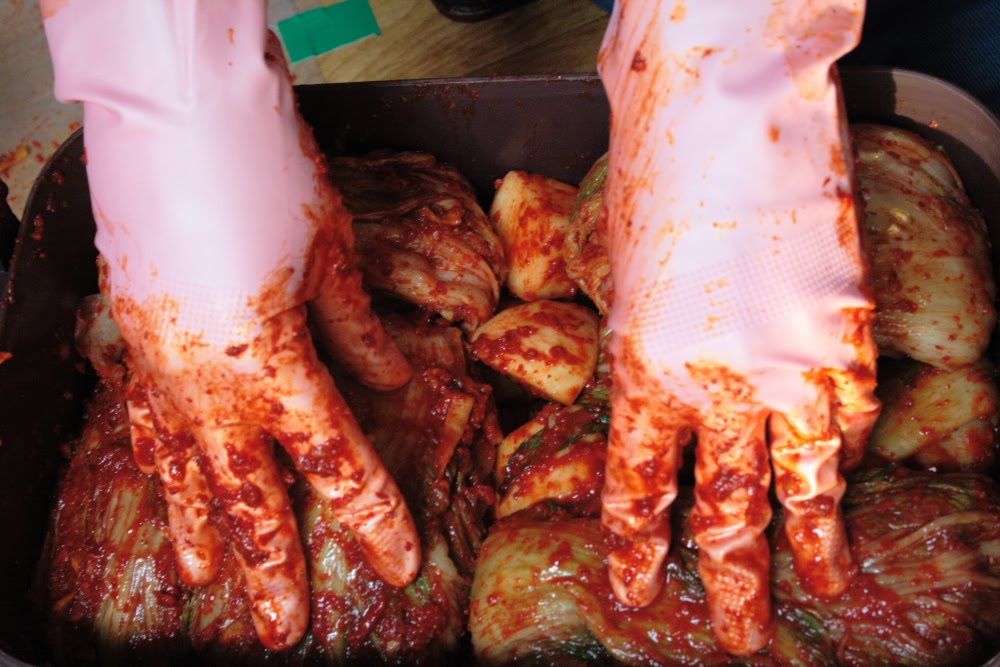
We visited my co-teacher Mrs. Lee's house to help her prepare their family's yearly batch. She had taped a large plastic sheet to her living room floor and piled a mound of salted cabbage on it, with two large bowls of red pepper sauce (prepared with red pepper powder, fish sauce, shrimp sauce, shrimp, radishes, white onions, and anchovies) and some gloves. She demonstrated the technique, even correcting her husband ("I am the kimchi expert"), and we dug right in. Mrs. Lee scolded me once for not using enough sauce, and then later, several times, for using too much. She said too much sauce overpowers the taste, and that she may end up hating me when she gets to my batch.


Mr. Lee cleaned off the plastic mat to reuse next year.
Mrs. Lee packed a giant tupperware container for us to take home, and stored the rest in her kimchi refrigerator.
We enjoyed the fruit of our labor with some steamed pork and cabbage pancakes.
We visited my co-teacher Mrs. Lee's house to help her prepare their family's yearly batch. She had taped a large plastic sheet to her living room floor and piled a mound of salted cabbage on it, with two large bowls of red pepper sauce (prepared with red pepper powder, fish sauce, shrimp sauce, shrimp, radishes, white onions, and anchovies) and some gloves. She demonstrated the technique, even correcting her husband ("I am the kimchi expert"), and we dug right in. Mrs. Lee scolded me once for not using enough sauce, and then later, several times, for using too much. She said too much sauce overpowers the taste, and that she may end up hating me when she gets to my batch.
Mr. Lee cleaned off the plastic mat to reuse next year.
Mrs. Lee packed a giant tupperware container for us to take home, and stored the rest in her kimchi refrigerator.
We enjoyed the fruit of our labor with some steamed pork and cabbage pancakes.
Labels:
kimchi
,
korea
,
korean customs
,
korean food
Wednesday, December 02, 2009
Slippers and spice and everything nice
Adjusting to life abroad in a new culture can be a frustrating task. But after waking up in Korea every day for the last 9 months, there are some things that still make me smile:
The spice of life (and food)
Chalk it up to my liberal palate or my stomach of steel, but I love everything about Korean food. Everything from the bountiful red pepper paste, the runny egg on a giant bowl of bibimbap, the sizzle and pop of marinated Korean barbecue, a giant slice of hot pepper tuna kimbap. I have even developed a taste for dried octopus. The tastes and flavors are so varied here, sampled in the seemingly infinite number of side dishes, that it rarely gets old. And when it does, or when a bowl of crunchy nuts turns out to be silkworm larvae, there's never a Mr. Pizza or an Outback Steakhouse too far away.
Slippers
Every morning my school principal waters the cabbage that lines the main driveway. I bow to him as I pass and we share a smile. My smile is always more like a chuckle, though, because beneath his perfectly tailored three-piece suit his feet are shod in a pair of $2 slippers from E-mart. Slippers represent, to me, the antithesis of stress. No matter how dynamic Korea is being on any particular day, when I slide into my classroom in a pair of little rubber slippers, I feel instantly better. It's hard to take anything too seriously when you can see the toes of everyone's socks.
Festivals, festivals, and more festivals!
Koreans love festivals, so they have A LOT of them, for every age and interest. There is a firefly festival, a mask dance festival, a kimchi festival, and several sunrise festivals. If those don't rock your boat, there is a mud festival, a puppet festival, an ice fishing festival, and a whale festival. Into art? There are film festivals, music festivals, art festivals, and bodypainting festivals. Still not interested? Then try a fire festival, a trout festival, a ginseng festival, a silk festival, and one of the many cherry blossom festivals. Should I go on? How about a bullfighting festival, a wild tea cultural festival, a lotus lantern festival, or a fireworks festival?
I'll stop now, but not because I can't continue. I'll stop because if you haven't made plans to come to Korea already, you're probably dead.


Koreans have amazing skin, and while I can't speak for any genetic predisposition, I can say that the weekly sauna and jjimjilbang visits can't hurt. There are few feelings in this world that are as refreshing as emerging from a sauna, freshly scrubbed with an Italy towel. After my first visit I was hooked. This is the first and probably last time I will ever write this statement: I love being naked in a steamy room full of other naked men. OK, maybe that's not totally accurate. I don't love that the room is full of other naked men. I don't actually care. I just love that I can be naked there, and no one else cares. Sure, there are some sideways glances - stares, even - but I chalk that up to foreign curiosity and move on. I go to the public bathhouses in Korea to soak and scrub off my dirt and stress, not to worry about what someone may or may not be looking at. I mean, let's be honest. EVERYONE LOOKS. It's a natural instinct when you spend 99% of your public life with multiple layers of clothing on. What's more surprising is how quickly that instinct wears off when you're neck-deep in water that's halfway to boiling.
Dynamic Korea!
Although Korea says that this slogan "succinctly illustrates the energetic image of Korea," to most Native English Teachers (NETs) it takes on a different shade of meaning. School schedules are known to change at the drop of the principal's hat, without much concern for the NET involved. Classes are canceled and new ones pop up with little warning, and we are always expected to roll with it. Some teachers find this infuriating. I find it refreshing. One of the main reasons I came to Korea was for a sense of adventure, to try something new. I didn't want just another average desk job to spend my time sleepwalking through 8 hours of work. I came for some excitement! That's why I embrace those "dynamic" moments when the computer doesn't work or I have 5 minutes to prepare for an unplanned class as an opportunity to test my creativity and have a little fun. "Dynamic Korea" adds a little extra spontaneity to my life. And who doesn't like spontaneity?
The spice of life (and food)
Chalk it up to my liberal palate or my stomach of steel, but I love everything about Korean food. Everything from the bountiful red pepper paste, the runny egg on a giant bowl of bibimbap, the sizzle and pop of marinated Korean barbecue, a giant slice of hot pepper tuna kimbap. I have even developed a taste for dried octopus. The tastes and flavors are so varied here, sampled in the seemingly infinite number of side dishes, that it rarely gets old. And when it does, or when a bowl of crunchy nuts turns out to be silkworm larvae, there's never a Mr. Pizza or an Outback Steakhouse too far away.
Slippers
Every morning my school principal waters the cabbage that lines the main driveway. I bow to him as I pass and we share a smile. My smile is always more like a chuckle, though, because beneath his perfectly tailored three-piece suit his feet are shod in a pair of $2 slippers from E-mart. Slippers represent, to me, the antithesis of stress. No matter how dynamic Korea is being on any particular day, when I slide into my classroom in a pair of little rubber slippers, I feel instantly better. It's hard to take anything too seriously when you can see the toes of everyone's socks.
Festivals, festivals, and more festivals!
Koreans love festivals, so they have A LOT of them, for every age and interest. There is a firefly festival, a mask dance festival, a kimchi festival, and several sunrise festivals. If those don't rock your boat, there is a mud festival, a puppet festival, an ice fishing festival, and a whale festival. Into art? There are film festivals, music festivals, art festivals, and bodypainting festivals. Still not interested? Then try a fire festival, a trout festival, a ginseng festival, a silk festival, and one of the many cherry blossom festivals. Should I go on? How about a bullfighting festival, a wild tea cultural festival, a lotus lantern festival, or a fireworks festival?
I'll stop now, but not because I can't continue. I'll stop because if you haven't made plans to come to Korea already, you're probably dead.


Koreans have amazing skin, and while I can't speak for any genetic predisposition, I can say that the weekly sauna and jjimjilbang visits can't hurt. There are few feelings in this world that are as refreshing as emerging from a sauna, freshly scrubbed with an Italy towel. After my first visit I was hooked. This is the first and probably last time I will ever write this statement: I love being naked in a steamy room full of other naked men. OK, maybe that's not totally accurate. I don't love that the room is full of other naked men. I don't actually care. I just love that I can be naked there, and no one else cares. Sure, there are some sideways glances - stares, even - but I chalk that up to foreign curiosity and move on. I go to the public bathhouses in Korea to soak and scrub off my dirt and stress, not to worry about what someone may or may not be looking at. I mean, let's be honest. EVERYONE LOOKS. It's a natural instinct when you spend 99% of your public life with multiple layers of clothing on. What's more surprising is how quickly that instinct wears off when you're neck-deep in water that's halfway to boiling.
Dynamic Korea!
Although Korea says that this slogan "succinctly illustrates the energetic image of Korea," to most Native English Teachers (NETs) it takes on a different shade of meaning. School schedules are known to change at the drop of the principal's hat, without much concern for the NET involved. Classes are canceled and new ones pop up with little warning, and we are always expected to roll with it. Some teachers find this infuriating. I find it refreshing. One of the main reasons I came to Korea was for a sense of adventure, to try something new. I didn't want just another average desk job to spend my time sleepwalking through 8 hours of work. I came for some excitement! That's why I embrace those "dynamic" moments when the computer doesn't work or I have 5 minutes to prepare for an unplanned class as an opportunity to test my creativity and have a little fun. "Dynamic Korea" adds a little extra spontaneity to my life. And who doesn't like spontaneity?

Labels:
korea
,
korean customs
,
korean food
Tuesday, December 01, 2009
Korean Pizza
Pizza has made some byroads into the heart of the Korean culinary experience. There are a couple of purely Korean franchises like Mr. Pizza and Pizza Etang, and though Domino's and Pizza Hut do exist (both within a mile of our house), all of the pizzas on their menus have certainly two inalienable Korean characteristics.
1. Yellow corn
I'm not really sure how the corn-topping craze hit the Korean pizza market, since yellow corn is an imported and rarely eaten food, but hit it has. Regardless of the type of pizza you order - meat lover's, seafood, potato, or corn-less - it will come with sweet yellow kernels of corn tossed in.
2. Crust variations
You can get cheese-filled and sweet-potato-filled, shrimp-topped and, as seen below, chicken-drumstick-topped. There are other variations as well, but Lisa doesn't like anybody messing with her pizza crust so we don't experiment with the options very often.

We also don't eat it very often because it's expensive and because, well, Korean food is pretty damn good as it is. I don't crave pizza often but even when I do I'm not really willing to shell out 20-30,000 won for a pie. I gotta admit, though - I do love an inventive crust.
1. Yellow corn
I'm not really sure how the corn-topping craze hit the Korean pizza market, since yellow corn is an imported and rarely eaten food, but hit it has. Regardless of the type of pizza you order - meat lover's, seafood, potato, or corn-less - it will come with sweet yellow kernels of corn tossed in.
2. Crust variations
You can get cheese-filled and sweet-potato-filled, shrimp-topped and, as seen below, chicken-drumstick-topped. There are other variations as well, but Lisa doesn't like anybody messing with her pizza crust so we don't experiment with the options very often.

We also don't eat it very often because it's expensive and because, well, Korean food is pretty damn good as it is. I don't crave pizza often but even when I do I'm not really willing to shell out 20-30,000 won for a pie. I gotta admit, though - I do love an inventive crust.
Labels:
korea
,
korean food
Wednesday, November 25, 2009
Ancestral Rites
A couple of weeks ago I visited a co-teacher's house to participate in the ancestral rites to honor her dead grandparents. It was the anniversary of her grandmother's death but they held the ceremony for both of them. In Korea, apparently, the bonds of matrimony aren't just for life - they're for eternity. Death ain't parting anyone.
Amy's mom prepared a lavish spread for them from fresh vegetables and fruit that she bought earlier in the day for this meal. In many places special stores exist for the express purpose of selling ancestral ceremony food that is guaranteed to be fresh and of the highest quality.
You may notice that all of the fruits have the tops cut off of them. This makes it easier for Amy's grandparents to eat them.
Before the ceremony began, Amy's father lit the candles and they opened the apartment door. At the time I thought Amy said that they were inviting the neighbors. It turns out they were letting in her grandparents.
After all of us performed some three bows on the mat and poured some special soju into a glass on the table, Amy's father chanted a poem.
I was worried that after the ceremony all of the food would be considered "tainted" and thrown away. Luckily it wasn't, and we ate it all. That is, what Amy's grandparents left behind.
Amy's mom prepared a lavish spread for them from fresh vegetables and fruit that she bought earlier in the day for this meal. In many places special stores exist for the express purpose of selling ancestral ceremony food that is guaranteed to be fresh and of the highest quality.
You may notice that all of the fruits have the tops cut off of them. This makes it easier for Amy's grandparents to eat them.
Before the ceremony began, Amy's father lit the candles and they opened the apartment door. At the time I thought Amy said that they were inviting the neighbors. It turns out they were letting in her grandparents.After all of us performed some three bows on the mat and poured some special soju into a glass on the table, Amy's father chanted a poem.
I was worried that after the ceremony all of the food would be considered "tainted" and thrown away. Luckily it wasn't, and we ate it all. That is, what Amy's grandparents left behind.
Labels:
korea
,
korean beliefs
,
korean customs
,
korean food
Sunday, November 01, 2009
Pocari Sweat

When we first arrived in Korea, and I saw Pocari Sweat on sale in vending machines and convenience stores, I laughed and mocked them and swore that I would never drink it. I tried it once, but the combination of the off-putting name and the fact that it actually looks like bottled sweat was too much for my mind to handle, and I hated it.
After a while, though, if you see something enough it starts to become ordinary. At some point the name of a product just becomes that product and nothing else, and the words don't have any other meaning outside of it.
So it was with Pocari Sweat. Lisa and I both have grown quite fond of it, and drink it regularly after a workout or on a hike. It doesn't have as much sugar as other sports drinks like Gatorade or Powerade (both of which are sold in Korea, though only in one flavor) and I have to admit it is quite refreshing.

Labels:
korea
,
korean food
Wednesday, October 21, 2009
A Stroke of Luck and a Brick of Rice Cake
My Principal recently became a grandfather, so to celebrate he bought every teacher in the school a package of rice cakes and a bottle of banana milk.

In Korea, rice cake is used in a similar capacity whenever anyone experiences a sudden stroke of luck or joy in their life. If someone gets engaged, we get rice cake. When someone has a baby, we have rice cake. When a student gets into college, their parents make sure we get full on rice cake. Usually it's more than I can really stomach - I mean they give us BRICKS of rice cake. Since I've been here I have probably thrown out a kg of rice cake after getting home from school. I mean, I can't share it with the other teachers - they have their own gigantic lump of rice cake to swallow.
I remember learning several years ago about how when a Japanese golfer hits a hole-in-one, he or she is expected to throw a party and buy food, alcohol, and gifts for pretty much all of their friends and everyone else on the golf course that day. They actually buy hole-in-one insurance to protect themselves against such an unlucky event.
In Korea I haven't heard of anything quite so drastic, but they do have traditions in a similar vein. When you experience good fortune in Korea, you are generally expected to share your happiness with others in the form of gifts (often rice cake). On your birthday, you are expected to buy all of your friends dinner - not the other way around, as most English teachers here are accustomed to doing. When you get engaged, married, have kids, and your kids do well enough to get recognized for something, you show your appreciation for those around you.
Granted, their friends and family will also buy them gifts or give them money to celebrate certain occasions, but the onus generally seems to be on the one celebrating to do the sharing.
As it turns out, either I'm getting more Korean or the rice cake the Principal delivered today is starting to taste a lot better. I'll probably eat the whole package by the end of the day.

In Korea, rice cake is used in a similar capacity whenever anyone experiences a sudden stroke of luck or joy in their life. If someone gets engaged, we get rice cake. When someone has a baby, we have rice cake. When a student gets into college, their parents make sure we get full on rice cake. Usually it's more than I can really stomach - I mean they give us BRICKS of rice cake. Since I've been here I have probably thrown out a kg of rice cake after getting home from school. I mean, I can't share it with the other teachers - they have their own gigantic lump of rice cake to swallow.
I remember learning several years ago about how when a Japanese golfer hits a hole-in-one, he or she is expected to throw a party and buy food, alcohol, and gifts for pretty much all of their friends and everyone else on the golf course that day. They actually buy hole-in-one insurance to protect themselves against such an unlucky event.
In Korea I haven't heard of anything quite so drastic, but they do have traditions in a similar vein. When you experience good fortune in Korea, you are generally expected to share your happiness with others in the form of gifts (often rice cake). On your birthday, you are expected to buy all of your friends dinner - not the other way around, as most English teachers here are accustomed to doing. When you get engaged, married, have kids, and your kids do well enough to get recognized for something, you show your appreciation for those around you.
Granted, their friends and family will also buy them gifts or give them money to celebrate certain occasions, but the onus generally seems to be on the one celebrating to do the sharing.
As it turns out, either I'm getting more Korean or the rice cake the Principal delivered today is starting to taste a lot better. I'll probably eat the whole package by the end of the day.
Labels:
korea
,
korean customs
,
korean food
Wednesday, June 24, 2009
Organic Food Delivery in Korea

Not only are most of the products actually cheaper than their non-organic counterparts on the shelves of E-Mart, but the best part about the company is that they deliver your entire order to your doorstep, on the day of your choosing. AND they'll send you a text message when they've made the delivery so you can go home and put everything in the fridge.
The only drawback, if you can call it that, is that the entire site is in Korean. (On the upside, it's a great way to learn Korean.) You'll need a Korean co-teacher or friend to help you set up an account, but luckily the process doesn't take long. After my co-teacher filled out my name, address, and ARC ID on the website, and made a couple of short phone calls to give the company my bank account number for direct transfer of funds, my account was active.
There are two membership options: one with no monthly payment, and another with a monthly payment of 20,000 원 and at least a 20% discount on all items. (So...if you spend about $100 a month on groceries, it's worth it.)
Did I mention that it comes with FREE delivery? You select the day you want the goods delivered, select the quantity of items you want, log out, and wait.
So far we've had two deliveries. The second time I ordered what I think is something similar to seitan, which was frozen, so they made the delivery in a big re-usable foam box. The next time I'm expecting a delivery I'll leave the box outside my door and they'll either re-fill it or take it back and use it for another delivery.
If you want any more info about it, please let me know. I'm quickly becoming one of their biggest fans.
Labels:
korea
,
korean food
Monday, June 22, 2009
Beating Your Meat (Or, "Dogs as Food in Korea")
Though not a staple of the Korean diet by any stretch of the imagination, dog meat is popular among a small subset of the population here. Older men are particularly fond of it, as it is a widely held belief among dog meat fans and foes alike that it boosts "stamina" - Koreans' not-so-subtle term for sexual energy. It is most often served as dog meat soup (보신탕), though most 보신탕 restaurants also serve a side dish of steamed dog skin (which is just about as appetizing as it sounds).
Many Koreans have never eaten dog meat, and they'll usually cite one of the following three reasons for their avoidance of it:
1) They love dogs.
I think it's safe to say that this is why most of the Western world dry heaves at the very notion of eating dog meat. It's tough to conjure an appetite when you picture the cutest, cuddly (& very anthropomorphised) puppy you've ever seen, roasted on a stick. 

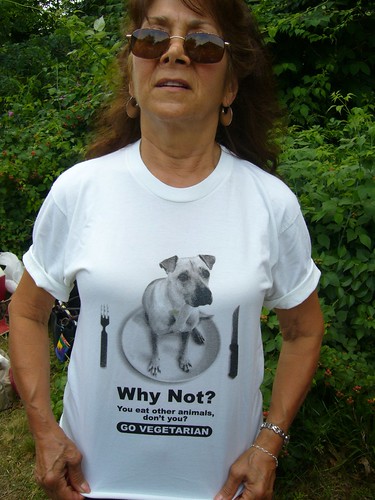
This seems a weak argument to me, if the thought of eating meat doesn't already make you cringe. (The t-shirt's vegetarian campaign seems equally as likely to backfire.) Dogs are popular pets because they exhibit traits we look for in friends - they are loyal, affectionate, and can usually be trained not to poop on the couch.
Any animal can be made to look cute enough, if you take it out of its natural habitat and give it a bath and a ribbon, or if it is small enough.

2) It's cruel.
I only found out how the dogs are killed after my second trip to eat 보신탕 with a co-teacher. I had, perhaps naively, assumed that dogs were slaughtered as humanely as possible. But because the meat is especially prized for its stamina-inducing properties, butchers prefer to kill dogs at their most energetic, so that customers get the full effect of the dog's adrenaline. According to my co-teacher (on whose sole testimony this account is based, and who eats dog regularly), some butchers will torture a dog briefly before smashing its head on the ground. This supposedly kills the dog instantly, trapping the dog's adrenaline in its meat.
According to this 2001 article from the BBC, however, violent forms of dog execution have been banned, and they are now "instantly killed by electrocution." But, until late 2008, dogs weren't considered livestock (to do so would be to actually admit their "problem" to the world), so it has been difficult for the government to control their treatment. Now, having changed their designation, the government is trying to crack down on illicit dog meat vendors.
If you can stomach it, here is a photo gallery of some of the abuses suffered by dogs in markets in Korea and elsewhere: http://www.all-creatures.org/anex/dog.html. Keep in mind that many animals consumed in the US routinely undergo similarly cruel treatment.
3) They're Buddhist.
Korean Buddhists don't eat dog meat, and this accounts for almost a quarter of the population. While I had most often heard that Korean Buddhists consider dogs to be sentient beings (though dogs seem to be alone in the animal kingdom as deserving of that status), I was recently told of another, more entertaining and mythical story that started like this: "Korean Buddhists believe if they eat dog meat they will die." Dissatisfied with such an outlandish, cursory statement, I pressed for an explanation, which follows:
The kings during the Joseun dynasty, motivated by Confucian teachings, banished Buddhists from practicing their religion in the country. As a result, temples were moved high into remote hills where they were hard to locate and destroy. Practicing buddhists were forced to journey through still-wild, forests - at that time still home to giant Korean tigers - in order to reach their religious grounds. Tigers, apparently, love dog meat, and can smell it even on the sweat of a man who has recently consumed it. They would not hesitate to kill a man to sate their hunger for dog. Buddhists quickly learned to abstain from eating dog meat, lest they be killed by mistake.
Wikipedia will also tell you that dog meat has been illegal in Korea since 1984, which, if true, would probably do something to keep dog consumption down. Other articles suggest that it was the Seoul city metropolitan government that banned the sale of dog (and, incidentally, snake) meat, not the entire country. Regardless of the national government's "official" stance on the issue, personal experience tells me that the dog meat industry is wholly tolerated as a serious business. No attempt is made to hide the consumption from anyone other than foreigners. Most Korean fans of dog meat, upon hearing a foreigner's mention of it, will usually deride it blithely and pass it off as an unusual custom. Once you express any openness to the idea of eating dog meat, however, the same Korean will openly admit their passion for it and will invite you for supper, and probably lunch the next day. Ever since the '88 Olympics (and subsequently the 2002 World Cup, co-hosted by Korea and Japan), when the Korean government first suggested a willingness to shun dog meat as an official policy, the Korean dog-eating populace has gotten the hint: keep it on the down low, and you can keep beating - and eating - your (dog) meat.
Labels:
buddhism
,
korea
,
korean beliefs
,
korean customs
,
korean food
Wednesday, June 17, 2009
I am almost surviving...
Soup is a mainstay of the Korean diet, and it is usually served piping hot. There is a Korean expression, 시원하다 (shi-weon-ha-da), which means that something is very hot but makes you feel cool, or comfortable (Google translates the expression as "Oh that's good!"). Today during lunch I used the expression with one of my co-teachers. Another teacher made a comment at which everyone laughed - 살 것 같다 (sal geot gatda)! Mrs. Yoon said she would explain it after lunch, which I took as her tactful way of saying she was kind of embarassed by it.
Later, in the hall, she explained that exam day doesn't only mean a day of rest for me - the teachers' only responsibility during the day is to supervise the students while they take exams. Since today's exam a practice test, students don't take it very seriously (indeed, on my way to lunch I noticed about half of the students in each class fast asleep), and teachers aren't concerned about cheating. Because the teachers "can feel comfortable," says Mrs. Yoon, many of them go out drinking heavily the night before.
A hot soup is considered essential to recovery from a hangover, and, luckily for many male teachers, today that is exactly what we had (actually, there's a whole class of soups Koreans consider hangover cures - 해장국, he-jang-guk - one of which is made of blowfish and bean sprouts). The teacher's retort to my "시원하다" comment was a joke, not at my expense, but at that of all the teachers nursing a hangover today. 살 것 같다, Mrs. Yoon explained, is used when you begin to feel better; having taken the first several sips of a steaming soup after a long night of binge drinking, perhaps. It means "I am almost surviving!"
Side note: I have apparently reached 100 blog posts!
Labels:
korea
,
korean beliefs
,
korean food
,
language
Wednesday, May 06, 2009
Exam Week
Last week all of the students at Idong High School had midterm exams, so I didn't have any classes. I still had to come to school, though, so I tried to spend the week working on lesson plans. I had a moderate amount of success (damn Facebook). The school day was shorter than usual; exams finished up around 1:20pm every day, so the teachers had social plans for every afternoon/evening. First floor teacher lunch one day, tennis club another day, etc. The English department had lunch on Monday afternoon at a sushi buffet. It was awesome - 15,000 won for all you can eat sushi and sashimi.

Maybe this is just a Korean thing - for some reason they throw really sweet stuff on otherwise savory dishes. Yet when it comes to actual desserts, they leave the sugar out (ie. rice cakes). Here is an example of what I mean:
That's whipped cream and sprinkles on a sushi roll.
Two of my faves: Mrs. Lee and Miss Hong. Miss Hong has loads of energy and is always laughing and clapping. It's hilarious and contagious. Mrs. Lee is more reserved, but she has a really generous heart. She also smiles shyly when she's nervous in a way that makes me think of puppies and hugs.
More faves. Miss Hwang, Mr. Lee (not Mrs. Lee's husband), Mrs. Yoon. Although I don't actually teach any classes with Miss Hwang (she's 3rd grade), I see her more than almost anyone else. She is very curious about English, and is always coming to my office with questions (instead of "Given that...", can I say "When we are given that..."?). She has also taken it upon herself to teach me Korean. We have class every Friday after lunch, when she quizzes me on the words she taught me the week before. Mr. Lee always explains random bits of trivia to me, like Winter's Envy. He also loves dog meat, and has taken us out a couple of times for bo-shin-tang (dog meat soup). Mrs. Yoon (Yoon Soon Yung, not to be confused with the other Mrs. Yoon, who I call "Mrs. Yoon with the broken arm", because I can't remember her other names) is my main co-teacher, and is amazing. She is the head of the English department, and is therefore ultra busy, but whenever I ask her a question she stops whatever she is doing at the moment to take care of my concerns. She's a superb sort of adoptive mother.
On Thursday we had a school-wide teachers outing. We drove 30 mins outside of Pohang to O-eo-san (O-eo mountain) for lunch and a hike. Everyone carpooled, which was really convenient until some teachers decided to leave halfway through without telling me and almost drive off with all of my stuff in their backseat. We ate at a secluded restaurant, with the place to ourselves. We had a choice between three kinds of bulgogi: Duck, goat, and beef. It definitely wasn't a vegetarian-friendly meal. I chose the duck, and it was delicious. So tender and spicy. We cooked it in the pot and shared it among four people, along with the side dishes and lettuce and mint leaves to wrap it in.

After lunch some of us went on a hike, which turned out to be much farther than I expected - about 3 hours round-trip. I thought it would be 1 hour max. The rest of the teachers went home, or stayed behind and gambled and drank.
Before we started the hike, Mr. Hong, the PE teacher, handed out snacks to everyone. Cherry tomatoes, a banana, a granola bar, and a bottle of
Mr. Hong is my tennis coach. He's also very interested to practice his English with me, though at times it's excruciating watching him smack his head and try to remember simple phrases. His enthusiasm is welcome, though. He really likes me, and always tells me to call him "hyeong nim", which means big brother. He's 32.
Halfway into the hike we stumbled upon a temple, high in the hills. They were getting ready for Buddha's birthday, and had strung up a rainbow of lanterns along the hillside. It was a beautiful, serene atmosphere.
Apparently the mountain was also used as a training ground for the Korean marines. It seemed strange to me that marines would be carrying out ops in the hills behind buddhist temples, but my teachers assured me that there was no combat involved. They also did a lot of trail maintenance - in particularly steep stretches, the marines draped thick ropes up the hillside to assist climbers.
A large gazebo sort of structure sat at the top of the mountain, with stunning, panoramic views of greater Pohang.

All of the teachers were in good spirits.


We flew back down the hill in half the time it took us to get up. At the bottom of the mountain, we took a few minutes to wander through O-oe-sa (O-oe temple), a famous Korean buddhist temple.
Lee Myung Bak, Korea's President, even sponsored a lantern here.

Built during the Silla dynasty, it was rebuilt in 1741. It was a small temple, but seemed to be popular. Many visitors would buy prayer beads and drape them over the plethora of Buddha figurines that sat on every available rock face.


When we finally got back to the restaurant, the rest of the teachers were good and drunk, and wanted to play Sepak Takraw. Actually a modified form of the Southeast Asian game, Korean men love to play it on tennis courts. While there are no flips or bicycle kicks involved, I've seen some pretty impressive high roundhouse aces. All Korean men, after all, served two years in the military and spent at least some of their childhood, no doubt, practicing Tae Kwon Do. Most of the teachers, though, could barely walk, much less kick a ball over a tennis net, and the game eventually devolved into what seemed to be a contest to see who could make the wildest, most hilarious attempt to make contact with the ball.
It was a long, fun day. The teachers spend so much of their time cooped up in school that when they get the chance to let loose, some of them go hog wild. It's funny to see many of them outside of the school environment, without suits and ties, and for the next several days there is a general bonhomie shared amongst all of the teachers, a silent smile that, luckily for me, doesn't require any words.

Maybe this is just a Korean thing - for some reason they throw really sweet stuff on otherwise savory dishes. Yet when it comes to actual desserts, they leave the sugar out (ie. rice cakes). Here is an example of what I mean:
That's whipped cream and sprinkles on a sushi roll.
Two of my faves: Mrs. Lee and Miss Hong. Miss Hong has loads of energy and is always laughing and clapping. It's hilarious and contagious. Mrs. Lee is more reserved, but she has a really generous heart. She also smiles shyly when she's nervous in a way that makes me think of puppies and hugs.
More faves. Miss Hwang, Mr. Lee (not Mrs. Lee's husband), Mrs. Yoon. Although I don't actually teach any classes with Miss Hwang (she's 3rd grade), I see her more than almost anyone else. She is very curious about English, and is always coming to my office with questions (instead of "Given that...", can I say "When we are given that..."?). She has also taken it upon herself to teach me Korean. We have class every Friday after lunch, when she quizzes me on the words she taught me the week before. Mr. Lee always explains random bits of trivia to me, like Winter's Envy. He also loves dog meat, and has taken us out a couple of times for bo-shin-tang (dog meat soup). Mrs. Yoon (Yoon Soon Yung, not to be confused with the other Mrs. Yoon, who I call "Mrs. Yoon with the broken arm", because I can't remember her other names) is my main co-teacher, and is amazing. She is the head of the English department, and is therefore ultra busy, but whenever I ask her a question she stops whatever she is doing at the moment to take care of my concerns. She's a superb sort of adoptive mother.On Thursday we had a school-wide teachers outing. We drove 30 mins outside of Pohang to O-eo-san (O-eo mountain) for lunch and a hike. Everyone carpooled, which was really convenient until some teachers decided to leave halfway through without telling me and almost drive off with all of my stuff in their backseat. We ate at a secluded restaurant, with the place to ourselves. We had a choice between three kinds of bulgogi: Duck, goat, and beef. It definitely wasn't a vegetarian-friendly meal. I chose the duck, and it was delicious. So tender and spicy. We cooked it in the pot and shared it among four people, along with the side dishes and lettuce and mint leaves to wrap it in.

After lunch some of us went on a hike, which turned out to be much farther than I expected - about 3 hours round-trip. I thought it would be 1 hour max. The rest of the teachers went home, or stayed behind and gambled and drank.
Before we started the hike, Mr. Hong, the PE teacher, handed out snacks to everyone. Cherry tomatoes, a banana, a granola bar, and a bottle of
Mr. Hong is my tennis coach. He's also very interested to practice his English with me, though at times it's excruciating watching him smack his head and try to remember simple phrases. His enthusiasm is welcome, though. He really likes me, and always tells me to call him "hyeong nim", which means big brother. He's 32.Halfway into the hike we stumbled upon a temple, high in the hills. They were getting ready for Buddha's birthday, and had strung up a rainbow of lanterns along the hillside. It was a beautiful, serene atmosphere.
Apparently the mountain was also used as a training ground for the Korean marines. It seemed strange to me that marines would be carrying out ops in the hills behind buddhist temples, but my teachers assured me that there was no combat involved. They also did a lot of trail maintenance - in particularly steep stretches, the marines draped thick ropes up the hillside to assist climbers.A large gazebo sort of structure sat at the top of the mountain, with stunning, panoramic views of greater Pohang.

All of the teachers were in good spirits.

We flew back down the hill in half the time it took us to get up. At the bottom of the mountain, we took a few minutes to wander through O-oe-sa (O-oe temple), a famous Korean buddhist temple.
Lee Myung Bak, Korea's President, even sponsored a lantern here.
Built during the Silla dynasty, it was rebuilt in 1741. It was a small temple, but seemed to be popular. Many visitors would buy prayer beads and drape them over the plethora of Buddha figurines that sat on every available rock face.


When we finally got back to the restaurant, the rest of the teachers were good and drunk, and wanted to play Sepak Takraw. Actually a modified form of the Southeast Asian game, Korean men love to play it on tennis courts. While there are no flips or bicycle kicks involved, I've seen some pretty impressive high roundhouse aces. All Korean men, after all, served two years in the military and spent at least some of their childhood, no doubt, practicing Tae Kwon Do. Most of the teachers, though, could barely walk, much less kick a ball over a tennis net, and the game eventually devolved into what seemed to be a contest to see who could make the wildest, most hilarious attempt to make contact with the ball.
It was a long, fun day. The teachers spend so much of their time cooped up in school that when they get the chance to let loose, some of them go hog wild. It's funny to see many of them outside of the school environment, without suits and ties, and for the next several days there is a general bonhomie shared amongst all of the teachers, a silent smile that, luckily for me, doesn't require any words.
Subscribe to:
Posts
(
Atom
)