Showing posts with label korean history. Show all posts

Friday, September 10, 2010

Taegukgi (태극기)

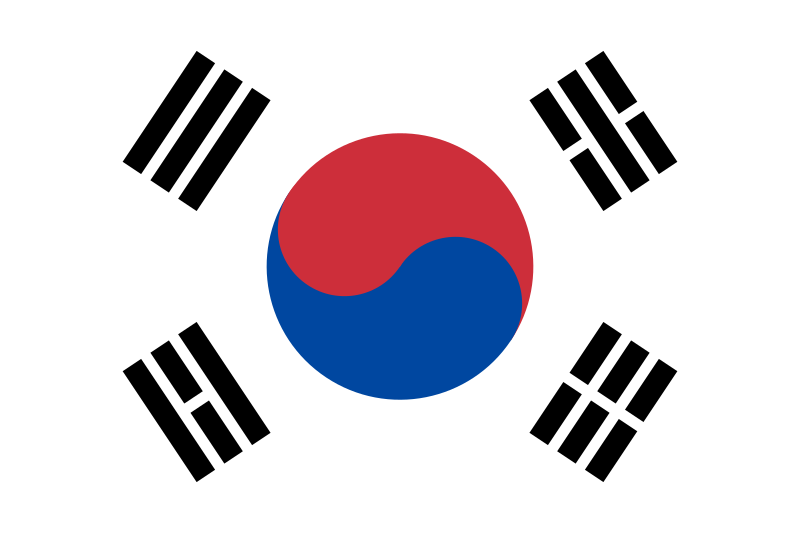
The Korean flag

The Korean flag is full of meaning. Though, depending on who you consult, it can mean many different things.

Elements of the Taegukgi [태극기]:

- Taeguk (the red and blue yin-yang symbol in the center): represents the cosmic forces of yin (blue) and yang (red) that gave birth to everything in the universe. Blue implies hope, while red is supposed to signify nobility. They combine to represent the creation of the truth (truthiness?) of the universe.

- White background: represents one, or all, of the following things: purity; the brightness of the Baeguiminjok [배귀민족] - people wearing white; and the desire of the Korean people for peace. Who knew white meant so many things? It's harder to keep straight than Ricky Martin.

- Gwae [괘] - in the four corners: represents movement and harmony. They also function conveniently as those optical illusions where you stare at them for 30 seconds and watch the dots appear.

Geon [건]: heaven (or sky), spring, east, humanity, father, metal, and justice.


Gon [곤]: earth, summer, west, righteousness, mother, and/or fertility.


Gam [감]: moon, winter, north, intelligence, daughter, water, and/or vitality.


Ri [리]: sun, autumn, south, courtesy, sun, fire, and/or wisdom.


It's sort of like a choose-your-own-adventure, all wrapped up into one convenient national icon!


* An interesting note, in answer to the question posed by Kevin: it appears that Korea chose to represent only four of the eight ba gua (also called gwae [괘], yi-ching, or tri-grams), all of which can be seen below in earlier versions of the flag, as a matter of simplicity and convenience.


In April 1882, an official Korean-Chinese meeting was held to discuss the question of the Korean flag. The "teaguk" emblem was proposed for the first time during this meeting. Official documents of the Korean Royal court state that the Chinese delegate Ma Chien-Chung promoted the use of the Yin-Yang spiral in red and blue and eight combinations of the Yi-ching, and imposed his views to the Korean delegate Kim Hong-Jip. Ma Chien-chung explained the symbolism of his proposal. The eight Yi-ching diagrams matched the eight Korean provinces, and red was the colour of the King whereas blue was the colour of ordinary people. Korea eventually adopted its flag under Chinese pressure and used it for its first diplomatic mission as said above.
The first version of the "taeguk" was very close to the original Yi-Ching diagram, which includes eight subdiagrams. The deletion of four of these subdiagrams is reported in the diary of Prince Pak Yeong-Hyo. The Prince showed the original flag design to James, the British captain of the vessel used for the mission. James found the design too complicated and proposed to delete four of the eight Yi-Ching diagrams.
It's interesting that they chose the simplified version, given the fact that the eight kwae matched the number of provinces (not including metropolitan cities and the special self-governing province, i.e. Korea's Hawaii).


These are some earlier images of the Korean emblem, as used in official delegations:
date unknown
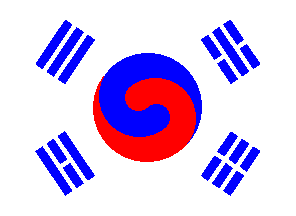
circa 1893
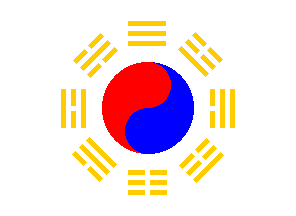
circa 1893


Friday, April 09, 2010

Dokdo Rocks! and rubber bands.


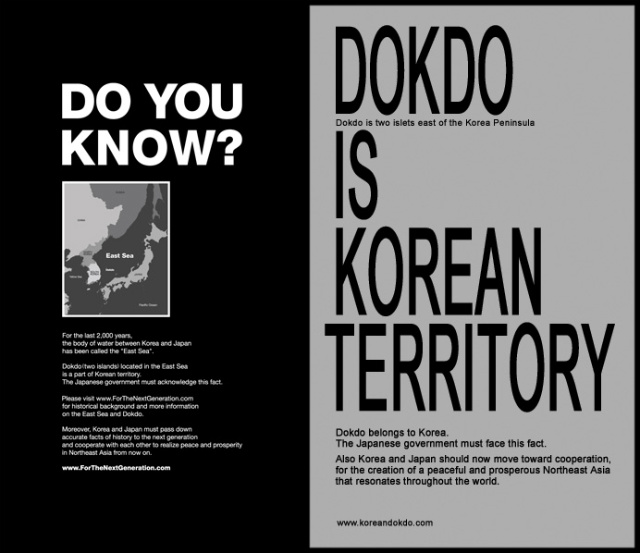
The Korea Times reported today that two Korean-American groups in the US (Korean American Leaders Association [KALA] and BYON International) are strategically distributing 100,000 rubber "Dokdo bracelets" in continuation of a PR campaign that has included a 2008 full-page ad in the NY Times and a 30-second video played in Times Square in 2009. (See the ad and video below.)


NY Times ad

Two questions have immediately come to your mind: "Why?" and "What the hell is Dokdo?"

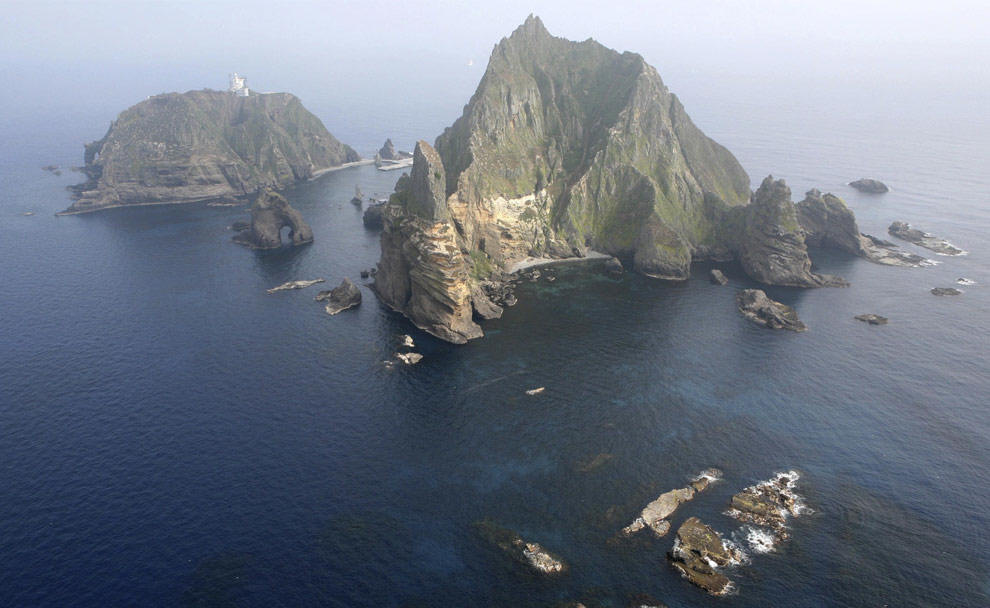
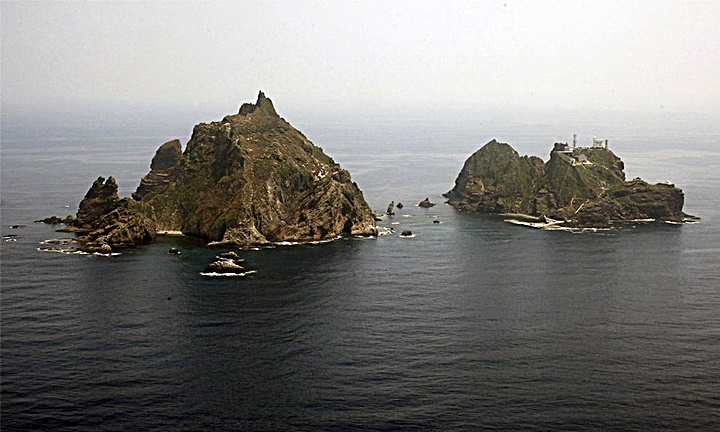
To answer your second question, Dokdo is Korea's name for two rocks, also called the Liancourt Rocks and Takeshima, in the middle of the Sea of Japan (or the East Sea, Korea's name for the Sea of Japan. They love re-naming things). As the NY Times ad above illustrates, the islands have been disputed territory with Japan for just about all of eternity. You can catch up on Dokdo's disputed history here.

View Dokdo in a larger map

The first question is the better one. If you ask this of your friends in Japan, they will probably answer with the second question ("What the hell is Dokdo?"). Even if they have heard the islands called by their Japanese name, Takeshima, they likely didn't hear much else about it. From the Japanese people and residents I've talked to, very few care about Dokdo/Takeshima at all. On the Japanese side of the dispute, the matter seems to be entirely political.

On the Korean side, however, politics is the least of it. Sure, there is economic potential in Dokdo as a commercial fishing outpost and a theoretical source of gas deposits. But for most Koreans, Dokdo has become a symbol of the entire country and its long history of fighting against colonial and imperial powers. It's almost as if South Koreans wouldn't know what to do if they weren't battling for something. So they've adopted the political fight for Dokdo as a very personal one.

Some Koreans have responded to Japan's personal affront on their property by removing Japanese condom advertisements, decapitating birds, cutting off their fingers, setting themselves on fire, and committing suicide, and riding motorcycles around the world. (One Japanese man was going to repond, but he was too busy watching human tetris.)

The author of this 2006 San Francisco Chronicle article about the "Dokdo bikers" was, in my opinion, spot on in his assessment of Korean pride over the dispute.
The conflict is partly over fishing rights and sea boundaries, but deeper down, Korean passion is fueled by enduring bitterness over Japan's harsh, 35-year occupation of Korea that ended in 1945 with Japan's defeat in World War.

According to the Korea Times article, the bracelets read "Dokdo is Korean Territory" and "East Sea is Korea", and will be distributed in NY and NJ.

KALA co-chair Hwang Sung-Ho compares Dokdo to the Falkland Islands in the article, complaining that Americans know about the latter but nothing of the former. Seriously?

Dokdo / Takeshima / Liancourt Rocks

First of all, the the Falkland Islands are 65,000 TIMES LARGER than Dokdo (Dokdo is 187,500 square meters, while the Falkland Islands cover 12,173 km2, or 12 billion square meters), people actually LIVE there, and there was a war fought specifically about the territory. Secondly, though some Americans might recognize the name "Falkland Islands", I doubt they could tell you anything about them.

Comparing Dokdo to any other islands, territories, or land under dispute anywhere else in the world is just asking to be criticized. Brian Deutsch brought up this argument on his blog after the 30-second ad for Dokdo aired in Times Square on March 1st.


The ad, though rather clever I think, serves only to draw attention to the differences between the islands rather than similarities. And as Brian pointed out, the ad's comparisons would never normally point to Dokdo as a logical conclusion here.

* Complete this series of analogies:
America: Hawaii
Italy: Sicily
Indonesia: Bali
Korea:

I'd be absolutely shocked if you answered anything other than Jeju.

Jeju, Korea's largest island, is a frequent vacation and honeymoon destination for Koreans. Dokdo is not. (Although Dokdo once played host to a wedding, the event was more of a protest to Japanese claims on the island than to celebrate the atmosphere of the rocks.) Though the islands receive over 100,000 visitors each year, they are overwhelmingly Korean, and they do little more than set foot on a closely guarded visitor area.

This dispute is likely to continue until both countries bring the issue to the International Court of Justice, as Japan has suggested. Korea rejected the proposal.


In the end, there's little that arguing (or cutting off appendages) will do to change reality. One commenter on Brian's blog put it best:

The only reality that we can quantify and analyze is our own reality, and in our reality, these are the facts about the Liancourt Rocks:
- Japan has claimed ownership of the Rocks, designating them Takeshima under Okinoshima, Oki District, Shimane Prefecture.
- Korea has claimed ownership of the Rocks, designating them Dokdo (Dok-do, Tokto) under Ulleung-eup, Ulleung County, North Gyeongsang Province.
- Due (in part) to historical political strife, as of today (2010/MAR/02), the two countries have not resolved the issue of ownership of the Rocks between themselves.
- Since both nations list the islands as part of their respective countries, the Rocks are disputed territory.
- While the Liancourt Rocks are currently administered by the Republic of Korea, as we all know, possession DOES NOT necessarily equal ownership.
- Japan has indicated that they are willing to settle this matter in international court. Korea has indicated that they do not. Therefore, the matter is neither resolved internally between the two countries, nor externally in international law.

Those are the facts. All the facts point to the Liancourt Rocks being disputed territory. Anything else - including personal beliefs - would be incorrect.

Monday, November 16, 2009

Bulguksa and Seokguram in Gyeongju

A month ago Lisa and I went on a short road trip to Gyeongju with our friends Bruce and Susie (aka Suji). Gyeongju is well-known throughout Korea as a "museum without walls" - it remained relatively untouched by 16th century Japanese invasions and the destruction of the North Korean army during the Korean war, and many relics from its heyday as the capital of the Silla dynasty remain. It's a haven for UNESCO world cultural heritage. And though it is only a hop skip and a short 30 minute drive (or 1 hour bus ride) from Pohang, Lisa and I haven't really spent much time there. We had attended a templestay at Golgulsa, just outside of Gyeongju, during Buddha's birthday this year, but only spent an hour or so walking through the burial mounds and taking pictures of "asia's oldest observatory."
asia's oldest observatory

This time we went to visit Gyeongju's oldest temple, Bulguksa. It is both a UNESCO world heritage site and the Korean government's "Historic and Scenic site No 1". It doesn't get much more significant than that, huh? It was originally built in the 700's, and though its wooden buildings were burnt down by the Japanese during the late 1500's and rebuilt over the next 200 years, most of the stone structures are original. The stone foundation on which the temple buildings sit look ancient, their edges worn down slowly by a millenia or more of wind, rain, monks, and grubby fingered child tourists.

Bruce and I peered through crevices in the wall like said tourists, scanning for the torn brown edges of a scroll or other treasure slipped in the cracks by a monk a thousand years ago. All I found was a Japanese coin from 1970. I put it back, just in case the owner had left it as a prayer or blessing. I didn't want some Japanese family blaming me for their misfortunes.

It really is an impressive temple, very simple in its construction and layout. The main entrance to the temple is no longer used in order to preserve the ancient granite staircase that leads to the temple doors. Its 33 steps represent Buddhism's 33 heavens, each one carrying you further on your path towards enlightenment. Most of the stones in the steps and the bridge below are from the original temple construction in 750.

Two things impress me greatly about Korean artifacts such as Bogyeong temple. One is their dizzyingly old age. Nothing in the US comes close. Korean heritage sites are easily 1,000 years older than the oldest piece of history in America. The second is the freedom allowed to tourists. Though the main stairway was off-limits, it was protected by a metal fence that didn't even reach my knees. As I stood in front of it, gaping like a schoolboy, a child hopped over the little fence and sat on it for a picture. My immediate reaction was one of reproach - "That's off-limits!" I wanted to scold - but when I looked around I realized I was the only one who cared. I suppose when something is that old there's no real point in worrying about it. The stone has lasted through 1400 years filled with much worse.

The same artifacts in the US would be closely guarded, and shielded from the curiosity of the public - perhaps because our history is so shallow. We don't have thousands of historical gems that we can trust to survive beyond us. And maybe I've bought into the stereotype of the ugly American, but I imagine that, if given the chance, most of us would probably try to carve our names into a 1500 year old piece of granite rock.

Right, the temple. The weather was beautiful, and it was consequently quite crowded. The famous stupa Dabotap, which is featured on the 10 won coin (not that anyone even glances at that worthless piece of metal anymore), was under renovation and I didn't bother to climb to scaffolding to get a look around the canvas. There were other equally stunning moments, like the rusted dragon-head handles on faded red doors, or the sun-streaked field crowded with stone cairns. Life's pleasures are in the details, I say.


Nestled up in the hills above Bulguksa is Seokguram Grotto (Korea's 24th national treasure and another UNESCO heritage site), which houses a giant Buddha statue erected in the mid-700's. It was a 20 minute drive and 15 minute hike up to the site. There is also a hiking trail directly from Bulguksa that is supposed to take about an hour (it's a more direct path than the road).
Though I respected the request not to take pictures inside, clearly someone didn't, and you can see the picture here.

Friday, October 09, 2009

Happy Hangeul Day

Today - October 9th - is Hangeul Day (한글날) in South Korea, to mark the creation of the unique Korean written alphabet. Invented in 1443 at the behest of the celebrated King Sejong, hangeul(한글) has become a source of pride for the Korean people. Prior to the dissemination of hangeul to the public, Koreans used borrowed Chinese characters to write their language. It was an unfortunate situation - Chinese was not only notoriously difficult to write; it was also unable to express certain Korean words. As a result, many ordinary Koreans were illiterate, and the ruling class took advantage of the dichotomy to exert power over them. King Sejong's creation of a national, simple written language was widely seen as a gift to the common citizens of the country. He is still a revered figure in Korean history largely because of this contribution.

In honor of the day, Google.co.kr changed their logo accordingly:


This year hangeul is not only celebrating its history - it has an ongoing achievement to celebrate - its advancement outside of Korea! The Cia-cia tribe in Indonesia, lacking a written version, has decided to adopt hangeul to transcribe its spoken language. Next month they plan to open a cultural center to educate the 60,000 tribespeople about their new Koreanized alphabet.

Check out this website for more detailed info on hangeul and its history.
Related Posts Plugin for WordPress, Blogger...