Showing posts with label buddhism. Show all posts

Friday, March 11, 2011

BURMA: Shwedagon Paya


I don't often travel to see things. Sure, things - buildings, temples, skylines - can be quite eye-catching, but they often give you little appreciation for a place without an understanding of their context. People are much more interesting to me. People explain things. People are vibrant and dynamic and exciting. People define the culture out of which things arise. Yet there are some destinations - some things - in the world that, regardless of the height of your expectations, still live up to (or surpass) the hype. (I've heard that the Taj Mahal in India and Angkor Wat in Cambodia are two such places.) For me, even three visits wasn't enough to satiate my appetite for Shwedagon Paya in Yangon, Burma.


Burma is one of the most overwhelmingly (about 90%) Buddhist countries in the world. And for the Burmese Buddhist there is no more important pilgrimmage site (domestically, anyway) than Shwedagon Paya ("paya" meaning, roughly, "pagoda" in Burmese). Sitting like a giant golden Hershey kiss on the highest point in Yangon, Shwedagon looks over everything, and everything looks up to Shwedagon. It greets the first rays of sunlight in the early morning and puts the sun to sleep at night. Even at night it remains illuminated by floodlamp, when it shimmers in stark brilliant contrast to the inky Burmese night sky. It outshines the moon.

To be fair, the dome is probably worth more than the actual moon itself - especially if the legend of its entombed relics is anywhere close to factual. Supposedly, soon after Gautama the Buddha first achieved enlightenment 2500 years ago under the bodhi tree in northern India, two Burmese merchant brothers encountered him with gifts of sweet cake. In thanks (or perhaps trade), the Buddha gave the brothers eight hairs from his own head (I wonder how many hairs they collected on their journey before they found an actual buddha). The brothers brought the future relics back to Burma and presented them to the king, who promptly enshrined them on the highest hill in the city now known as Yangon. Enshrined along with it were a staff, water filter, and part of a tunic from three previous buddhas. The king erected a giant stupa erected above them in their honor.

To pay tribute to the relics contained beneath her, the Burmese have clothed Shwedagon in a golden bejeweled dress that would likely give the country's central bank a run for its, well, money.

The riches: 
  • 5,448 diamonds (including a 76-carat jewel at the top) 
  • 2,317 rubies
  • Lots and lots and lots of gold. (The entire stupa is covered in actual gold plates.)


By day the soft translucent marble of the pagoda platform cools the bare feet of pilgrims and tourists that flock here. Under the cool evening sky it glows like warming coals under the reflection of the giant golden dome above.

In accordance with Myanmar astrology, 8 planetary posts surround the pagoda - one for each day of the week and two for Wednesday -  AM and PM. Pilgrims locate the post for their own birth day to pray for blessings as they pour water over the buddha image and animals that represent their day. 


The pagoda is best seen at sunrise and sunset, though plan to spend a few hours - at least - strolling around the platform or just sitting in silence and soaking it all in. Monks often enjoy approaching foreigners to practice their English. 

To visit: Everyone must take off their shoes, and foreigners must pay 5 USD (per entrance, not per day). It's totally worth it. Like I said, I visited three times. And that doesn't count the times I went just to hang around outside. 

Sunday, September 19, 2010

108 Bows (108 배) : Korean Buddhism

Korean Buddhists bow a lot.

It's a meditative practice that encourages reflection and concentration. Though three bows is common, the more dedicated followers often practice 108 bows [백팔배], a long tradition whose number is particularly significant for the following:

There are 6 bodily pathways that lead to suffering: eyes, ears, skin, nose, tongue, mind.
There are 6 objects that lead to suffering: something you see, hear, feel, smell, taste, think about.
There are 3 time periods in which you suffer: the past, the present, and the future.

[6x6x3 = 108]

(the interpretation may depend on the temple you visit, though, and other explanations may differ slightly.)

108 sounds like a heck of a lot, I know. It is. And though it feels a little awkward at first, you get into a rhythm pretty quickly. The whole thing takes about 20 minutes.

I've done 108 bows several times in templestays or at a meeting for Buddhist teachers that I was invited to. Every time, though, they put on a recording of a deep-throated man lyrically chanting 108 prayers in Korean over a meditative soundtrack made up of a flute and bird noises.


Though I was told just to "focus on things you want to change in yourself", I always kind of wanted to know what the guy was saying. I didn't want to think I was bowing all along to commit my soul to Kim Yun-A or something (though I would. Oh GOD would I).

Over the weekend I did another templestay at Golgulsa, and finally got an English copy of what (I think) the Korean man with the nice voice is actually saying. Some are more abstract than I would prefer (hard to focus on), and many are just not practical, but I imagine it still affects your mindset positively, much like visualization or repetition.

If you have knees, I highly suggest you try it. I can even send you an mp3 file of myself reading the list if you need motivation. (Visit this page for a video instruction on bowing.)

My personal favorites are #8, 25, 31, 34, 50 and 104. I bow, uh, extra hard when those come up. I think it goes without saying that I love #11, too, because - let's be honest (Buddha wants me to be HONEST, right??) - I really, really love myself.

Leave me a comment to tell me your favorites, or which prayers you wish Buddha had put on the "bow list".

108 Bows
Before bowing, I prepare the proper mindset:
- Bowing is one way to purify myself.
- Through bowing, I learn how to humble myself and how to have a healthy body and mind.
- I bow to realize that others' lives are just as valuable as mine.
- I bow to get rid of my selfishness.
- I bow because it is the desire of my true self.
- I bow for all living things, and for peace in the universe.

1. I bow to wonder where I came from and where I am and where I am going.
2. I bow to appreciate my parents for giving birth to me.
3. I bow to think about who I am.
4. I bow to find my true self.
5. I bow to always appreciate my body and spirit.
6. I bow for the well-being of my body and spirit.
7. I bow to think about my true desires.
8. I bow to find myself and to learn how to control myself.
9. I bow to appreciate the life I live today.
10. I bow to give thanks for being alive.
11. I bow to think about how much I love myself.
12. I bow to be able to always love my family.
13. I bow to feel happiness and peace of mind through love.
14. I bow to look for happiness only through love.
15. I bow to know that unchangeable love is flowing through the universe.
16. I bow to the teacher who has shown me the right way.
17. I bow to feel that love originates inside me.
18. I bow to reflect that my teacher's lessons are inside me.
19. I bow to feel that all living things, and the universe, are inside me.
20. I bow to remember that my ancestors and gods are inside me.
21. I bow to ask for forgiveness from the people I have hurt, because it hurts the whole universe.
22. I bow to take care of myself and not to do bad things.
23. I bow to rid myself of arrogance.
24. I bow to rid myself of false humility, even if I am in bad circumstances.
25. I bow to call attention to the good in others, but not the bad.
26. I bow to keep others' secrets.
27. I bow to rid myself of hatred of others.
28. I bow to rid myself of anger against others.
29. I bow to not repeat anything I have not heard.
30. I bow to not repeat anything I have not seen.
31. I bow to always be ready, but not to expect things to be easy.
32. I bow to avoid expecting obedience from others.
33. I bow to avoid expecting difficulty in my life.
34. I bow to make the best of each moment in my life.
35. I bow to live a righteous life.
36. I bow to repay even the smallest debt of gratitude.
37. I bow to not put my own needs over the needs of others.
38. I bow to not be stingy to others.
39. I bow to not harm others in order to get ahead.
40. I bow to try not to obtain valuable things with little effort.
41. I bow to have the power to control my desires.
42. I bow to reflect that life is more valuable than anything else.
43. I bow to know that suffering comes from an attached mind.
44. I bow to avoid making foolish mistakes out of ignorance.
45. I bow to try to attain deep wisdom.
46. I bow to learn to be nice to people, even if I have negative feelings toward them.
47. I bow to avoid clinging to the strong in order to hurt those who are weaker than me.
48. I bow to be honest with myself, and also to avoid flattering others.
49. I bow to be true and honest with myself above all others.
50. I bow to know that happiness, unhappiness, and desire are all within my mind.

51.  I bow to know that happiness does not come from others, it comes from me.
52. I bow to realize the value of living a smooth, peaceful life.
53. I bow to avoid looking back at the past, and to not worry about the future.
54. I bow to own possessions, but not to be controlled by them.
55. I bow to know that I can find peace by being patient.
56. I bow to know that having a repentant mind is the best mind.
57. I bow to find freedom through wisdom.
58. I bow to control my mind, not to be controlled by it.
59. I bow to be diligent in my efforts to improve myself.
60. I bow to be thankful for the hard times I have had, because they have made me strong.
61. I bow to keep my original pure mind, even when time passes.
62. I bow to pray with a thankful mind for everything.
63. I bow to be thankful that I can find myself in silence.
64. I bow to reflect on the value of living a pure, honest life.
65. I bow for the people who are working in bad conditions.
66. I bow for the people who are starving, poor, and living hard lives.
67. I bow for the people who work to provide me with healthy food.
68. I bow to have a generous mind, even if I don't have enough for myself.
69. I bow for the precious lives of my children, who I have brought into the world.
70. I bow for my partner, who became one with me through love.
71. I bow for all disabled people.
72. I bow for friends who have been beside me, sharing my laughter and tears.
73. I bow for moderation, even when I have enough to waste.
74. I bow for a humble mind.
75. I bow for humility, so that I can always put others first.
76. I bow to realize that nature is being destroyed.
77. I bow to realize that all lives are interconnected.
78. I bow for all the lives destroyed by the greed of humanity.
79. I bow for all the ecosystems that are recovering after being hurt by humanity.
80. I bow to listen to the sounds of life that are all around me.
81. I bow to realize that my life is the movement of my soul.
82. I bow to realize that the object of love and longing is life.
83. I bow to feel my soul being purified when I hear the sound of a clean, clear stream.
84. I bow to give thanks for being able to hear and enjoy the beautiful songs of birds.
85. I bow to be refreshed by the feeling of a cool breeze.
86. I bow to be thankful as I breathe in fresh air.
87. I bow to be thankful for the sight of beautiful wildflowers that are always present.
88. I bow to give thanks for the mountains and landscapes that speak to me through wind and snow.
89. I bow to the Earth, which feeds all living things.
90. I bow to the sky, which gives life to all living things.
91. I bow for my own peace.
92. I bow to hope for peace in everything around me.
93. I bow for the peace of my neighbor.
94. I bow for peace within countries that have been separated for no reason.
95. I bow for peace between countries arguing for political reasons.
96. I bow for peace and harmony among all religions.
97. I bow to hope for peace in all dead and living things.
98. I bow to hope for peace between human beings and nature.
99. I bow for a mind that is enlightened and peaceful
100. I bow for harmony between the poor and the rich.
101. I bow for harmony between the sick and the healthy.
102. I bow for harmony between those who have learned and those who have not.
103. I bow for those who have fallen into darkness.
104. I bow to accept all of the things I have done.
105. I bow to be thankful for all of the people who love me and take care of me.
106. I bow to be thankful for all of the good and beautiful things in my life.
107. I bow to be thankful for my life and to reflect on the lives that are yet to be.
108. I bow for myself, realizing that my own precious life is like the universe.

and if you're still here, I'm thankful for you!

What's up with the bowing? Visiting a Korean temple

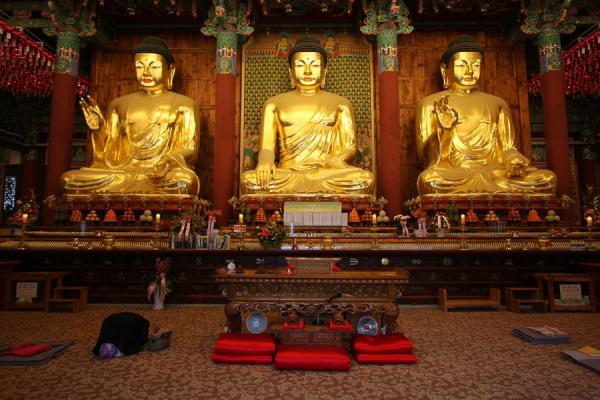
If you've ever visited a Korean temple for more than just the 산채 비빔밥 (mountain vegetable bibimbap), you've witnessed a procession of Buddhist followers removing their shoes, entering the temple doors, bowing three times (or more) in front of a giant Golden statue of Buddha, and leaving. If you ever dismissed this behavior as nothing more than simple idol worship  - lord knows I always did! - you missed the point. Big time.

Although there does happen to be a giant golden statue of a buddha in the temple, and the practitioners do bow in front of it, they are not actually bowing to the statue, or even to Gautama, the one they call the Buddha. (Ok, maybe one or two of them are. But think of them as the crazy lady teetering in front of the train station who blows her nose on her dress.) When you bow in a Buddhist temple, you are bowing to a more tangible buddha - the one inside of you. 

Korean Buddhists bow in two ways:
1. A half bow: Enacted by bending at the waist, palms pressed together in front of chest. Performed at the beginning and end of a full bow sequence, whenever they see a monk (to recognize the buddha inside of them), and pretty much whenever they enter or exit a building on the temple grounds.

2. A full bow: Usually with a thick cushion in front, bowers will press their palms together in prayer position, kneel on the pillow, and lay their forearms and forehead on the ground in front of them. With the forehead still on the ground, they will turn their palms face-up and raise them above their ears. Then back down again, a return to kneeling position, and a roll-back onto the toes and they're up and voila! that's one.


When Korean Buddhists enter a temple (shoes off and through the SIDE door, please - the main door is for monks only!), they find an open spot on the floor, and perform a sequence of three bows (or three half-bows, if they are lazy, handicapped, or tired): one half bow followed by three full bows followed by one half bow. 

Significance: 
For the Buddha (whichever buddha you want, I suppose)
For the Dhamma (Buddha's teachings)
For the Sangha (the community of practitioners)

More dedicated (or bored) followers will tackle a full 108 bows (or more): one half bow followed by 108 full bows followed by one half bow.


Tuesday, September 14, 2010

A Personal Buddha

I had an essay published in this month's edition of The Gyodeung [교등], "The Korean Buddhist Teacher's Association Newsletter"! It was one of five essays printed in the publication, along with three others from actual monks. Since the newsletter editors published the essay in Korean, here it is below in English.

A Personal Buddha
By jonnyontheroad

The place to improve the world is first in one's own heart and head and hands.
– Robert Pirsig

I grew up in a Christian family. We were very active in our church, and until middle
school I attended a small private Christian academy. I read my Bible daily and prayed to God,
and I tried to believe really hard that I would go to heaven. But doubt plagued my mind. Hell
is a terrifying place to imagine, especially for a child, and I remember days from my
childhood when I was sick with fear and guilt for the sins I had committed. My doubts
compounded my fear – to doubt means to not believe completely, and didn’t Jesus
say “whoever believes in me shall not perish, but shall have eternal life”? I felt sure that I
wasn’t believing strongly enough. I couldn’t talk to anyone about my uncertainty, because
everyone I knew was in the church. It was unsettling to be a part of a community that didn’t
question what they were taught. It seemed fake and insincere. I believed what Tom Robbins
wrote in Another Roadside Attraction:

Real courage is risking something that might force you to rethink your thoughts and
suffer change and stretch consciousness. Real courage is risking one's clichés.

Later in my life, when I began to learn about other world religions, more questions
arose in my mind. I knew I was a Christian only because I had been born into a Christian
family and dutifully exposed to the faith. What would have happened if I had been born into a
Hindu family in India? Would I have been condemned to eternity in hell by the chance of
birth? Many religions teach the existence of mutually exclusive deities; you can’t believe in
all of them, and if you don’t believe in the right one you’re out of luck for eternity. The
Christian image of God had begun to fade in my beliefs. There were too many good people in
the world to be condemned to an eternity of torture just because they believed something out
of ignorance. And I have met many mean, spiteful Christians who would go to heaven just by
believing something they were taught.

I can’t recall when or where my first introduction to Buddhism occurred, but I
remember being drawn to the idea that certain eternal truths reside within all of us. They
cannot be taught by someone else or read in a book – we have to realize them for ourselves
through insight and reflection. According to Alan Watts, a British philosopher, “Buddhism
has in it no idea of there being a moral law laid down by some kind of cosmic lawgiver.”
Even the Buddha said, in one of his most powerful and meaningful quotes,

Do not believe in anything simply because you have heard it. Do not believe in anything
simply because it is spoken and rumored by many. Do not believe in anything simply
because it is found written in your religious books. Do not believe in anything merely on
the authority of your teachers and elders. Do not believe in traditions because they have
been handed down for many generations. But after observation and analysis, when you find
that anything agrees with reason and is conducive to the good and benefit of one and all,
then accept it and live up to it.

Though I have never considered Buddhism to be a religion – rather, a guide to living – the
Buddha is nonetheless a religious figure. And what could be more honest and unpretentious
than a religious leader who tells his disciples not to believe anything he says, but to put it to
the test? And so I did.

In 2006 I was invited to participate in a 10-day Vipassana retreat in Nairobi, Kenya.
I had never really meditated before (“meditation” was something of a bad word in my
childhood church, akin to “New Age” or eastern religions), but I believed in the power of the
mind and was eager to try. 'Meditation' used to conjure up in my mind images of relaxation,
of peace and tranquility. It was, perhaps, an old man seated by the bank of a bubbling river, contemplating its nature, or a long-haired hippie in a commune, visualizing peace and
harmony for all of mankind. I thought that a 10-day retreat would give me time to myself, to
clear my mind and figure out answers to some of the questions that had been bothering me
lately. I never thought that I would actually be asked to work.

'Vipassana,' 'insight' in the ancient Indian language of Pali, is what the Buddha
called the technique of meditation 2500 years ago that led him to his enlightenment. His
enlightenment was basically the revelation of the truth of nature; impermanence, or change.
Most people would probably contemplate this for a few moments and shake their head. Duh!
This is a simple concept to understand. But the Buddha didn't just understand this idea at an
intellectual level. He understood it at an experiential level within the framework of his own
body, through careful, constant self-observation. This experiential understanding is the goal
of Vipassana, and it resonated with me more than anything I had learned before in my life.

We practiced seated meditation for 11-12 hours per day, beginning with ‘anapana’,
or ‘breathing’ meditation, and progressing to an hour-long ‘determined sitting’, during which
we were asked not to move at all. It was excruciating at times. After an hour of sitting in one
position, my knees felt like they had been beaten with a sledgehammer and my back was a
spasm of fireworks. At first I was skeptical. But I stayed, and gave it a chance. This was the
teaching of the founder of Buddhism, Gautama the Buddha. I figured ten days wouldn't hurt,
though after the second and third days I have to say I felt like bolting. But I stayed, and I
learned. The Buddha said “It is a man's own mind, not his enemy or foe, that lures him to evil
ways,” and I practiced meditation with a pure mind and heart. When I became distracted or
angry thoughts entered my mind, I practiced equanimity. My resolve became stronger, my
mind clearer. For a few beautiful moments I existed in the present and only the present,
without thought of the past or the future, and I began to understand what Jesus meant when he
spoke of heaven.

Monday, November 16, 2009

Bulguksa and Seokguram in Gyeongju

A month ago Lisa and I went on a short road trip to Gyeongju with our friends Bruce and Susie (aka Suji). Gyeongju is well-known throughout Korea as a "museum without walls" - it remained relatively untouched by 16th century Japanese invasions and the destruction of the North Korean army during the Korean war, and many relics from its heyday as the capital of the Silla dynasty remain. It's a haven for UNESCO world cultural heritage. And though it is only a hop skip and a short 30 minute drive (or 1 hour bus ride) from Pohang, Lisa and I haven't really spent much time there. We had attended a templestay at Golgulsa, just outside of Gyeongju, during Buddha's birthday this year, but only spent an hour or so walking through the burial mounds and taking pictures of "asia's oldest observatory."
asia's oldest observatory

This time we went to visit Gyeongju's oldest temple, Bulguksa. It is both a UNESCO world heritage site and the Korean government's "Historic and Scenic site No 1". It doesn't get much more significant than that, huh? It was originally built in the 700's, and though its wooden buildings were burnt down by the Japanese during the late 1500's and rebuilt over the next 200 years, most of the stone structures are original. The stone foundation on which the temple buildings sit look ancient, their edges worn down slowly by a millenia or more of wind, rain, monks, and grubby fingered child tourists.

Bruce and I peered through crevices in the wall like said tourists, scanning for the torn brown edges of a scroll or other treasure slipped in the cracks by a monk a thousand years ago. All I found was a Japanese coin from 1970. I put it back, just in case the owner had left it as a prayer or blessing. I didn't want some Japanese family blaming me for their misfortunes.

It really is an impressive temple, very simple in its construction and layout. The main entrance to the temple is no longer used in order to preserve the ancient granite staircase that leads to the temple doors. Its 33 steps represent Buddhism's 33 heavens, each one carrying you further on your path towards enlightenment. Most of the stones in the steps and the bridge below are from the original temple construction in 750.

Two things impress me greatly about Korean artifacts such as Bogyeong temple. One is their dizzyingly old age. Nothing in the US comes close. Korean heritage sites are easily 1,000 years older than the oldest piece of history in America. The second is the freedom allowed to tourists. Though the main stairway was off-limits, it was protected by a metal fence that didn't even reach my knees. As I stood in front of it, gaping like a schoolboy, a child hopped over the little fence and sat on it for a picture. My immediate reaction was one of reproach - "That's off-limits!" I wanted to scold - but when I looked around I realized I was the only one who cared. I suppose when something is that old there's no real point in worrying about it. The stone has lasted through 1400 years filled with much worse.

The same artifacts in the US would be closely guarded, and shielded from the curiosity of the public - perhaps because our history is so shallow. We don't have thousands of historical gems that we can trust to survive beyond us. And maybe I've bought into the stereotype of the ugly American, but I imagine that, if given the chance, most of us would probably try to carve our names into a 1500 year old piece of granite rock.

Right, the temple. The weather was beautiful, and it was consequently quite crowded. The famous stupa Dabotap, which is featured on the 10 won coin (not that anyone even glances at that worthless piece of metal anymore), was under renovation and I didn't bother to climb to scaffolding to get a look around the canvas. There were other equally stunning moments, like the rusted dragon-head handles on faded red doors, or the sun-streaked field crowded with stone cairns. Life's pleasures are in the details, I say.


Nestled up in the hills above Bulguksa is Seokguram Grotto (Korea's 24th national treasure and another UNESCO heritage site), which houses a giant Buddha statue erected in the mid-700's. It was a 20 minute drive and 15 minute hike up to the site. There is also a hiking trail directly from Bulguksa that is supposed to take about an hour (it's a more direct path than the road).
Though I respected the request not to take pictures inside, clearly someone didn't, and you can see the picture here.

Monday, November 09, 2009

More rice cakes!

On Thursday the 3rd grade students will take 수능, the Korean version of the SATs but with a lot more at stake. If their scores aren't high enough, their career options will be limited. Teachers and parents have been swarming to Buddhist temples in recent weeks to pray for their children's success on the exam. Mrs. Yoon, one of my co-teachers and a sometimes-Buddhist, told me that she had never bowed to a statue of Buddha before, and had to look up the procedure online before she visited the temple with her father. I don't know what would happen to her son if she messed up the prayer.

Today everyone in school received sticky rice cakes as a sort of good luck charm for the third graders. The sticky rice is supposed to make good fortune stick to the students so they can enter the university of their choice.

Since Koreans also love to give rice cakes as gifts to celebrate success, I betcha I can guess what will happen after exam results come back and we find out how many students got the grade they were hoping for.

Monday, June 22, 2009

Beating Your Meat (Or, "Dogs as Food in Korea")

Though not a staple of the Korean diet by any stretch of the imagination, dog meat is popular among a small subset of the population here. Older men are particularly fond of it, as it is a widely held belief among dog meat fans and foes alike that it boosts "stamina" - Koreans' not-so-subtle term for sexual energy. It is most often served as dog meat soup (보신탕), though most 보신탕 restaurants also serve a side dish of steamed dog skin (which is just about as appetizing as it sounds).

Many Koreans have never eaten dog meat, and they'll usually cite one of the following three reasons for their avoidance of it:

1) They love dogs.
I think it's safe to say that this is why most of the Western world dry heaves at the very notion of eating dog meat. It's tough to conjure an appetite when you picture the cutest, cuddly (& very anthropomorphised) puppy you've ever seen, roasted on a stick.
This seems a weak argument to me, if the thought of eating meat doesn't already make you cringe. (The t-shirt's vegetarian campaign seems equally as likely to backfire.) Dogs are popular pets because they exhibit traits we look for in friends - they are loyal, affectionate, and can usually be trained not to poop on the couch.

Any animal can be made to look cute enough, if you take it out of its natural habitat and give it a bath and a ribbon, or if it is small enough.

2) It's cruel.
I only found out how the dogs are killed after my second trip to eat 보신탕 with a co-teacher. I had, perhaps naively, assumed that dogs were slaughtered as humanely as possible. But because the meat is especially prized for its stamina-inducing properties, butchers prefer to kill dogs at their most energetic, so that customers get the full effect of the dog's adrenaline. According to my co-teacher (on whose sole testimony this account is based, and who eats dog regularly), some butchers will torture a dog briefly before smashing its head on the ground. This supposedly kills the dog instantly, trapping the dog's adrenaline in its meat.

According to this 2001 article from the BBC, however, violent forms of dog execution have been banned, and they are now "instantly killed by electrocution." But, until late 2008, dogs weren't considered livestock (to do so would be to actually admit their "problem" to the world), so it has been difficult for the government to control their treatment. Now, having changed their designation, the government is trying to crack down on illicit dog meat vendors.

If you can stomach it, here is a photo gallery of some of the abuses suffered by dogs in markets in Korea and elsewhere: http://www.all-creatures.org/anex/dog.html. Keep in mind that many animals consumed in the US routinely undergo similarly cruel treatment.

3) They're Buddhist.
Korean Buddhists don't eat dog meat, and this accounts for almost a quarter of the population. While I had most often heard that Korean Buddhists consider dogs to be sentient beings (though dogs seem to be alone in the animal kingdom as deserving of that status), I was recently told of another, more entertaining and mythical story that started like this: "Korean Buddhists believe if they eat dog meat they will die." Dissatisfied with such an outlandish, cursory statement, I pressed for an explanation, which follows:

The kings during the Joseun dynasty, motivated by Confucian teachings, banished Buddhists from practicing their religion in the country. As a result, temples were moved high into remote hills where they were hard to locate and destroy. Practicing buddhists were forced to journey through still-wild, forests - at that time still home to giant Korean tigers - in order to reach their religious grounds. Tigers, apparently, love dog meat, and can smell it even on the sweat of a man who has recently consumed it. They would not hesitate to kill a man to sate their hunger for dog. Buddhists quickly learned to abstain from eating dog meat, lest they be killed by mistake.


Wikipedia will also tell you that dog meat has been illegal in Korea since 1984, which, if true, would probably do something to keep dog consumption down. Other articles suggest that it was the Seoul city metropolitan government that banned the sale of dog (and, incidentally, snake) meat, not the entire country. Regardless of the national government's "official" stance on the issue, personal experience tells me that the dog meat industry is wholly tolerated as a serious business. No attempt is made to hide the consumption from anyone other than foreigners. Most Korean fans of dog meat, upon hearing a foreigner's mention of it, will usually deride it blithely and pass it off as an unusual custom. Once you express any openness to the idea of eating dog meat, however, the same Korean will openly admit their passion for it and will invite you for supper, and probably lunch the next day. Ever since the '88 Olympics (and subsequently the 2002 World Cup, co-hosted by Korea and Japan), when the Korean government first suggested a willingness to shun dog meat as an official policy, the Korean dog-eating populace has gotten the hint: keep it on the down low, and you can keep beating - and eating - your (dog) meat.

Wednesday, May 13, 2009

Templestay on Buddha's Birthday


Back in 2002, when Japan and Korea were preparing to co-host the World Cup, monks from several temples around Korea met to discuss an idea to increase Korea's tourist hosting capacity while simultaneously improving awareness of Korean Buddhism. The templestay program that they developed has grown in success since then, and is now a major tourist attraction promoted by the Korean Tourism Organization. There are now dozens of temples throughout Korea that offer templestays ranging from one night to over a month.

Since last Saturday, May 2nd was Buddha's birthday (부저님 오신날), Lisa and I decided there was no better time to do a templestay. It turns out that we were wrong - there definitely ARE better times to do a templestay, but I'll get to that later. Few temples actually offer templestay programs during Buddha's birthday because they are usually crowded with tourists during this hectic time, but we found one, Golgul Temple (골굴사), that was taking reservations. One of my co-teachers, when she found out that we were interested in a templestay, rushed to print out information on all of the temples within an hour of us that had templestay programs. Golgulsa was one of them, and sounded like one of the coolest.

The temple is into a hillside, the original 6th century temple building having been built out of solid rock and a series of caves, that slopes up a rocky embankment to an ancient carving of a Maya Tathagata Buddha. When Seol Jeog-un, Golgulsa's Master Monk, re-discovered the site in the late 70's, the temple was in a state of serious disrepair. There were no roads that led to the temple site, and the Buddha carving was quickly being eroded. So he began the renovation process, installing a new temple building, several boarding quarters, and other buildings to support a full-time monk contingent. He also had built a protective covering over the Buddha carving to retard the erosion process.


Seol Jeog-un is also largely responsible for the re-introduction of the ancient Korean practice of Sunmudo, a silent, meditative form of martial arts, and Golgulsa is now basically the headquarters for the practice. According to the Sunmudo website,

Golgulsa temple's Sunmudo is different from martial arts in that it is silent training, teaching Zen-meditation, Yoga, and the techniques of Buddhist moving meditation. The harmony of inner energy and physical strength is attained through a balanced combination of these slow meditative movements with selfdefense and fighting technique. Zen Buddhists believe that exercising both the mind and body in this way leads to good health, inner peace, and ultimately enlightenment. The opportunity to practice this philosophy and to experience life in a traditional Buddhist temple attracts martial artists and truth seekers from around the world to Golgulsa.
Here's a good video introduction to some Sunmudo movements. (The white guy in the video was actually in the Golgulsa Buddha's Bday celebration ceremony.)

We arrived just shy of 3pm on Saturday afternoon, when the Buddha's Birthday celebrations were to begin. We made the 15 minute climb from the temple gate up the hill to the temple grounds, which were bustling with people. As Buddha's Birthday approaches, every temple in Korea decks itself out with rainbow strings of lanterns, and Golgulsa was no exception. The walkway up to the temple was lined with lanterns, and the entire rock hillside to the right of the main temple was draped in a heavy coat of them.
These guys were guarding the gate. I suppose 18-pack abs is normal for Sunmudo monks.

The Sunmudo demonstration took place on a large wooden platform directly in front of the main temple, that rose 30 feet above the hillside beneath it. Throngs of people surrounded the platform, and even climbed the rock wall to stand beneath the stone Buddha to watch the presentation. A row of six monks, dressed in grey and black, sat silently on the back edge of the platform. A golden buddha was placed to the left, on granite altar of sorts, surrounded by candles and heaps of fresh fruit, and when Seol Jeog-un arrived with his baby monkey he sat on a large yellow pillow directly in front of it. (That's right, he had a baby monkey. I don't think I was more jealous of anyone in the world at that exact moment. He's going to teach the monkey Sunmudo!)
The monks demonstrated several Sunmudo movement progressions, and a couple of elegant, elaborately dressed women danced.


After the celebration, most of the visitors disappeared quickly, and Lisa and I went back to the main office to register for the templestay. Buddha's Birthday proved to be a popular time for Golgulsa, as there were about 12 foreigners in total signing up for the night. Another 6-8 Koreans also joined us, though they apparently stayed in different quarters. After reading through the usual templestay schedule, we were told that most of it didn't apply. "Because of Buddha's Birthday, all of tonight's activities will be canceled." Which meant that we would miss out on the 90 minute evening Sunmudo session and meditation, and in its place we would eat a lot of fruit in honor of the Buddha. Kind of a gyp, if you ask me. (We still had to pay the full 40,000 won participation fee.)

The biggest benefit of staying the night on Buddha's Birthday was the lanterns. After nightfall the monks scattered around the temple grounds, connecting wires and flipping switches until all of the lanterns on the property were illuminated. As the darkness settled into the mountains, the thousand-or-so glowing globes seemed to float along the hillside, gently hugging the temple and ancient stone Buddha carving.


It was beautiful. But we didn't have to do the templestay to see it - we could have just hung around after the show. Even without the Sunmudo training, though, when we laid down on our thin blankets on the hard wooden floor of our dorm, we quickly fell asleep.
In the morning, a monk came to our sleeping quarters at 4am with a stick and wooden gong - our alarm bell. He stayed outside of our respective rooms (men and women sleep separately) until he saw our lights flicker on, and then began his slow trudge back up the hill to the temple in the morning rain, the hollow sound of his gong echoing as he disappeared. We followed closely behind, careful to get to the temple on time. A note on our schedule demanded punishment for missing the 4:30 deadline: 3,000 bows. (This seemed to be more a playful than actual threat; there was a similar warning posted on our bathroom door, requiring 1,500 bows for flushing toilet paper down the toilet.)

From 4:30 - 5:00am, we sat in a small, dim alcove under the main temple while the monks chanted to the rhythm of the gong. It was mesmerizing, and for the rest of the day the rise and fall of their deep voices would be ringing softly in my head. After chanting, we spent 30 minutes meditating, though the monks didn't give any instructions about what we should focus on during the meditation, a point I thought could use review in the future, particularly for first-time meditators. Perhaps, as monks, their meditative process is so ingrained in them that they don't think of mentioning it to others.

Next we were supposed to do "walking meditation" but it was still raining outside so we were led through 108 bows instead. A monk stood behind us with the same wooden gong that served as our morning alarm, and he hit it once for every required bow. From a standing position, we would kneel, then prostrate ourselves forward, then back to kneeling, then stand up just in time for the next gong to sound. 108 times. It sounds excruciating, and it was at first, but after a while it was easy to get into a rhythm. We had been instructed by another, long-term templestay participant, to focus during each bow on something that we are thankful for in our lives, or something we would like to change. For the first dozen or three bows, all I could think about was how clumsy I felt, and how much my knees were going to hurt. But eventually my body took over the mechanics and left my mind free for meditation, and I closed my eyes.

After a hot breakfast of soup and vegetables, we had our first Sunmudo training. (It would have been our second, had we not visited during Buddha's Birthday.) Golgusa has a really nice Sunmudo training center which looked pretty new, with beautiful dark wood floors and giant windows that looked out into the surrounding woods. It was a very peaceful place.

On the wall hung pictures of Seol Jeog-un in his younger days, demonstrating his athleticism and prowess. It was quite impressive.


The first 60 minutes of the training were spent in postures very similar to those of hatha yoga, though they seemed fairly intense for a first day introduction to the practice. Borim, the monk that led us through the 90-minute session, was an 11-year Sunmudo veteran, having practiced in Seoul for 10 years before his full-time move to Golgulsa, and he didn't waste any time throwing his body into different twisted positions. Several templestayers gave up trying completely and just sat on their mats, watching him.

During the last half hour we moved into the martial arts. Borim quickly wore us out, leading us through quick successions of punching, kicking and jumping movements. During the final few exercises he slowed us down and we worked on channeling our energy through concerted and precise motions. I quickly went from a feeling of exhaustion to one of power and control, one that I have rarely felt in my life. It was an amazing transformation, and I finished the session feeling energized and refreshed. Even when we discovered we had another 108 bows left, I was unfazed, and my mind quickly slipped back into the meditative state it left at the end of the last 108.

After lunch, we showered and left. The soreness hit both of us like a train the next morning, and lingered for several days. As slighted as we felt having missed the evening Sunmudo session on Saturday, it was probably for the best. Even 90 minutes of training was exhausting.

For future templestays, we'll plan to go during the week, when there are fewer other tourists, and for a longer period. Judging from our experience after even one night in the temple, an extended stay would be a welcome retreat, relaxing and invigorating at the same time, much like the 10-day buddhist retreat I attended in Kenya. But definitely more physically demanding.

Wednesday, May 06, 2009

Exam Week

Last week all of the students at Idong High School had midterm exams, so I didn't have any classes. I still had to come to school, though, so I tried to spend the week working on lesson plans. I had a moderate amount of success (damn Facebook). The school day was shorter than usual; exams finished up around 1:20pm every day, so the teachers had social plans for every afternoon/evening. First floor teacher lunch one day, tennis club another day, etc. The English department had lunch on Monday afternoon at a sushi buffet. It was awesome - 15,000 won for all you can eat sushi and sashimi.


Maybe this is just a Korean thing - for some reason they throw really sweet stuff on otherwise savory dishes. Yet when it comes to actual desserts, they leave the sugar out (ie. rice cakes). Here is an example of what I mean:
That's whipped cream and sprinkles on a sushi roll.
Two of my faves: Mrs. Lee and Miss Hong. Miss Hong has loads of energy and is always laughing and clapping. It's hilarious and contagious. Mrs. Lee is more reserved, but she has a really generous heart. She also smiles shyly when she's nervous in a way that makes me think of puppies and hugs.

More faves. Miss Hwang, Mr. Lee (not Mrs. Lee's husband), Mrs. Yoon. Although I don't actually teach any classes with Miss Hwang (she's 3rd grade), I see her more than almost anyone else. She is very curious about English, and is always coming to my office with questions (instead of "Given that...", can I say "When we are given that..."?). She has also taken it upon herself to teach me Korean. We have class every Friday after lunch, when she quizzes me on the words she taught me the week before. Mr. Lee always explains random bits of trivia to me, like Winter's Envy. He also loves dog meat, and has taken us out a couple of times for bo-shin-tang (dog meat soup). Mrs. Yoon (Yoon Soon Yung, not to be confused with the other Mrs. Yoon, who I call "Mrs. Yoon with the broken arm", because I can't remember her other names) is my main co-teacher, and is amazing. She is the head of the English department, and is therefore ultra busy, but whenever I ask her a question she stops whatever she is doing at the moment to take care of my concerns. She's a superb sort of adoptive mother.


On Thursday we had a school-wide teachers outing. We drove 30 mins outside of Pohang to O-eo-san (O-eo mountain) for lunch and a hike. Everyone carpooled, which was really convenient until some teachers decided to leave halfway through without telling me and almost drive off with all of my stuff in their backseat. We ate at a secluded restaurant, with the place to ourselves. We had a choice between three kinds of bulgogi: Duck, goat, and beef. It definitely wasn't a vegetarian-friendly meal. I chose the duck, and it was delicious. So tender and spicy. We cooked it in the pot and shared it among four people, along with the side dishes and lettuce and mint leaves to wrap it in.


After lunch some of us went on a hike, which turned out to be much farther than I expected - about 3 hours round-trip. I thought it would be 1 hour max. The rest of the teachers went home, or stayed behind and gambled and drank.

Before we started the hike, Mr. Hong, the PE teacher, handed out snacks to everyone. Cherry tomatoes, a banana, a granola bar, and a bottle of
Mr. Hong is my tennis coach. He's also very interested to practice his English with me, though at times it's excruciating watching him smack his head and try to remember simple phrases. His enthusiasm is welcome, though. He really likes me, and always tells me to call him "hyeong nim", which means big brother. He's 32.
Halfway into the hike we stumbled upon a temple, high in the hills. They were getting ready for Buddha's birthday, and had strung up a rainbow of lanterns along the hillside. It was a beautiful, serene atmosphere.
Apparently the mountain was also used as a training ground for the Korean marines. It seemed strange to me that marines would be carrying out ops in the hills behind buddhist temples, but my teachers assured me that there was no combat involved. They also did a lot of trail maintenance - in particularly steep stretches, the marines draped thick ropes up the hillside to assist climbers.

A large gazebo sort of structure sat at the top of the mountain, with stunning, panoramic views of greater Pohang.
All of the teachers were in good spirits.

We flew back down the hill in half the time it took us to get up. At the bottom of the mountain, we took a few minutes to wander through O-oe-sa (O-oe temple), a famous Korean buddhist temple.
Lee Myung Bak, Korea's President, even sponsored a lantern here.

Built during the Silla dynasty, it was rebuilt in 1741. It was a small temple, but seemed to be popular. Many visitors would buy prayer beads and drape them over the plethora of Buddha figurines that sat on every available rock face.


When we finally got back to the restaurant, the rest of the teachers were good and drunk, and wanted to play Sepak Takraw. Actually a modified form of the Southeast Asian game, Korean men love to play it on tennis courts. While there are no flips or bicycle kicks involved, I've seen some pretty impressive high roundhouse aces. All Korean men, after all, served two years in the military and spent at least some of their childhood, no doubt, practicing Tae Kwon Do. Most of the teachers, though, could barely walk, much less kick a ball over a tennis net, and the game eventually devolved into what seemed to be a contest to see who could make the wildest, most hilarious attempt to make contact with the ball.
It was a long, fun day. The teachers spend so much of their time cooped up in school that when they get the chance to let loose, some of them go hog wild. It's funny to see many of them outside of the school environment, without suits and ties, and for the next several days there is a general bonhomie shared amongst all of the teachers, a silent smile that, luckily for me, doesn't require any words.
Related Posts Plugin for WordPress, Blogger...