Showing posts with label korean beliefs. Show all posts

Friday, November 26, 2010

Evil Spirits: They hate red beans

Yesterday, one of my co-teachers moved into a new apartment with her family. Today, following the Korean custom to ward off evil spirits, she made red bean rice cake [시루떡] for everyone.


According to another teacher, this tradition can be traced back to the Silla dynasty, when Seol Chong [설총], son of the famous monk Wonhyo and princess Yoseok, used red beans to eradicate evil spirits (called dokkaebi in Korean) from his house.

Dokkaebi [도깨비] are mischievous mythical creatures said to be the transformed spirit of inanimate objects. They were traditionally depicted with only one leg, probably because of the belief that they were the embodied spirit of useful objects that had been misused or neglected, like a broom.  Nowadays they have two legs - because a one-legged monster isn't really that scary. They love to play pranks and tricks on people, or challenge wayward travelers to wrestling matches. (A one-legged wrestler isn't too believable now, is it?)

Legend has it that Seol Chong once returned from a battle or something to find that an evil spirit had slept with his wife. (Apparently his broom wasn't the only thing that had been feeling neglected lately!) His first reaction, apparently, was to whip up a batch of red bean rice cake, which scared the...ahem!...mischievous spirit away. As he later bragged about this feat to his neighbors, a legend was born (along with, perhaps, an illegitimate child).

And that, folks, is how traditions begin. Kinda like Christmas!

Thursday, October 21, 2010

A Korean Fortune - Saju [사주]

I am a flower. I have lots of water in me. I should seek fire and trees and mountains. South and East are good directions. 2014 will mark the beginning of a good time for me. I shouldn't have more than two children (though if I want more, adopting is OK). I know this, because my birthday tells me so.


Saju [사주], or "human's life", is an ancient form of Korean fortune-telling which uses your birth date and time to reveal aspects of your personality and character, including predilections, positive attributes and talents, and needs. It is based on five elements that are said to make up all things:

  • water
  • fire
  • earth
  • trees
  • metal
The Chinese characters that represent these elements also have corollary meanings, like animals, directions, and family members, so the reader can glean answers to many of the client's questions from the eight original characters formed by their birth date.

Many Koreans believe strongly in the power of the saju, and consult theirs regularly in times of change, particularly before a big move, job change, or prior to a wedding, to see if they or their children are compatible with the spouse-to-be. The fortune teller, or reader, will often become a sort of counselor to her clients, advising them on a particular action based on the revelations in their saju.


On the 6th floor
of Home Plus (CGV) next to the shiwae bus terminal in Pohang, two fortune tellers spend their evenings behind lace curtains in cozy plywood huts, reading birth dates and tarot cards for a steady stream of customers of every age.
Saju consultation: 9,000 won.
Tarot reading: 4,000 won.

I went to visit Min Jung, my friend Tony's girlfriend, who has been studying saju for four years under the tutelage of a 75 year-old buddhist monk living in the mountains around Gyeongju. Min Jung is an incredibly peaceful, yet warm person who I immediately felt comfortable around. We had been rock climbing together on a couple of occasions before, so I already knew her from those outings as well.

She invited me into her small "office" and pulled two giant tomes off of the small bookshelf beside her chair. She asked my birthdate and time, spent a few minutes consulting the books, then drew two rows of four Chinese characters on a blank sheet of paper with a calligraphy brush. She spent another few minutes whispering to herself while she circled characters and drew lines between them, writing other characters beneath them with numbers and dates.

When Min Jung had finished, she began to describe my "human's life". Saju is not "fortune-telling" in the sense that it reveals your future (although Min Jung did tell me that from 2014 would be a good time for me, and that I would be healthy into old age), but rather a picture of your character and how you relate to the world around you. Your character affects your future, though, and your saju can tell you what factors to consider when it comes time for a decision - where you should go, what kind of job you should hold, or what kind of person would be good for you to marry. I asked her questions about food I should eat (stay away from pork, eat lots of leafy greens), sports I should play (be careful with water sports), people I should befriend (look for fire, trees, mountains in others), colors that are bad for me (black and white).

I left feeling quite good, but unsure how I felt about saju and Korean fortune telling. Most of what Min Jung told me about myself I believe, but not because my saju told me I am that way. I believe it because I have already witnessed it in my own life - it confirmed much of what I already knew about myself, or what I felt but had never put words to before. I don't consider myself a very superstitious person, and I definitely don't believe in fate. But I was surprised at the accuracy of my saju, and everyone I know who has heard theirs has felt the same way. For now, I guess my jury's out - not that it matters, in the end. Beliefs are only shadows, after all, of what really is.

Tuesday, October 12, 2010

A little off the top

I have been spending a lot of time lately in self-reflection and meditation, trying to address my weaknesses and shortcomings. Trying to be the man I want to be. One of the biggest obstacles I face on a daily basis is my ego; the part of me that attaches itself to material or physical possessions; the part of me that is selfish and proud and greedy.

On Friday I shaved my head.

Yesterday I arrived at school to students and teachers agape and gasping, as Koreans are never shy to do. They're the kind of noises and stares that are impossible to interpret, that contain no judgment, that mean only that something interesting is happening.

One of my students was not so ambivalent. "WHY?!!" He practically screamed at me. "I don't understand why you cut off all of your hair!!" He seemed to be on the verge of tears. I tried to explain how convenient the hairstyle can be, how I can roll out of bed without worrying about a bad hair day. He couldn't understand. He loved his hair. He appeared to be genuinely distraught.

Mr. Lee, one of my co-teachers, saw me in the hallway today. "In Korea, when someone gets a drastic haircut like that, we say that their character has changed." I smiled, thinking of my own attempt to influence my character in recent weeks, but then I thought again. Changed in a positive or negative way? "Usually negative," he replied, chuckling.

Sunday, September 19, 2010

108 Bows (108 배) : Korean Buddhism

Korean Buddhists bow a lot.

It's a meditative practice that encourages reflection and concentration. Though three bows is common, the more dedicated followers often practice 108 bows [백팔배], a long tradition whose number is particularly significant for the following:

There are 6 bodily pathways that lead to suffering: eyes, ears, skin, nose, tongue, mind.
There are 6 objects that lead to suffering: something you see, hear, feel, smell, taste, think about.
There are 3 time periods in which you suffer: the past, the present, and the future.

[6x6x3 = 108]

(the interpretation may depend on the temple you visit, though, and other explanations may differ slightly.)

108 sounds like a heck of a lot, I know. It is. And though it feels a little awkward at first, you get into a rhythm pretty quickly. The whole thing takes about 20 minutes.

I've done 108 bows several times in templestays or at a meeting for Buddhist teachers that I was invited to. Every time, though, they put on a recording of a deep-throated man lyrically chanting 108 prayers in Korean over a meditative soundtrack made up of a flute and bird noises.


Though I was told just to "focus on things you want to change in yourself", I always kind of wanted to know what the guy was saying. I didn't want to think I was bowing all along to commit my soul to Kim Yun-A or something (though I would. Oh GOD would I).

Over the weekend I did another templestay at Golgulsa, and finally got an English copy of what (I think) the Korean man with the nice voice is actually saying. Some are more abstract than I would prefer (hard to focus on), and many are just not practical, but I imagine it still affects your mindset positively, much like visualization or repetition.

If you have knees, I highly suggest you try it. I can even send you an mp3 file of myself reading the list if you need motivation. (Visit this page for a video instruction on bowing.)

My personal favorites are #8, 25, 31, 34, 50 and 104. I bow, uh, extra hard when those come up. I think it goes without saying that I love #11, too, because - let's be honest (Buddha wants me to be HONEST, right??) - I really, really love myself.

Leave me a comment to tell me your favorites, or which prayers you wish Buddha had put on the "bow list".

108 Bows
Before bowing, I prepare the proper mindset:
- Bowing is one way to purify myself.
- Through bowing, I learn how to humble myself and how to have a healthy body and mind.
- I bow to realize that others' lives are just as valuable as mine.
- I bow to get rid of my selfishness.
- I bow because it is the desire of my true self.
- I bow for all living things, and for peace in the universe.

1. I bow to wonder where I came from and where I am and where I am going.
2. I bow to appreciate my parents for giving birth to me.
3. I bow to think about who I am.
4. I bow to find my true self.
5. I bow to always appreciate my body and spirit.
6. I bow for the well-being of my body and spirit.
7. I bow to think about my true desires.
8. I bow to find myself and to learn how to control myself.
9. I bow to appreciate the life I live today.
10. I bow to give thanks for being alive.
11. I bow to think about how much I love myself.
12. I bow to be able to always love my family.
13. I bow to feel happiness and peace of mind through love.
14. I bow to look for happiness only through love.
15. I bow to know that unchangeable love is flowing through the universe.
16. I bow to the teacher who has shown me the right way.
17. I bow to feel that love originates inside me.
18. I bow to reflect that my teacher's lessons are inside me.
19. I bow to feel that all living things, and the universe, are inside me.
20. I bow to remember that my ancestors and gods are inside me.
21. I bow to ask for forgiveness from the people I have hurt, because it hurts the whole universe.
22. I bow to take care of myself and not to do bad things.
23. I bow to rid myself of arrogance.
24. I bow to rid myself of false humility, even if I am in bad circumstances.
25. I bow to call attention to the good in others, but not the bad.
26. I bow to keep others' secrets.
27. I bow to rid myself of hatred of others.
28. I bow to rid myself of anger against others.
29. I bow to not repeat anything I have not heard.
30. I bow to not repeat anything I have not seen.
31. I bow to always be ready, but not to expect things to be easy.
32. I bow to avoid expecting obedience from others.
33. I bow to avoid expecting difficulty in my life.
34. I bow to make the best of each moment in my life.
35. I bow to live a righteous life.
36. I bow to repay even the smallest debt of gratitude.
37. I bow to not put my own needs over the needs of others.
38. I bow to not be stingy to others.
39. I bow to not harm others in order to get ahead.
40. I bow to try not to obtain valuable things with little effort.
41. I bow to have the power to control my desires.
42. I bow to reflect that life is more valuable than anything else.
43. I bow to know that suffering comes from an attached mind.
44. I bow to avoid making foolish mistakes out of ignorance.
45. I bow to try to attain deep wisdom.
46. I bow to learn to be nice to people, even if I have negative feelings toward them.
47. I bow to avoid clinging to the strong in order to hurt those who are weaker than me.
48. I bow to be honest with myself, and also to avoid flattering others.
49. I bow to be true and honest with myself above all others.
50. I bow to know that happiness, unhappiness, and desire are all within my mind.

51.  I bow to know that happiness does not come from others, it comes from me.
52. I bow to realize the value of living a smooth, peaceful life.
53. I bow to avoid looking back at the past, and to not worry about the future.
54. I bow to own possessions, but not to be controlled by them.
55. I bow to know that I can find peace by being patient.
56. I bow to know that having a repentant mind is the best mind.
57. I bow to find freedom through wisdom.
58. I bow to control my mind, not to be controlled by it.
59. I bow to be diligent in my efforts to improve myself.
60. I bow to be thankful for the hard times I have had, because they have made me strong.
61. I bow to keep my original pure mind, even when time passes.
62. I bow to pray with a thankful mind for everything.
63. I bow to be thankful that I can find myself in silence.
64. I bow to reflect on the value of living a pure, honest life.
65. I bow for the people who are working in bad conditions.
66. I bow for the people who are starving, poor, and living hard lives.
67. I bow for the people who work to provide me with healthy food.
68. I bow to have a generous mind, even if I don't have enough for myself.
69. I bow for the precious lives of my children, who I have brought into the world.
70. I bow for my partner, who became one with me through love.
71. I bow for all disabled people.
72. I bow for friends who have been beside me, sharing my laughter and tears.
73. I bow for moderation, even when I have enough to waste.
74. I bow for a humble mind.
75. I bow for humility, so that I can always put others first.
76. I bow to realize that nature is being destroyed.
77. I bow to realize that all lives are interconnected.
78. I bow for all the lives destroyed by the greed of humanity.
79. I bow for all the ecosystems that are recovering after being hurt by humanity.
80. I bow to listen to the sounds of life that are all around me.
81. I bow to realize that my life is the movement of my soul.
82. I bow to realize that the object of love and longing is life.
83. I bow to feel my soul being purified when I hear the sound of a clean, clear stream.
84. I bow to give thanks for being able to hear and enjoy the beautiful songs of birds.
85. I bow to be refreshed by the feeling of a cool breeze.
86. I bow to be thankful as I breathe in fresh air.
87. I bow to be thankful for the sight of beautiful wildflowers that are always present.
88. I bow to give thanks for the mountains and landscapes that speak to me through wind and snow.
89. I bow to the Earth, which feeds all living things.
90. I bow to the sky, which gives life to all living things.
91. I bow for my own peace.
92. I bow to hope for peace in everything around me.
93. I bow for the peace of my neighbor.
94. I bow for peace within countries that have been separated for no reason.
95. I bow for peace between countries arguing for political reasons.
96. I bow for peace and harmony among all religions.
97. I bow to hope for peace in all dead and living things.
98. I bow to hope for peace between human beings and nature.
99. I bow for a mind that is enlightened and peaceful
100. I bow for harmony between the poor and the rich.
101. I bow for harmony between the sick and the healthy.
102. I bow for harmony between those who have learned and those who have not.
103. I bow for those who have fallen into darkness.
104. I bow to accept all of the things I have done.
105. I bow to be thankful for all of the people who love me and take care of me.
106. I bow to be thankful for all of the good and beautiful things in my life.
107. I bow to be thankful for my life and to reflect on the lives that are yet to be.
108. I bow for myself, realizing that my own precious life is like the universe.

and if you're still here, I'm thankful for you!

What's up with the bowing? Visiting a Korean temple

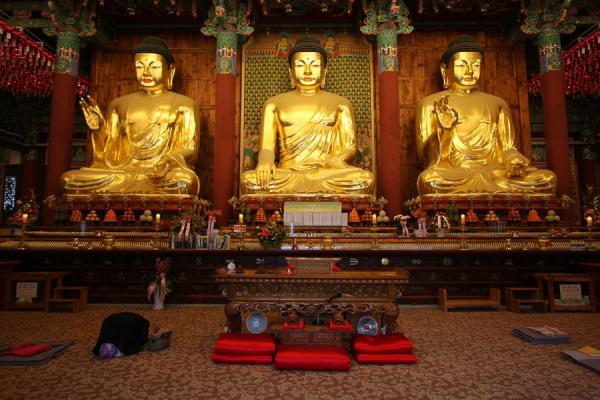
If you've ever visited a Korean temple for more than just the 산채 비빔밥 (mountain vegetable bibimbap), you've witnessed a procession of Buddhist followers removing their shoes, entering the temple doors, bowing three times (or more) in front of a giant Golden statue of Buddha, and leaving. If you ever dismissed this behavior as nothing more than simple idol worship  - lord knows I always did! - you missed the point. Big time.

Although there does happen to be a giant golden statue of a buddha in the temple, and the practitioners do bow in front of it, they are not actually bowing to the statue, or even to Gautama, the one they call the Buddha. (Ok, maybe one or two of them are. But think of them as the crazy lady teetering in front of the train station who blows her nose on her dress.) When you bow in a Buddhist temple, you are bowing to a more tangible buddha - the one inside of you. 

Korean Buddhists bow in two ways:
1. A half bow: Enacted by bending at the waist, palms pressed together in front of chest. Performed at the beginning and end of a full bow sequence, whenever they see a monk (to recognize the buddha inside of them), and pretty much whenever they enter or exit a building on the temple grounds.

2. A full bow: Usually with a thick cushion in front, bowers will press their palms together in prayer position, kneel on the pillow, and lay their forearms and forehead on the ground in front of them. With the forehead still on the ground, they will turn their palms face-up and raise them above their ears. Then back down again, a return to kneeling position, and a roll-back onto the toes and they're up and voila! that's one.


When Korean Buddhists enter a temple (shoes off and through the SIDE door, please - the main door is for monks only!), they find an open spot on the floor, and perform a sequence of three bows (or three half-bows, if they are lazy, handicapped, or tired): one half bow followed by three full bows followed by one half bow. 

Significance: 
For the Buddha (whichever buddha you want, I suppose)
For the Dhamma (Buddha's teachings)
For the Sangha (the community of practitioners)

More dedicated (or bored) followers will tackle a full 108 bows (or more): one half bow followed by 108 full bows followed by one half bow.


Tuesday, September 14, 2010

A Personal Buddha

I had an essay published in this month's edition of The Gyodeung [교등], "The Korean Buddhist Teacher's Association Newsletter"! It was one of five essays printed in the publication, along with three others from actual monks. Since the newsletter editors published the essay in Korean, here it is below in English.

A Personal Buddha
By jonnyontheroad

The place to improve the world is first in one's own heart and head and hands.
– Robert Pirsig

I grew up in a Christian family. We were very active in our church, and until middle
school I attended a small private Christian academy. I read my Bible daily and prayed to God,
and I tried to believe really hard that I would go to heaven. But doubt plagued my mind. Hell
is a terrifying place to imagine, especially for a child, and I remember days from my
childhood when I was sick with fear and guilt for the sins I had committed. My doubts
compounded my fear – to doubt means to not believe completely, and didn’t Jesus
say “whoever believes in me shall not perish, but shall have eternal life”? I felt sure that I
wasn’t believing strongly enough. I couldn’t talk to anyone about my uncertainty, because
everyone I knew was in the church. It was unsettling to be a part of a community that didn’t
question what they were taught. It seemed fake and insincere. I believed what Tom Robbins
wrote in Another Roadside Attraction:

Real courage is risking something that might force you to rethink your thoughts and
suffer change and stretch consciousness. Real courage is risking one's clichés.

Later in my life, when I began to learn about other world religions, more questions
arose in my mind. I knew I was a Christian only because I had been born into a Christian
family and dutifully exposed to the faith. What would have happened if I had been born into a
Hindu family in India? Would I have been condemned to eternity in hell by the chance of
birth? Many religions teach the existence of mutually exclusive deities; you can’t believe in
all of them, and if you don’t believe in the right one you’re out of luck for eternity. The
Christian image of God had begun to fade in my beliefs. There were too many good people in
the world to be condemned to an eternity of torture just because they believed something out
of ignorance. And I have met many mean, spiteful Christians who would go to heaven just by
believing something they were taught.

I can’t recall when or where my first introduction to Buddhism occurred, but I
remember being drawn to the idea that certain eternal truths reside within all of us. They
cannot be taught by someone else or read in a book – we have to realize them for ourselves
through insight and reflection. According to Alan Watts, a British philosopher, “Buddhism
has in it no idea of there being a moral law laid down by some kind of cosmic lawgiver.”
Even the Buddha said, in one of his most powerful and meaningful quotes,

Do not believe in anything simply because you have heard it. Do not believe in anything
simply because it is spoken and rumored by many. Do not believe in anything simply
because it is found written in your religious books. Do not believe in anything merely on
the authority of your teachers and elders. Do not believe in traditions because they have
been handed down for many generations. But after observation and analysis, when you find
that anything agrees with reason and is conducive to the good and benefit of one and all,
then accept it and live up to it.

Though I have never considered Buddhism to be a religion – rather, a guide to living – the
Buddha is nonetheless a religious figure. And what could be more honest and unpretentious
than a religious leader who tells his disciples not to believe anything he says, but to put it to
the test? And so I did.

In 2006 I was invited to participate in a 10-day Vipassana retreat in Nairobi, Kenya.
I had never really meditated before (“meditation” was something of a bad word in my
childhood church, akin to “New Age” or eastern religions), but I believed in the power of the
mind and was eager to try. 'Meditation' used to conjure up in my mind images of relaxation,
of peace and tranquility. It was, perhaps, an old man seated by the bank of a bubbling river, contemplating its nature, or a long-haired hippie in a commune, visualizing peace and
harmony for all of mankind. I thought that a 10-day retreat would give me time to myself, to
clear my mind and figure out answers to some of the questions that had been bothering me
lately. I never thought that I would actually be asked to work.

'Vipassana,' 'insight' in the ancient Indian language of Pali, is what the Buddha
called the technique of meditation 2500 years ago that led him to his enlightenment. His
enlightenment was basically the revelation of the truth of nature; impermanence, or change.
Most people would probably contemplate this for a few moments and shake their head. Duh!
This is a simple concept to understand. But the Buddha didn't just understand this idea at an
intellectual level. He understood it at an experiential level within the framework of his own
body, through careful, constant self-observation. This experiential understanding is the goal
of Vipassana, and it resonated with me more than anything I had learned before in my life.

We practiced seated meditation for 11-12 hours per day, beginning with ‘anapana’,
or ‘breathing’ meditation, and progressing to an hour-long ‘determined sitting’, during which
we were asked not to move at all. It was excruciating at times. After an hour of sitting in one
position, my knees felt like they had been beaten with a sledgehammer and my back was a
spasm of fireworks. At first I was skeptical. But I stayed, and gave it a chance. This was the
teaching of the founder of Buddhism, Gautama the Buddha. I figured ten days wouldn't hurt,
though after the second and third days I have to say I felt like bolting. But I stayed, and I
learned. The Buddha said “It is a man's own mind, not his enemy or foe, that lures him to evil
ways,” and I practiced meditation with a pure mind and heart. When I became distracted or
angry thoughts entered my mind, I practiced equanimity. My resolve became stronger, my
mind clearer. For a few beautiful moments I existed in the present and only the present,
without thought of the past or the future, and I began to understand what Jesus meant when he
spoke of heaven.

Monday, August 30, 2010

South Korea: it's a 125cc, baby!

Though it may be on its way to 50cc status...

Asian countries have been lauded in recent decades for their steadily rapid economic growth. For their prowess they earned the moniker "economic tigers," particularly the four economic powerhouses of Hong Kong, Singapore, South Korea, and Taiwan, with other southeast Asian countries recently dubbed "tiger cub economies". But tigers in Asia are severely endangered, with worldwide population estimates hovering around 3,500. Three of the nine original tiger subspecies have already become extinct.

Perhaps we should choose a better mascot for these still-thriving economies than an animal which, like it or not, is on a seemingly irreversible decline.

Perhaps we should consider an image still vibrant and visible throughout the continent, a representative of the asian worker's struggle, his pride in his work, her defiance of larger, looming economies that threatened to drive her off the road.

Perhaps it's time we thought outside the box.

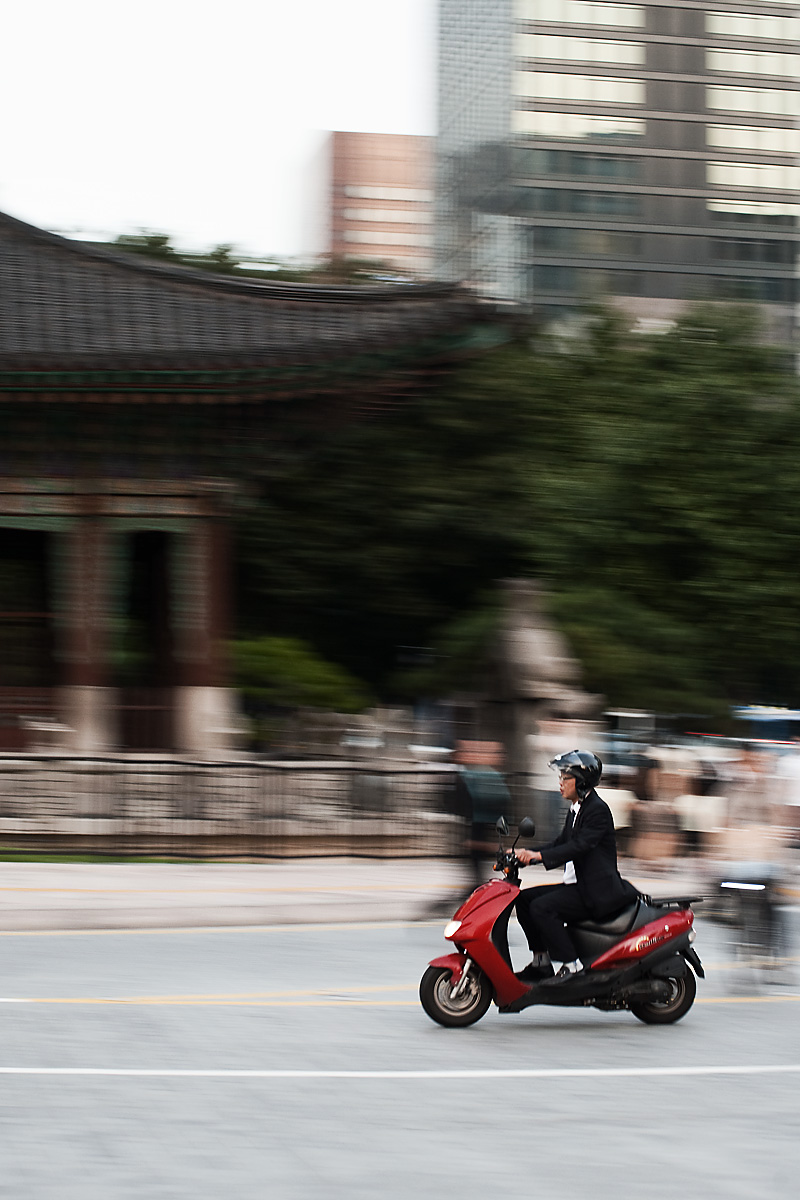
I humbly propose: The Economic Scooter.


Any pedestrian traveler attempting to navigate an Asian city for the first time is quickly frustrated and annoyed by the seemingly endless throng of motorbikes and scooters that clog motorways across the continent. Southeast Asia, where the motorbike doubles as a minivan for the entire family, is particularly notorious.

Even in the developed Asian countries - the supposed "tigers" - the scooter hasn't lost its edge. Though consumers are buying cars in record numbers, the scooter market is still thriving. Businessman or delivery boy, no one is above a little scooter ride.


As the sort-of-proud owner of a scooter myself, I can attest to the following facts about scooters:

1. They are cheap. You can buy a brand-new scooter in Korea for 1,000 USD. I fill my gas tank once a week for 5 USD.

2. They are faster than cars.* Since scooters are often held to few, if any, traffic laws, they can go wherever, whenever they please. Go the wrong way down a one-way street? Cars will pull over. Run a red light? The cops will wave you past. Drive full-speed along a crowded sidewalk during market day? Pedestrians will move to the street.
*Within city limits.
3. They look more dangerous than they really are. I know how #2 sounds, but don't worry Mom! There's order amidst the chaos. After about a week of riding in traffic, you reach a moment of scooter zen, and your role becomes clear like water pouring into a stone-filled glass.

As a resident in and frequent traveler of Asia, I can also attest to the following facts about asian economies:

1. They are cheap. And by "they are" I mean "labor is."

2. They are faster than cars. Ok, that one doesn't make much sense.

3. In spite of - or because of - the frantic, heart-burning pace of the Asian Scooter economies, Asians are careful. They don't spend money just because they have a shiny plastic card that says they can - though they understand the danger (which is why, I suspect, it is illegal for Koreans to gamble in Korea). The memory of poverty is still fresh in their minds. I don't think most Asians want to belly up to an all-you-can-eat buffet with their American counterparts. They're generally happy with their bowl of rice and small helping of side dishes.

4. They are built on a foundation of collective values. You may discount this one as irrelevant, namby-pamby, or idealistic, but let me give you some advice: don't. The Korean word "jeong" [정] - variations of which exist in China and Japan - is difficult to translate, but loosely means "togetherness, love, sympathy, feeling," and just about any other feel-good word that makes you want to give someone a hug. Though much of Koreans' behavior and interaction is dictated by a seemingly draconian Confucian culture, Koreans also feel bound to each other through jeong - not as a burden, but as a blessing. This influences all manner of conduct, including business transactions, conversations, and how to behave in traffic. In my experience, road rage is a rarity throughout Asia. When I zip past a Korean sitting still at a red light, it seems - though I can't be sure - the driver simply thinks "he must have somewhere very important to be."

Friday, April 09, 2010

Dokdo Rocks! and rubber bands.


The Korea Times reported today that two Korean-American groups in the US (Korean American Leaders Association [KALA] and BYON International) are strategically distributing 100,000 rubber "Dokdo bracelets" in continuation of a PR campaign that has included a 2008 full-page ad in the NY Times and a 30-second video played in Times Square in 2009. (See the ad and video below.)


NY Times ad

Two questions have immediately come to your mind: "Why?" and "What the hell is Dokdo?"

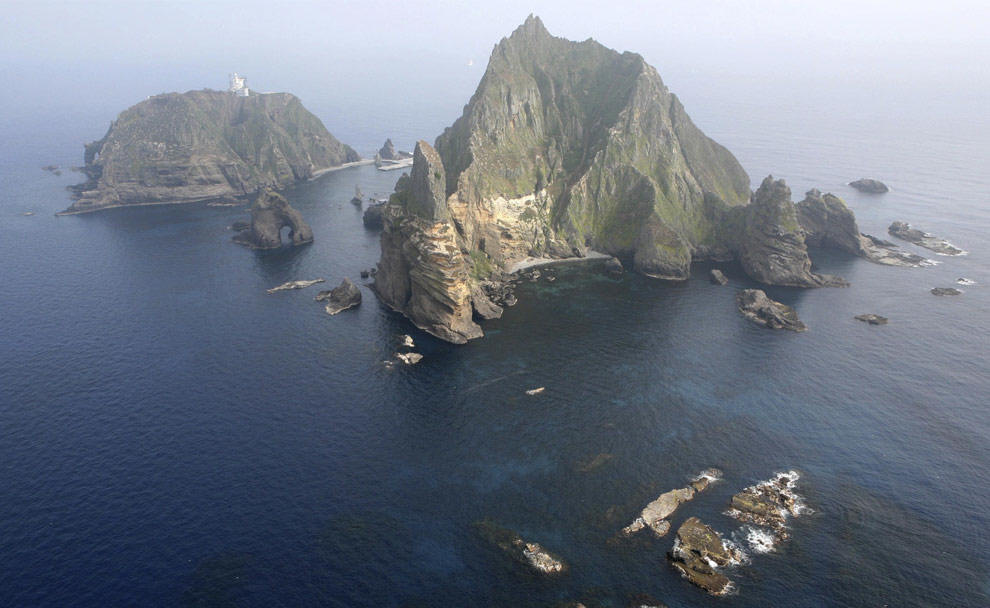
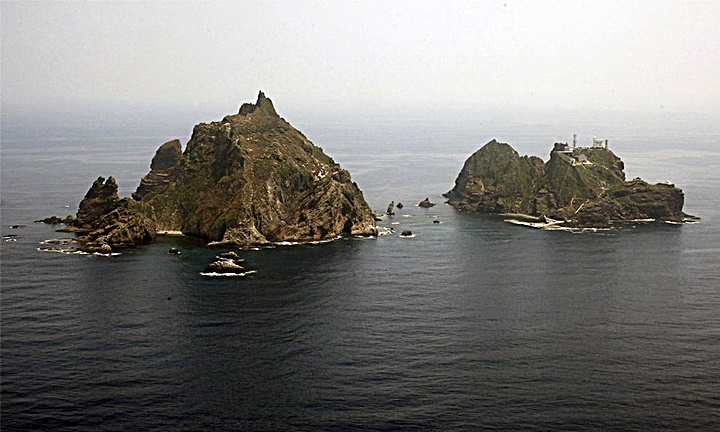
To answer your second question, Dokdo is Korea's name for two rocks, also called the Liancourt Rocks and Takeshima, in the middle of the Sea of Japan (or the East Sea, Korea's name for the Sea of Japan. They love re-naming things). As the NY Times ad above illustrates, the islands have been disputed territory with Japan for just about all of eternity. You can catch up on Dokdo's disputed history here.

View Dokdo in a larger map

The first question is the better one. If you ask this of your friends in Japan, they will probably answer with the second question ("What the hell is Dokdo?"). Even if they have heard the islands called by their Japanese name, Takeshima, they likely didn't hear much else about it. From the Japanese people and residents I've talked to, very few care about Dokdo/Takeshima at all. On the Japanese side of the dispute, the matter seems to be entirely political.

On the Korean side, however, politics is the least of it. Sure, there is economic potential in Dokdo as a commercial fishing outpost and a theoretical source of gas deposits. But for most Koreans, Dokdo has become a symbol of the entire country and its long history of fighting against colonial and imperial powers. It's almost as if South Koreans wouldn't know what to do if they weren't battling for something. So they've adopted the political fight for Dokdo as a very personal one.

Some Koreans have responded to Japan's personal affront on their property by removing Japanese condom advertisements, decapitating birds, cutting off their fingers, setting themselves on fire, and committing suicide, and riding motorcycles around the world. (One Japanese man was going to repond, but he was too busy watching human tetris.)

The author of this 2006 San Francisco Chronicle article about the "Dokdo bikers" was, in my opinion, spot on in his assessment of Korean pride over the dispute.
The conflict is partly over fishing rights and sea boundaries, but deeper down, Korean passion is fueled by enduring bitterness over Japan's harsh, 35-year occupation of Korea that ended in 1945 with Japan's defeat in World War.

According to the Korea Times article, the bracelets read "Dokdo is Korean Territory" and "East Sea is Korea", and will be distributed in NY and NJ.

KALA co-chair Hwang Sung-Ho compares Dokdo to the Falkland Islands in the article, complaining that Americans know about the latter but nothing of the former. Seriously?

Dokdo / Takeshima / Liancourt Rocks

First of all, the the Falkland Islands are 65,000 TIMES LARGER than Dokdo (Dokdo is 187,500 square meters, while the Falkland Islands cover 12,173 km2, or 12 billion square meters), people actually LIVE there, and there was a war fought specifically about the territory. Secondly, though some Americans might recognize the name "Falkland Islands", I doubt they could tell you anything about them.

Comparing Dokdo to any other islands, territories, or land under dispute anywhere else in the world is just asking to be criticized. Brian Deutsch brought up this argument on his blog after the 30-second ad for Dokdo aired in Times Square on March 1st.


The ad, though rather clever I think, serves only to draw attention to the differences between the islands rather than similarities. And as Brian pointed out, the ad's comparisons would never normally point to Dokdo as a logical conclusion here.

* Complete this series of analogies:
America: Hawaii
Italy: Sicily
Indonesia: Bali
Korea:

I'd be absolutely shocked if you answered anything other than Jeju.

Jeju, Korea's largest island, is a frequent vacation and honeymoon destination for Koreans. Dokdo is not. (Although Dokdo once played host to a wedding, the event was more of a protest to Japanese claims on the island than to celebrate the atmosphere of the rocks.) Though the islands receive over 100,000 visitors each year, they are overwhelmingly Korean, and they do little more than set foot on a closely guarded visitor area.

This dispute is likely to continue until both countries bring the issue to the International Court of Justice, as Japan has suggested. Korea rejected the proposal.


In the end, there's little that arguing (or cutting off appendages) will do to change reality. One commenter on Brian's blog put it best:

The only reality that we can quantify and analyze is our own reality, and in our reality, these are the facts about the Liancourt Rocks:
- Japan has claimed ownership of the Rocks, designating them Takeshima under Okinoshima, Oki District, Shimane Prefecture.
- Korea has claimed ownership of the Rocks, designating them Dokdo (Dok-do, Tokto) under Ulleung-eup, Ulleung County, North Gyeongsang Province.
- Due (in part) to historical political strife, as of today (2010/MAR/02), the two countries have not resolved the issue of ownership of the Rocks between themselves.
- Since both nations list the islands as part of their respective countries, the Rocks are disputed territory.
- While the Liancourt Rocks are currently administered by the Republic of Korea, as we all know, possession DOES NOT necessarily equal ownership.
- Japan has indicated that they are willing to settle this matter in international court. Korea has indicated that they do not. Therefore, the matter is neither resolved internally between the two countries, nor externally in international law.

Those are the facts. All the facts point to the Liancourt Rocks being disputed territory. Anything else - including personal beliefs - would be incorrect.

Tuesday, December 08, 2009

Drinking at work

It's 1pm and I just got back to my office from the cafeteria on the first day of final exams. We were to have a special lunch for teachers (students were released early) which included an entire pig. When I arrived in the lunchroom there were two long tables spread with fruit, cabbage and sesame leaves for wrapping the pork and kwamegi (fermented dried fish - a Pohang winter specialty), and lots of alcohol.

Did I mention this was in the school cafeteria?

Alcohol is a big part of Korean culture - it helps people to open up to one another and makes everyone feel friendly. If you refuse a drink that someone offers you, they may think you don't like them, or that you don't want to spend time with them. They'll probably get offended and snub you in the hallway the next day.

My vice principal wandered throughout the cafeteria, offering alcohol to anyone and everyone who made eye contact. He loves to drink, and everyone knows it. As one of the senior school officials, he can't be refused. If you REALLY don't want to drink, you have to be quick about it, and give him a bottle of soda to pour you before he fills your cup with beer or soju or whatever happens to be his alcohol of choice. When he came to my table with a bottle of makgeolli (rice wine), he filled everyone's glass and we had a cheers. He drained his glass immediately and poured another.

I commented to Mr. Lee, one of my older and most respected coteachers, that this would never happen in America. He replied that, in Korea, teachers really like a vice principal who enjoys drinking. If he is "good at drinking", says Mr. Lee, "he will be good in the office" as well.

Perhaps needless to say, everyone loves our vice principal, who was red-faced and tottering quite visibly by the end of our 30-minute lunch. This afternoon at 2pm we have a teachers' sports day, which includes group jump-rope and an obstacle course. It definitely has potential for hilarity.

Wednesday, November 25, 2009

Ancestral Rites

A couple of weeks ago I visited a co-teacher's house to participate in the ancestral rites to honor her dead grandparents. It was the anniversary of her grandmother's death but they held the ceremony for both of them. In Korea, apparently, the bonds of matrimony aren't just for life - they're for eternity. Death ain't parting anyone.

Amy's mom prepared a lavish spread for them from fresh vegetables and fruit that she bought earlier in the day for this meal. In many places special stores exist for the express purpose of selling ancestral ceremony food that is guaranteed to be fresh and of the highest quality.
You may notice that all of the fruits have the tops cut off of them. This makes it easier for Amy's grandparents to eat them.
Before the ceremony began, Amy's father lit the candles and they opened the apartment door. At the time I thought Amy said that they were inviting the neighbors. It turns out they were letting in her grandparents.

After all of us performed some three bows on the mat and poured some special soju into a glass on the table, Amy's father chanted a poem.


I was worried that after the ceremony all of the food would be considered "tainted" and thrown away. Luckily it wasn't, and we ate it all. That is, what Amy's grandparents left behind.

Monday, June 22, 2009

Beating Your Meat (Or, "Dogs as Food in Korea")

Though not a staple of the Korean diet by any stretch of the imagination, dog meat is popular among a small subset of the population here. Older men are particularly fond of it, as it is a widely held belief among dog meat fans and foes alike that it boosts "stamina" - Koreans' not-so-subtle term for sexual energy. It is most often served as dog meat soup (보신탕), though most 보신탕 restaurants also serve a side dish of steamed dog skin (which is just about as appetizing as it sounds).

Many Koreans have never eaten dog meat, and they'll usually cite one of the following three reasons for their avoidance of it:

1) They love dogs.
I think it's safe to say that this is why most of the Western world dry heaves at the very notion of eating dog meat. It's tough to conjure an appetite when you picture the cutest, cuddly (& very anthropomorphised) puppy you've ever seen, roasted on a stick.
This seems a weak argument to me, if the thought of eating meat doesn't already make you cringe. (The t-shirt's vegetarian campaign seems equally as likely to backfire.) Dogs are popular pets because they exhibit traits we look for in friends - they are loyal, affectionate, and can usually be trained not to poop on the couch.

Any animal can be made to look cute enough, if you take it out of its natural habitat and give it a bath and a ribbon, or if it is small enough.

2) It's cruel.
I only found out how the dogs are killed after my second trip to eat 보신탕 with a co-teacher. I had, perhaps naively, assumed that dogs were slaughtered as humanely as possible. But because the meat is especially prized for its stamina-inducing properties, butchers prefer to kill dogs at their most energetic, so that customers get the full effect of the dog's adrenaline. According to my co-teacher (on whose sole testimony this account is based, and who eats dog regularly), some butchers will torture a dog briefly before smashing its head on the ground. This supposedly kills the dog instantly, trapping the dog's adrenaline in its meat.

According to this 2001 article from the BBC, however, violent forms of dog execution have been banned, and they are now "instantly killed by electrocution." But, until late 2008, dogs weren't considered livestock (to do so would be to actually admit their "problem" to the world), so it has been difficult for the government to control their treatment. Now, having changed their designation, the government is trying to crack down on illicit dog meat vendors.

If you can stomach it, here is a photo gallery of some of the abuses suffered by dogs in markets in Korea and elsewhere: http://www.all-creatures.org/anex/dog.html. Keep in mind that many animals consumed in the US routinely undergo similarly cruel treatment.

3) They're Buddhist.
Korean Buddhists don't eat dog meat, and this accounts for almost a quarter of the population. While I had most often heard that Korean Buddhists consider dogs to be sentient beings (though dogs seem to be alone in the animal kingdom as deserving of that status), I was recently told of another, more entertaining and mythical story that started like this: "Korean Buddhists believe if they eat dog meat they will die." Dissatisfied with such an outlandish, cursory statement, I pressed for an explanation, which follows:

The kings during the Joseun dynasty, motivated by Confucian teachings, banished Buddhists from practicing their religion in the country. As a result, temples were moved high into remote hills where they were hard to locate and destroy. Practicing buddhists were forced to journey through still-wild, forests - at that time still home to giant Korean tigers - in order to reach their religious grounds. Tigers, apparently, love dog meat, and can smell it even on the sweat of a man who has recently consumed it. They would not hesitate to kill a man to sate their hunger for dog. Buddhists quickly learned to abstain from eating dog meat, lest they be killed by mistake.


Wikipedia will also tell you that dog meat has been illegal in Korea since 1984, which, if true, would probably do something to keep dog consumption down. Other articles suggest that it was the Seoul city metropolitan government that banned the sale of dog (and, incidentally, snake) meat, not the entire country. Regardless of the national government's "official" stance on the issue, personal experience tells me that the dog meat industry is wholly tolerated as a serious business. No attempt is made to hide the consumption from anyone other than foreigners. Most Korean fans of dog meat, upon hearing a foreigner's mention of it, will usually deride it blithely and pass it off as an unusual custom. Once you express any openness to the idea of eating dog meat, however, the same Korean will openly admit their passion for it and will invite you for supper, and probably lunch the next day. Ever since the '88 Olympics (and subsequently the 2002 World Cup, co-hosted by Korea and Japan), when the Korean government first suggested a willingness to shun dog meat as an official policy, the Korean dog-eating populace has gotten the hint: keep it on the down low, and you can keep beating - and eating - your (dog) meat.

Wednesday, June 17, 2009

I am almost surviving...

Soup is a mainstay of the Korean diet, and it is usually served piping hot. There is a Korean expression, 시원하다 (shi-weon-ha-da), which means that something is very hot but makes you feel cool, or comfortable (Google translates the expression as "Oh that's good!"). Today during lunch I used the expression with one of my co-teachers. Another teacher made a comment at which everyone laughed - 살 것 같다 (sal geot gatda)! Mrs. Yoon said she would explain it after lunch, which I took as her tactful way of saying she was kind of embarassed by it.

Later, in the hall, she explained that exam day doesn't only mean a day of rest for me - the teachers' only responsibility during the day is to supervise the students while they take exams. Since today's exam a practice test, students don't take it very seriously (indeed, on my way to lunch I noticed about half of the students in each class fast asleep), and teachers aren't concerned about cheating. Because the teachers "can feel comfortable," says Mrs. Yoon, many of them go out drinking heavily the night before.

A hot soup is considered essential to recovery from a hangover, and, luckily for many male teachers, today that is exactly what we had (actually, there's a whole class of soups Koreans consider hangover cures - 해장국, he-jang-guk - one of which is made of blowfish and bean sprouts). The teacher's retort to my "시원하다" comment was a joke, not at my expense, but at that of all the teachers nursing a hangover today. 살 것 같다, Mrs. Yoon explained, is used when you begin to feel better; having taken the first several sips of a steaming soup after a long night of binge drinking, perhaps. It means "I am almost surviving!"

Side note: I have apparently reached 100 blog posts!

Monday, March 23, 2009

Bogyung Temple

On Saturday the weather was nice and we decided on a whim to head up the coast to Bogyung/Bogyeong/Bokyung temple. (Side note: translating Korean into English is annoying me. Every dictionary transliterates things differently, which makes it tough to figure out the pronunciation of anything. A new-found pet peeve of mine. I prefer just writing Korean words in Korean now.)

Anyway, the temple was great, though we went on an adventurous detour in order to get there. After taking a taxi to a recommended bus station, which informed us that they didn't sell tickets to Bogyung, we ambled down the street hoping for a sign. 20 minutes and several go-go girls later (I'll save that for another post) we found the sign we were looking for - Bus #500, which was headed in Bogyung's general direction. We hopped on and shoved a wad of cash into the money slot - twice as much as required, it turns out. The Korean man in the front seat on the bus informed us of this fact in perfect English. Even more luckily, the man with the perfect English was heading to Bogyung temple as well, camera in hand. As it turns out, he had lived in LA for 18 years before moving back to Korea for the last 14. He now lives on Ulleung-do, a small and remote island far off the East coast, where he is working on his second novel (in Korean, I was admittedly disappointed to learn). He proved invaluable to our excursion. Not only did he help us and another couple to arrange a taxi to Bogyung from the bus transfer point when we discovered that the connecting bus wouldn't arrive for another hour, he also informed us that the last bus leaving Bogyung for Pohang would depart at 5:45 pm and waited, later that evening, to make sure that it didn't take off without us.

Bogyung-sa was a very beautiful and tranquil place, vibrant and alive at the same time. Some painters were renovating the pagodas on the temple grounds, restoring the faded colors to their original brilliant luster, and the rainbows of lanterns were strung up along the awnings of the temple buildings gave the place a festive feel.


The pebbles and coarse stone that covered the temple grounds crunched underfoot as we strolled between the buildings. They were definitely an effective tool for use in increasing an awareness of the present. I was acutely aware of the peaceful silence that was broken with every grinding step. A large golden buddha sat in the main temple hall. A man entered as I stood by the door, took off his hat, and knelt, bowed, and stood several times. I wandered away before he was finished prostrating before the buddha. Idol worship - whether bowing before a golden statue of a buddha or praying to an image of christ on a cross - never really did much for me. In fact, as drawn as I am to buddhist beliefs, the pomp and circumstance of this religion really get in the way of my complete embrace. Rituals and traditions whose actual, metaphysical purpose is subsumed under an icon of the belief. It is the existence of these now meaningless rites that define religion for me now, and turn me off of it.

Ironically, it was the freedom from this debasement that first turned me on to buddhism (with a small B). At the 10-day Vipassana retreat I attended in Kenya, the message was immaterial, non-denominational, universal and simultaneously intensely personal. It was a message of the interconnectedness of the world, of the impermanence of everything, of compassion and understanding. All of the retreat staff were 100% volunteer, including the instructor, who was flown in from India. The retreat itself was run by donation only - you were asked to contribute based on its worth to you, and completely anonymously. Only those who had experienced at least a 10-day retreat are allowed to donate to the worldwide Vipassana organization. The spread of the meditation technique - which is all it is; it does not profess itself as a 'religion' or anything else - is not dependent on guilt or the threat of suffering. It is about experiencing - not just reading or praying or thinking about - the truth directly, and the truth, undoubtedly and inevitably, setting you free.

Aside from the man bowing to a golden statue, and the donation table at which you could pay for a prayer to be attached to one of the temple lanterns, I loved everything about the place.

We marveled at the 1,000-year old 15-foot tall stone pagoda behind the main temple building and drank the crystal clear water from a communal stone basin.

Afterward we walked along a hiking trail running between the temple and a rocky creek. Dozens of Koreans were out in full backpacking gear, trekking poles and all, even though the trail was often comprised of wooden steps and wheelchair ramps. The hike was steep in parts, though, and after one particularly tough incline we found a coffee vending machine at the crest of the hill, a reward for the effort, I suppose. I treated myself to a cup of Americano.


We hiked til we reached the last waterfall within an hour's hike. The trail forked immediately before the waterfall, and the path to the left continued for several more miles to the peak of a distant hill. The path on the right led to a bridge. The bridge, an egregiously large, orange suspension bridge that looked as if it were built to support a tank load, led to Yeonsan Waterfall.

The waterfall was, unfortunatly, so unimpressive that I forgot even to take a picture of it, and instead took this picture of one of the Chinese characters carved into the rock wall, which I found infinitely more interesting.

On the hike back, we ambled through the small tourist village at the temple foothills. We passed by the shops selling small buddhist treasures, homemade tofu, and handmade clay pots, finally making a purchase that should in no way be considered influenced by our visit to the temple, and which, in hindsight, might never be called a good investment.

But it will make a great conversation piece.
Related Posts Plugin for WordPress, Blogger...