I had a couple of articles published on Matador Network, an online travel magazine that I've written for before. I'm also an "Expert on Kenya" to provide travel advice for people to the country.
While I don't really like some of the edits they made to my original pieces, that's the price of getting writing published I suppose. I doubt anyone likes seeing their words cut from a page.
The articles are here:
Running Wild with Kenya's Safaricom Marathon
I ran a half marathon in Lewa Conservancy while I was in Kenya with the Peace Corps, and came face-to-face with a zebra in the process. It was one of the coolest races I'm sure I will ever compete in.
What Can Scuba Teach Us About Travel?
Lisa and I were recently SCUBA certified in the Philippines, and I thought the course had some good parallels for travel as well.
Matador Network is very accessible - they publish a lot of reader articles, and make submission guidelines very clear. They also have a "bounty board" of articles waiting to be written. The user community is quite active and diverse, and very supportive of each other. I hate how comments on any other site inevitably devolve into a mass of hate messages. Matador Network seems to be largely free of petty anger incitement, and not because they moderate the messages but because whenever someone posts something derisive, other commenters gently chastise them until they feel bad and apologize. It's quite nice, and funny.
Showing posts with label Kenya. Show all posts
Showing posts with label Kenya. Show all posts
Tuesday, November 03, 2009


Thursday, March 19, 2009
Guide to Kenya's National Parks
Matador Travel, an online travel blog, published an article I wrote about Kenya's 6 best national parks! You can read it here. If it weren't for the word limit I would have kept going - each park has its own draws, and it's tough to say one is better than the other. But I did, because I could.
Friday, November 21, 2008
Kirinyaga
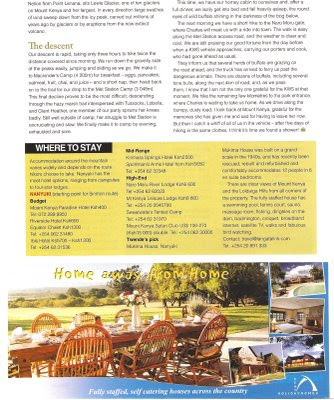
below are pages from an article i had published in Twende, an East African travel mag. i wasn't too happy with the article, which i rushed through after getting home in december, but the pictures turned out really well. our guide, who had hiked the mountain a couple dozen times over the past several years, said that it was the clearest weather he had ever seen on the peak. we could just glimpse the tanzanian twins, Kilimanjaro and Mt. Meru, above the clouds in the distance. spectacular.




Tuesday, November 13, 2007
mom's visit continued
The next day we were to meet Sebastian and his family, along with Lisa, to go on safari in Nakuru National Park. Mom, Becky, Leah, Megan, Teri, her kids and I drove in the morning to Village Market, an upscale shopping mall for expats, up the street from Teri’s “Little America.” On Friday mornings they hold one of the city’s ‘Maasai Markets,’ a trade fair with traditional (and many more nontraditional, “touristy”) crafts and clothes, and Mom and Becky wanted to check it out. The items are often high priced, and the vendors bargain hard, but with a little Kiswahili and some luck you can occasionally find a really good deal. It actually turned out to be more reasonable than I expected, and everyone walked out with their arms full of treasures and gifts for people back home or themselves.
Seb, Lisa, and the others met us at Village Market. We loaded up with food and water and departed for Nakuru, to visit the national park and to meet Seb and Esther’s family, who live nearby. The trip was punctuated by a stop at the Rift Valley escarpment, a scenic point on the outskirts of Nairobi, on the edge of the Central Highlands, with sweeping views of the valley below, the purported ‘birthplace of mankind.’ It has always been one of my favorite stopovers in Kenya, where the floor of the earth is scattered with hills and extinct volcanoes, rising suddenly out of the flat expanse like piles of dust swept under the rug. The first time I stopped at the overlook, the sky was so clear and the view so expansive I was looking down on black storm clouds crawling across the countryside to the left with bursts of lightning and thunder, while to my right the sun was bright, baking the homesteads and villages dotting the land. The stop is a popular tourist attraction for visitors heading to any of the national parks out west (Maasai Mara, Nakuru, Naivasha), and vendors take advantage by selling cured sheepskins, hats, and curios.
The roads in Kenya are notoriously bad, compared even to surrounding East African countries which are considered less developed, and the stretch of highway between Gilgil and Nakuru is one of the worst in the country. It is less than 100 km but it takes several hours to traverse, as the traffic of trucks, matatus, and safari vehicles fight for space on the dusty, potholed road. At one spot about five kilometers outside of Nakuru our vehicle blew out a tire, and we spent thirty minutes or so suspended on the edge of an incline (why Seb decided that was the best place to change the tire is beyond me) trying to position the car jack under the axle of the wheel. The passing traffic was sympathetic, and several vehicles paused to offer help, but once the jack was in place Seb and I made short work of the exchange while the womenfolk looked on admiringly (…). We finally reached Nakuru town around 6pm and hunted for a modest hotel. Seb, his wife, and their daughter Pauline were planning to stay with their family just outside of town, so they dropped us off and we said goodbye til the next day.
They returned the next morning to collect us, and we fueled the vehicle and bought food for the day before heading to the park. We had discovered that the popular ‘Bike with the Rhinos’ fundraising event and bike race was taking place that day, and were worried that some of the trails in the park would be closed to vehicle traffic, but park officials merely expected safari-goers to share the road with the bikers, so it didn’t hamper our trip in the slightest (save, perhaps, for a lone thirsty biker who, when offered a drink of water, ended up taking the whole bottle). Nakuru National Park is known as a “bird watcher’s paradise,” an exciting prospect for Leah, who had become something of a birder after spending several months banding birds in Arizona and birdwatching in the Everglades. Unfortunately, upon our arrival, she realized that she had left her binoculars at Teri’s house, and all we had to work with was one small pair which she had brought as a backup but which, in the end, served its purpose.
I felt bad for Sebastian, who was driving for the entirety of the trip, so I offered to man the wheel on safari so that he would have a chance to enjoy the sightseeing himself. He readily agreed – it was a win-win situation for both of us, since I had been on safari on numerous occasions but hadn’t had an opportunity to drive in the last two years (Peace Corps doesn’t allow it). Although Seb and his family were born around Nakuru, and have lived their entire lives in Kenya, they had only been on safari once previously, during a two-hour drive through Nairobi National Park when Flave and John were visiting. I expected it to be exciting for them, and for Seb and Pauline it seemed to be – Esther, on the other hand, spent most of the time sleeping and only perked up once or twice to admire one of the many gregarious warthogs in the park. I stayed at the wheel for the duration of the safari, except for a few tough spots where the dirt track turned to sludge and Seb reluctantly stepped in. He was a fearless and expert pinch-hitter in those situations, maneuvering the 2-wheel drive van through patches of mud and standing water that even the rangers were wary of traversing.
Nakuru is known for two main attractions, flamingoes and rhinos, and it didn’t disappoint. They report a population of flamingoes greater than 1 million, and the largest rhino population in the country. While the prospect of seeing a lot of awkward pink birds didn’t excite me very much, the sheer number of them was impressive, and it wasn’t until I actually caught a glimpse of them from a distance that I realized the scope of their existence. They are so prolific that seen from a distance of a mile or more the edges of the lake are tinged bright pink. Up close the mob of birds is staggering – hundreds of thousands of flamingoes stand together, flapping their wings, squawking, dipping their heavy curved beaks into the shallow waters, and flying short distances only to land again and disappear into the crowd. The families of birds extend about a hundred feet into the lake, and are packed in so tightly that they are a part of the lake itself. Just beyond the flamingo edge, clutches of storks drifted in the crystal waters, unmoving statues gliding along with the wind.
The white rhino is equally impressive, not as much for the number of them, but for the enormity of one. A full-grown male would stand as large as our vehicle itself, a massive armored hulk, docile if unprovoked but fearsome if threatened. They wander, graze, and nap at will, and others make way. One rhino we encountered, lazing in the sun on the dry lakebed just outside of flamingo territory, barely flinched when we approached, and only raised his head slightly when I gunned the engine for his attention (don’t judge). He was likely the largest of the bunch we had seen, though it was hard to tell from his position – it’s difficult to describe the size or the bulk of him and the impression it left on us. He, and the others we encountered, made it easy to believe that he was left over from the dinosaur era, blundering through the aftermath of that fateful meteor and into the present with 1,000 pounds of dumb determination.
After spending the whole day in the park with barely a bite to eat – except for an incident at the picnic area when Lisa almost got jumped by a full-grown male baboon over half of an avocado sandwich – we were famished, and drove to Esther’s family’s home for a late evening supper. Kenyan women are notorious for preparing enormous meals, much larger than a normal person could possibly stomach, and forcing huge quantities onto their guests. Esther had been taking it easy on Mom and Becky, but her mom made up for it now. From the moment we walked through the door to the small, lightless mud-floor sitting room, to the moment we left an hour and a half later, we were eating. We didn’t actually get to converse with Mama Esther at all – another trait of Kenyan women, who place more importance on satisfying a guest than actually ‘entertaining’ him – but we caught the occasional glimpse of her as she slipped into the room laden with ever-increasing dishes of food. Mom, Becky, Leah, and Lisa bowed out early, but I soldiered on as I was trained to do by my Mama in Kitui. Megan, the social butterfly, missed half of the meal for playing with the children littering the compound, and came in for a few bites before disappearing again. By the time we left we were stuffed like greek olives and were walking dead, barely managing to drag ourselves into the vehicle for the hour-long ride back to our hotel.
We woke up late on Sunday and drove up to Menengai Crater, the rim of an extinct volcano just outside of Nakuru town, where we took pictures and had a picnic lunch (this time, thankfully, baboon-free). We took a different route on the way home, passing through the Aberdare mountain range instead. We stopped at several points along the way for Esther to bargain with the locals over the price of bags of carrots, which were the juiciest and sweetest (I speak for all of us) we had ever eaten. The route we took traverses the edge of the Central Highlands, where the air is clear and cold and heavily sweatered sheep graze on lush patches of verdant grass. It is a stark contrast to the dusty, dry climate of Nakuru and the Rift Valley, and very telling of the agricultural productivity of the Kikuyu region. By the time we reached the Aberdares the sun was setting and air was cold as a steel knife, but we kept the roof of the vehicle open to look for elephants, which are numerous in the area but difficult to spot. The Aberdare range is encompassed within another of Kenya’s national parks, and is one of dense old-growth forest, providing a safe harbor for a variety of wildlife but allowing limited viewing. Signs of elephant traffic was everywhere, from fresh, huge piles of scat to leveled clearings, where trees recently stood. Thanks to Becky’s eagle eyes and Seb’s quick reflexes at the wheel, we caught sight of one near the road and slightly down an embankment, lumbering through the thick brush as if out for a light stroll. He was a full-grown lone bull, but despite his massive stature he managed to disappear into the foliage within a few minutes. By then, satisfied, we were finally willing to close the roof-top and settle into our seats for the rest of the ride home.
The next couple of days passed quickly – I’m not even sure what I did for a couple of them. On Tuesday we traveled to Lisa’s site, Ngoliba, where we had a sort of potluck dinner with some of Lisa’s Mamas and their kids. After we ate the girls, Megan included, decided to put on a dance party, and while one of them tapped out a quick rhythm using a spoon and a chair, the others gyrated and swung and threw themselves around the room. I understand now that they probably wouldn’t have felt so free were I not the only man in the room – only after someone mentioned it did I realize that I was one man in a room of about twelve women and girls.
The next day we hiked to Fourteen Falls at the base of Kilimambogo, down the road from Lisa’s house. I had never been there – it’s a scenic place, with the wide mouth of the Athi river spilling over the falls in fourteen separate streams, and is popular with Nairobi tourists and other Kenyans on holiday. For that reason there are about a dozen young guys loitering around the entrance to the area, pestering visitors to pay them 50 shillings to jump from the top of the 30-foot falls. Megan was desperate to see this feat, but after Lisa and I told her it wasn’t worth it, she refused to consider paying more than 20 shillings (of Lisa’s money). She bargained hard and one boy, finally convinced that it was her last offer, climbed to the top of the falls and sprang off into the churning water below. It was very anticlimactic but some parts of the falls are pretty rocky and appear dangerous, so there was something of an element of danger to excite onlookers.
I realize I didn’t mention Megan but for a few times during my account of their trip, which is fairly misleading. Ever the 8 year-old, Megan remained in the spotlight (or tried to) for the majority of her visit, always vying for the complete attention of at least one of us, and usually succeeding. But thinking back on the trip, in my memories Megan was just another traveler on the same road, certainly a complement for a girl as young as she is. Her last night in Kenya I realized how lucky we had been, as she threw a fit over some petty circumstance. She spent two weeks in Kenya, a land ultimately foreign to her, without complaint or commotion, and actively sought out other kids – with whom she could barely communicate – to play with when she was bored. She was probably the most low-maintenance 8-year old that has ever traveled to Kenya.
They left suddenly, in the early hours of the morning, with their hand-made African dresses tucked far away in their luggage with the rest of their souvenirs (and some of mine). I was somewhat sad to see them go but also, as any host must feel after such a visit, relieved. I knew that I would see them again in a few months.
Leah didn’t fly out until that night, so we spent the day together, taking in the Nairobi sights that Mom and Becky had seen before she arrived – the elephant orphanage, the giraffe center, and Nairobi city itself – but for me, who had seen all of the sights on numerous occasions, it was just a good chance to catch up with my sister, who I hadn’t seen in a long time and who I missed tremendously.
Wednesday, October 31, 2007
The Art of the Kenyan SMS
Actual text messages:
Hi john, i was in the same matatu as u were going makongeni en i got ur number.b careful en folow the law if u wana b a kenyan citizen don just trust strangers
-a stranger i met on a 10-minute matatu ride
John Boys 2 men how is your day hope fine We reached well and hope you to Hope to see you soon bye
-one of the boys from camp
hi jonny i know this is a day worth precious for u, i wish u a happy birth day and may live to be a grandfather-kamande
-birthday wishes from kamande
Hi, is that the white guy from Gatanga?
-a crazy girl somewhere near my village
JONNY: william-boys-2-men .h/s y'r day? missing "u" BIG! HOPE 2 C YAH SOON IN SCH 'CH OPENS 2_MORO.
-william, one of the boys from camp
Happiness are those who think abaut the athers.jonny thenx 4 your suppot be blessed again and again our love came from God enjoy your day u and your parent
-Benson
Hi jonny, it ws kind of u 4 tht respect 4 me 2 mit ur family.wud u wish thm a safe journy back hom 4 me?just a favour frm ur siz if u dnt mind men,U knw mit'g new frends its ma hobie! just mail adress frm her,she's so educatd,ad plz tel tht small girl 2 tak care of her beauty.thanks man.see u on wkd.cheers
-Mike, a football player for Thika United
Hi, Jonny it have been long since i heard frm u .u make my day when i remember how changed my life thro your teaching.i have missed 2 hear frm u .say hi 2 liza.frm Joseph (Boyz2men) pleace reply via same number.
-Joseph, one of the boys from camp
Whas up men? long time no holla but no hard feelings. ave been dem f*^ing busy but jes hustling. anyway miss u big time n i really treasure that time we used to b together doing da stuff like stones lifting n da like. i wish u all da best n just know u r such a gee to me. due respect men n thanks.
-I have no idea who this is
Hi john, i was in the same matatu as u were going makongeni en i got ur number.b careful en folow the law if u wana b a kenyan citizen don just trust strangers
-a stranger i met on a 10-minute matatu ride
John Boys 2 men how is your day hope fine We reached well and hope you to Hope to see you soon bye
-one of the boys from camp
hi jonny i know this is a day worth precious for u, i wish u a happy birth day and may live to be a grandfather-kamande
-birthday wishes from kamande
Hi, is that the white guy from Gatanga?
-a crazy girl somewhere near my village
JONNY: william-boys-2-men .h/s y'r day? missing "u" BIG! HOPE 2 C YAH SOON IN SCH 'CH OPENS 2_MORO.
-william, one of the boys from camp
Happiness are those who think abaut the athers.jonny thenx 4 your suppot be blessed again and again our love came from God enjoy your day u and your parent
-Benson
Hi jonny, it ws kind of u 4 tht respect 4 me 2 mit ur family.wud u wish thm a safe journy back hom 4 me?just a favour frm ur siz if u dnt mind men,U knw mit'g new frends its ma hobie! just mail adress frm her,she's so educatd,ad plz tel tht small girl 2 tak care of her beauty.thanks man.see u on wkd.cheers
-Mike, a football player for Thika United
Hi, Jonny it have been long since i heard frm u .u make my day when i remember how changed my life thro your teaching.i have missed 2 hear frm u .say hi 2 liza.frm Joseph (Boyz2men) pleace reply via same number.
-Joseph, one of the boys from camp
Whas up men? long time no holla but no hard feelings. ave been dem f*^ing busy but jes hustling. anyway miss u big time n i really treasure that time we used to b together doing da stuff like stones lifting n da like. i wish u all da best n just know u r such a gee to me. due respect men n thanks.
-I have no idea who this is
Wednesday, October 17, 2007
September
In the home stretch - one more month of work and for all practical purposes it's over. I never expected to last this long, save for a brief surge of optimism before I left the states. At at least two points I was prepared to pack my bags and leave Kenya; on one occasion I actually went to the market to buy gifts for everyone back home, and spent my entire monthly allowance at a go.
But here I am, sticking it out til the (bitter?) end. Only a handful of volunteers are staying until our "official" COS (close of service) date, November 30th, and I am one of them. Likely due to poor planning and procrastination, this last month will get pretty hectic between the peer education program, soap-making project, setting up the library's board of directors, and finishing the boys2men manual, on top of applying to grad schools and planning a travel itinerary around Europe. But I can't complain, and I won't - for so long I was desperate to go home, sick of living here and sick for friends and family back home. Yet as sure as I became comfortable in my homesickness, my idea of home changed. I learned to love the lazy, boring weekends doing laundry, cleaning my house and listening to narrated plays on the BBC. I found patience to deal with closed- or small-mindedness, to deal with tardiness, to put up with stares and taunts and beggars. I learned to appreciate small things that go well, and shrug off things that go poorly. I got comfortable with inane greetings and holding hands with men and cooking from scratch. I learned not to assume I know a beggar's story and to hate him because of it. I discovered how to walk in the mud during the rains without covering my clothes in it.
Things began to fall into place. I can't say when or how, only that change flowed by and I fell into the current and was swept away.
Near the end of PC service, volunteers tend to start talking in "lasts." The last visit to a particular school; last harambee; last time to draw water from a well; last anything. During September I had my last visit - Mom, her friend Becky, Leah, and Becky's granddaughter Megan flew in for two estrogen-filled weeks (Leah for 9 days). Due to lack of space in my own house, I had arranged with my supervisor Sebastian for Mom, Becky, and Megan to stay with him and his family. His two daughters, Pauline, 8, and Nancy, 12, were really excited for sleepovers with Megan, and his wife Esther was preparing to make dresses for all of the visitors in a traditional African style.
The morning of their arrival Sebastian was supposed to pick me up at 5am in order to make it to the airport by 6, when their flight arrived. Instead he slept through his alarm, woke up and 5 and didn’t pick me up until 5:30. By the time we hit Thika Road towards Nairobi it was packed with traffic from the morning commute. At around 6 we were still stuck in traffic, 30 minutes from the airport even on clear roads, and I began to feel…tense. It was an experience I haven’t had in a long time, and it didn’t feel good. I’ve been immersed for two years in a culture of laxity with respect to time, surrounded by people who don’t mind making others wait, just as they don’t mind to be made to wait. And I realized that that tense moment was caused by nothing more than my expectation of the people who were expecting me. Kenyans expect to wait, so being (reasonably) late doesn’t bother me. Americans do not expect, or know how to wait, so I was tense – I pictured Mom and Becky arriving in the airport, exhausted with Megan in tow, annoyed that I wasn’t there and trying to call every five minutes to see where I was. I was hoping beyond reason that their flight was delayed.
In the end my expectations were proved to be unfounded, and I got one call from Becky checking to see where we were. I told her to give us 30 minutes, and when we arrived an hour and a half later (I’ve also adopted the particularly frustrating Kenyan habit of waaaay underestimating time), they were not mad at all, just happy to see me.
Leah would arrive four days later, so in the meantime they met everyone in Gatanga, took naps, went to the market, visited farmers & friends, and drove with Sebastian and his family up to the tea zone. There we met Elizabeth, who farms tea on a precipice piece of land with wild pineapple in cultivation at the base. We spent an hour or so trekking through her property, picking the ripe fruits. I kept getting confused by the sunburnt yellow pineapples, thinking they were ripe, only to discard them a moment later. After hiking back to Elizabeth's house she brought out a knife and sliced up the freshest ones, doling out the juiciest slices of pineapple you can imagine.
Afterwards we visited my friend Benson and his family's homestead for a feast of spaghetti noodles, rice, chapati, greens, cabbage, avocadoes, bananas, pineapple, loquat, and i can't remember what else. Throughout these three days (as well as the rest of the trip), Megan spent the lion's share of her time playing slap games with Pauline and Nancy. It's amazing how easily culture is spread and shared among kids.
On the day of Leah's arrival we traveled to Nairobi for some city sightseeing; a visit to the elephant orphanage (where Megan adopted a baby elephant named Sinya), the giraffe center (to feed giraffes from a raised platform), and around Nairobi city. We dropped our bags at my friend Teri's house in the American Embassy compound, where we were staying for the night (picture a neighborhood in southern CA, patrolled 24/7 by security guards and surrounded by 10ft. walls and razor wire). They were having New Orleans night in the café, so after some delicious sausage & shrimp jambalaya and a hurricane, mom & I took a cab to the airport to pick up Leah. She was tired but happy to arrive, with enough stories to carry us back to Teri's, where everyone collapsed, exhausted.
The next morning after coffee and bagels we headed out for Kitui to visit my mama and baba from my homestay during training. No one was looking forward to the 3-hour matatu ride, but I was excited for mom to meet mama, who I had told long ago that they would meet when mom came to visit. In spite of their apprehension of the trip, it is a beautiful journey, which crosses from Nairobi's temperate climate of the central highlands into the desert climate of eastern province, towards Somalia. Giraffes, gazelles, and other wildlife is often seen on the drive, though we weren't lucky enough to spot any on this occasion. Their trepidation proved to be warranted, however, as the driver had clearly dismantled the speed governor and was traveling over 120km/hr (the governors cap the speed at 80) along the potholed roads, swerving around and off the road to avoid them. I've rarely been as scared on any of the matatus I've ridden over the last 25 months as I was during that trip, but I tried not to show it to avoid freaking out the others. Luckily we made it alive.
When we arrived I found out my baba was in the hospital. The last time I had visited - about a month ago - he had just recovered from a 3-month long illness, so I assumed this was a continuation of that disease. Hospitalization is not something that is taken lightly in Kenya, though, so I knew it must be more serious that I previously thought. My mama escorted us to the hospital upon our arrival, and led us into the ward in which by baba was admitted. I have never been into a sick ward in a hospital in Kenya, and it was as depressing a place as I could have imagined. Everything you would expect a hospital in Africa to be, this was. With no private rooms or even privacy, every other bed was occupied with decrepit bodies, some young, some old, with flies buzzing around the room and crawling on the patients' wasted faces. A light, heavily worn blanket covered the bodies on the light aluminum beds. A few patients were struggling to eat mashed maize and beans, the rest staring blankly into space or watching us pass. We passed two columns of beds before arriving at my baba's, which 30 or so people had surrounded in support and condolence, silently shuffling and whispering to one another. Mama led me through the crowd of people to the bed where my baba sat in the corner, while Mom and the others waited slightly behind, watching. Mama had told us that the drugs he was given were making him weak, but I was unprepared for the sight before me. Baba was propped up in his bed, supported by his best friend, another older man that I knew and recognized. I greeted the friend first, then turned to baba. In the month that had passed since I had last seen him, he must have lost about 40 pounds - he was a shell of a man, his ribs clearly visible through his thin hospital clothing. His face was gaunt and his eyes were bulging, staring ahead, uncomprehending. His thin frame was shaking and he could barely move his bony hands in recognition of me as I said hello and lightly hugged his tiny body. His breath was shallow but labored, as if it took every ounce of strength in his body just to breathe. I introduced him to Mom, Becky, Leah and Megan, and then greeted the rest of his family and friends that I recognized before leaving with mama. We were quiet as we left, as uncomprehending as baba seemed to be of what was happening. Mama assured us later that he would be fine, that the drugs were just strong and that the doctor had told her that baba would be able to walk again within the next few days.
I was concerned that baba might have AIDS, and that with the stigma surrounding the disease mama would be afraid to agree to a test, meaning he would never get the treatment he needed to overcome it. I asked mama later that day when we were alone - I expressed my concern for her and asked whether baba had ever been tested. She surprised me when she said he had, twice. "These days people know about the risk," she said. "It's better to know than to die."
After the hospital we dropped our bags at the ‘Kitui Tourist Hotel’ (likely some of the few tourists that Kitui has ever seen) and drove with mama to her house for lunch. Given everything that had happened over the last week I felt bad imposing on mama in this way, but she had already made the preparations for us and seemed to be in good spirits, considering the circumstances. She was as good-natured as I remembered her, laughing and smiling profusely between her rotund cheeks. Some of baba’s relatives had arrived to help mama with her household chores, and she had apparently hired a house girl about six months previously, to assist her while baba was ill. They had prepared a lunch of chapati, fried cabbage (a favorite of everyone), stew, and rice, so we sat down and ate and talked with mama in the sweltering Kitui heat. Mama mentioned three or four times how hot it was before Leah finally suggested that she take off her coat (she was dressed in heavy polyester fabrics – her Sunday best – to greet the visitors at baba’s bedside). “Oh thank you,” Mama gasped in reply, getting up to remove her coat while the rest of us looked at each other and chuckled. “Do you mean you would have kept your coat on if I hadn’t said anything?” Leah asked. “Of course,” said Mama, smiling brightly above her light black sleeveless shirt.
We ate and talked, and I showed them around the house. I introduced them to Gloria, mama’s eldest daughter (10) who has a severe mental and physical illness to the point where she can’t speak or function on her own. She sat outside on the stoop and laughed when we swung her arms around and tickled her. Vicky – Mama’s 8 year-old daughter – wouldn’t get home from school for another hour, so we took a walk down to the seasonal riverbed near the house, where we watched local boys wade into the stagnant water and dredge the mud for fish. Mama said she had never seen anyone fishing there before, but the boys seemed to know what they were doing as they pulled fist-size fish out of the muck and tossed them in a bucket. “For eating,” they said.
We walked back – slowly, because it was so hot, and the women talked on the way, about crops and climate and Kitui. When we returned we sat down again to eat mandazi (finally they would get a taste of what I was forced through during training) and drink chai and wait for Vicky to return. Baba’s mama came over and chatted, she and I in the little Kiswahili that she knows, and she laughed at the dainty bow and arrow that I had made for Megan. When Vicky finally got home, we gave them the presents that Mom & Becky had brought for them (t-shirts from VA Tech, crayons and markers for Vicky, a book of pictures from Virginia), and Vicky and Megan ran outside to play with the neighborhood kids. Around 5:30 we began the hour-long trek back to the hotel, along the path I walked every day to reach ‘the hub,’ or Peace Corps training center, two years ago. It seemed so long ago that I had been there but so recent at the same time – a strange dichotomy of memory that left me feeling like my time there was an anachronism of a parallel life.
The next day we hiked back to mama’s house for breakfast – we found her awake but exhausted, having spent the entire night at baba’s bedside without sleep. She seemed to be expecting the worst but outwardly projected only confidence in baba’s full recovery. We had a short meal of eggs, bread, and chai before heading back to the hotel to pack up. On the way we stopped by a friend’s, who had just given birth a week earlier. She had spent only a few hours in the hospital and returned home the same day as her child was born, but was healthy and in good spirits, as was the baby, who we woke up to play with. She had tiny little threads tied on the outside of her pinky fingers to cut off circulation to the boneless sixth fingers growing on each hand.
After packing our bags back at the hotel we took a taxi to the hospital to check on baba before catching a bus back to Nairobi (after the ordeal with the matatu ride to Kitui, everyone agreed on a bus trip back). We found most of the same people in baba’s ward as the previous day, including mama, who had somehow beat us there. We didn’t get to say goodbye to baba, who was asleep on his bed with his best friend still by his side. Baba didn’t appear to have improved at all – if anything he was only getting worse. His breath was raspy and dry, his eyes half-open and his body contorted as if in pain. But he looked peaceful, and we left, hoping that mama’s prediction of recovery was correct. The next day we would find out that it wasn’t. Baba passed away at 10pm that evening.
The ride back to Nairobi was cramped and hot, but at least it wasn’t speeding. In the end that almost turned out to bite us, as we arrived in the city around 7:30 – well after dark – in a seedy part of town. I argued with the driver for a while over the drop-off point but finally just arranged with another passenger to help us locate a taxi. I rushed Mom and the others off the bus, again trying not to show my agitation, and we located a taxi fairly easily. He gave us a really good deal to the other side of town, where we finally sat down to eat before heading onto Teri’s house again where we all collapsed in exhaustion.
tbd...
Thursday, September 06, 2007
Boys2Men
We all arrived on an overcast Saturday afternoon - some later than others - amidst the chaos of food arrangements and last minute scheduling details. Most of the chaos was my own - part failure to delegate tasks sufficiently, part panic and apprehension. my fears would prove to be misplaced, but in the meantime i put my patience to the test.
Only 1 boy was left behind due to illness - though he would arrive two days later - so 19 high schoolers, seven peace corps volunteers, and two friends checked into the DEPOT that day. The DEPOT (Dan Eldon Place of Tomorrow) also hosts Camp GLOW (Girls Leading Our World), the major project of the Peace Corps' Gender and Development committee, but had yet to host a camp of high school boys and were at least as apprehensive as the rest of us. in spite of the apprehension, we were all excited, and looking forward to the week ahead - especially the boys. on the hour ride to nairobi i asked Dominic how long it had been since he had visited the capital city. "10 years," he replied. He is only now a freshman.
My five boys - Dominic, Teddy, Gachoka, William, and Nicolas, all from Gatunyu Secondary near my house - were some of the most sheltered in the bunch, but continually surprised me throughout the camp with their lucid observations and largely progressive views on controversial topics. It really made me proud. Watching the boys change and mature, even in six days, was by far the most rewarding aspect of Boys2Men. Because the school system in Kenya discourages individual thinking and questioning authority, students are by and large much more timid than their american counterparts. This deference is often mistaken for respect, but much more often it is a product of fear, which effectively limits the range of discourse and dialogue in the classroom. At the onset of Boys2Men, we encouraged the boys to be open and honest with us - there were no "wrong" opinions, nor would anyone be punished or reprimanded for sharing their point of view. This statement, backed up throughout the sessions by our reinforcing behavior as (mostly) objective facilitators, had an amazing impact on the entire week.
The first day was simple but fun. a couple of hours of icebreakers allowed us to get a feel for the personalities of the boys, as we took turns in a circle sharing our names and an item of the same first letter that we would take on a trip. John was taking javelins, teddy was taking teapots, peter plates, delick drugs. This last was a talking point on two fronts - one, obviously, was that he would choose to bring drugs on a trip. The second was less concerning but much more amusing. His parents, apparently unable to differentiate between the pronunciation of the letters "r" and "l" (as many kenyans are unable to do), ended up spelling his name very uniquely. Perhaps as strange was that no one, except for the Americans present, thought anything of it.
The educational sessions during the week were interspersed with meals, tea breaks (two per day - Kenyans can't really survive without them. Thanks, England!), campfires, and DEPOT activities. All of their activities are geared toward teambuilding and leadership, and the surrounding forest is dotted with activity areas, often a conglomeration of boards nailed to trees in different intriguing patterns. In one activity, the group was faced with a web of string running between two trees, about 15 feet apart. They were instructed to get every member of the group to the other side of the web in 10 minutes, without touching the string and without going over or under the web or around the trees. Since the openings in the web were less than two feet in any direction, and were mostly triangular, it seemed impossible. As facilitators we were given the tasks independently of the group of boys, to prevent our dominating the decision-making process. While we only had six people to fit through the web, the boys had 20. By the end of an hour the boys made it, and were all smiles and jokes.
Much of the teambuilding and education took place outside of the structured sessions as well. During the introduction to Boys2Men we split the boys up into five teams, which were all responsible for sharing the chores of camp. Since there were five main chores in a day, each team had responsibilities.
1. Breakfast prep and cleanup
2. Lunch prep and cleanup
3. Dinner prep and cleanup
4. Bathrooms
5. Campfire and water tank duty
Some of the chores were more labor-intensive than others, but we rotated the teams throughout the week so everyone performed all of the duties at one point or another. Bathrooms were easy - scrubbing the floors after breakfast - while meal duties took longer. Campfire responsibilites included building the campfire at night as well as maintaining a fire under the bathwater tank in the morning and evening.
Many of the boys had never washed a dish before in their lives - most household chores are delegated to women, or girls, and men often do not assist in them. This was the main aim of requiring the boys to perform chores around camp; boys need to know not only that they CAN perform those duties just as well as their sisters, but also that it is acceptable to do so. One of the challenges of the camp was the presentation of this idea without forcing the boys to accept it. Ultimately they returned to their homes and societies where certain gender expectations exist, and we didn't want them getting in trouble or reprimanding their elders over controversial topics. But no one is going to be punished for offering to help with the dishes, or by asking their mama if she needs their assistance. In the end all we could hope for was that the boys understood the information we gave them and were able to come to their own conclusion about it, in the context of their own culture as well as objectively.
The education sessions covered a wide range of topics, some more controversial than others. During Rape & Sexual Assault, discussion raged for over an hour about what, exactly, constitutes consent, and whether or not a man has the right to force his wife to have sex with him (which is actually a very commonly held Kenyan belief, and which the MP's recently debated in Parliament before deciding that they could not, in fact, call it rape). During debates we tried to remain objective and not to present our views as fact, which proved to be especially difficult during some of the more emotionally-charged discussions. It helped, during Rape & Sexual Assault especially, that we had previously covered Human Rights, during which the boys outlined basic human rights that all people - men, women, and children - are entitled to. Some of the boys found themselves cornered when we asked them why it was OK for a man to force his wife to have sex if she had the basic human right to make decisions about her own body.
The dance party took place on the last night of camp. If you're thinking that a dance party of high school boys wouldn't work, think again. When I joked that the dance party was cancelled and everyone was going to bed early, the boys were genuinely and visibly upset. Homosexuality may be illegal in Kenya, but the cultural lines of what defines homosexuality is very different from those of the US. Most visitors are surprised the first time they see two men holding hands or caressing each other as they talk. Most would probably be more surprised to see the way men dance with each other - though it's really no different from the way girls dance with each other in clubs in the US. The boys at the camp were no exception, and the lack of girls didn't stop them from getting down.
The final day was relaxed as we took down our tents, wrote notes in each others' journals, and had a final "tie-it-together" session before lunch and departure. The session was one of the most rewarding of the week, as the boys expressed how they would apply the knowledge gained during the week to their communities at home. One told a moving story about his alcoholic father, who he would encourage to quit drinking after learning about the detrimental physical and mental effects of alcohol and drug abuse. Another said he wanted to start a campaign against sexual violence. All of them thanked us for giving them "the best style of learning ever."
We moved out of the DEPOT together, and although boys don't cry (ok, they might cry sometimes. the camp wasn't for nothing), it was definitely a sad group of boys that moved out that day.
Only 1 boy was left behind due to illness - though he would arrive two days later - so 19 high schoolers, seven peace corps volunteers, and two friends checked into the DEPOT that day. The DEPOT (Dan Eldon Place of Tomorrow) also hosts Camp GLOW (Girls Leading Our World), the major project of the Peace Corps' Gender and Development committee, but had yet to host a camp of high school boys and were at least as apprehensive as the rest of us. in spite of the apprehension, we were all excited, and looking forward to the week ahead - especially the boys. on the hour ride to nairobi i asked Dominic how long it had been since he had visited the capital city. "10 years," he replied. He is only now a freshman.
My five boys - Dominic, Teddy, Gachoka, William, and Nicolas, all from Gatunyu Secondary near my house - were some of the most sheltered in the bunch, but continually surprised me throughout the camp with their lucid observations and largely progressive views on controversial topics. It really made me proud. Watching the boys change and mature, even in six days, was by far the most rewarding aspect of Boys2Men. Because the school system in Kenya discourages individual thinking and questioning authority, students are by and large much more timid than their american counterparts. This deference is often mistaken for respect, but much more often it is a product of fear, which effectively limits the range of discourse and dialogue in the classroom. At the onset of Boys2Men, we encouraged the boys to be open and honest with us - there were no "wrong" opinions, nor would anyone be punished or reprimanded for sharing their point of view. This statement, backed up throughout the sessions by our reinforcing behavior as (mostly) objective facilitators, had an amazing impact on the entire week.
The first day was simple but fun. a couple of hours of icebreakers allowed us to get a feel for the personalities of the boys, as we took turns in a circle sharing our names and an item of the same first letter that we would take on a trip. John was taking javelins, teddy was taking teapots, peter plates, delick drugs. This last was a talking point on two fronts - one, obviously, was that he would choose to bring drugs on a trip. The second was less concerning but much more amusing. His parents, apparently unable to differentiate between the pronunciation of the letters "r" and "l" (as many kenyans are unable to do), ended up spelling his name very uniquely. Perhaps as strange was that no one, except for the Americans present, thought anything of it.
The educational sessions during the week were interspersed with meals, tea breaks (two per day - Kenyans can't really survive without them. Thanks, England!), campfires, and DEPOT activities. All of their activities are geared toward teambuilding and leadership, and the surrounding forest is dotted with activity areas, often a conglomeration of boards nailed to trees in different intriguing patterns. In one activity, the group was faced with a web of string running between two trees, about 15 feet apart. They were instructed to get every member of the group to the other side of the web in 10 minutes, without touching the string and without going over or under the web or around the trees. Since the openings in the web were less than two feet in any direction, and were mostly triangular, it seemed impossible. As facilitators we were given the tasks independently of the group of boys, to prevent our dominating the decision-making process. While we only had six people to fit through the web, the boys had 20. By the end of an hour the boys made it, and were all smiles and jokes.
Much of the teambuilding and education took place outside of the structured sessions as well. During the introduction to Boys2Men we split the boys up into five teams, which were all responsible for sharing the chores of camp. Since there were five main chores in a day, each team had responsibilities.
1. Breakfast prep and cleanup
2. Lunch prep and cleanup
3. Dinner prep and cleanup
4. Bathrooms
5. Campfire and water tank duty
Some of the chores were more labor-intensive than others, but we rotated the teams throughout the week so everyone performed all of the duties at one point or another. Bathrooms were easy - scrubbing the floors after breakfast - while meal duties took longer. Campfire responsibilites included building the campfire at night as well as maintaining a fire under the bathwater tank in the morning and evening.
Many of the boys had never washed a dish before in their lives - most household chores are delegated to women, or girls, and men often do not assist in them. This was the main aim of requiring the boys to perform chores around camp; boys need to know not only that they CAN perform those duties just as well as their sisters, but also that it is acceptable to do so. One of the challenges of the camp was the presentation of this idea without forcing the boys to accept it. Ultimately they returned to their homes and societies where certain gender expectations exist, and we didn't want them getting in trouble or reprimanding their elders over controversial topics. But no one is going to be punished for offering to help with the dishes, or by asking their mama if she needs their assistance. In the end all we could hope for was that the boys understood the information we gave them and were able to come to their own conclusion about it, in the context of their own culture as well as objectively.
The education sessions covered a wide range of topics, some more controversial than others. During Rape & Sexual Assault, discussion raged for over an hour about what, exactly, constitutes consent, and whether or not a man has the right to force his wife to have sex with him (which is actually a very commonly held Kenyan belief, and which the MP's recently debated in Parliament before deciding that they could not, in fact, call it rape). During debates we tried to remain objective and not to present our views as fact, which proved to be especially difficult during some of the more emotionally-charged discussions. It helped, during Rape & Sexual Assault especially, that we had previously covered Human Rights, during which the boys outlined basic human rights that all people - men, women, and children - are entitled to. Some of the boys found themselves cornered when we asked them why it was OK for a man to force his wife to have sex if she had the basic human right to make decisions about her own body.
The dance party took place on the last night of camp. If you're thinking that a dance party of high school boys wouldn't work, think again. When I joked that the dance party was cancelled and everyone was going to bed early, the boys were genuinely and visibly upset. Homosexuality may be illegal in Kenya, but the cultural lines of what defines homosexuality is very different from those of the US. Most visitors are surprised the first time they see two men holding hands or caressing each other as they talk. Most would probably be more surprised to see the way men dance with each other - though it's really no different from the way girls dance with each other in clubs in the US. The boys at the camp were no exception, and the lack of girls didn't stop them from getting down.
The final day was relaxed as we took down our tents, wrote notes in each others' journals, and had a final "tie-it-together" session before lunch and departure. The session was one of the most rewarding of the week, as the boys expressed how they would apply the knowledge gained during the week to their communities at home. One told a moving story about his alcoholic father, who he would encourage to quit drinking after learning about the detrimental physical and mental effects of alcohol and drug abuse. Another said he wanted to start a campaign against sexual violence. All of them thanked us for giving them "the best style of learning ever."
We moved out of the DEPOT together, and although boys don't cry (ok, they might cry sometimes. the camp wasn't for nothing), it was definitely a sad group of boys that moved out that day.
Sunday, August 05, 2007
Barbed Wire - technology of the future
In a country of as much inequality, disparity, and insecurity, protection of property is a difficult task. Nations struggling with these issues could learn a thing or two from Kenya, which has developed exciting new technology and employed it on a scale unseen before in the modern world. It is called "barbed wire."
Kenyans use barbed wire in such proliferation that it is surprising that crime, or poverty for that matter, still exists. Homeowners use barbed wire and broken glass to fend off intruders. Schools wrap entire compounds in barbed wire to protect their valuable sports fields from rogue athletes who don't know how to open a gate. Government offices, libraries, and businesses line their sidewalks with barbed wire to guide visitors in the right direction. Public parks even incorporate barbed wire into the bordering bushes and the groundcover shrubs located throughout the towns. While the purpose of this last use may escape you, you can be sure that the person who put them there knew what he or she was doing. Unless you're a Kenyan, you're not a Kenyan - don't judge Kenyans blindly using the standards of your own native land.
Aside from the obvious security that barbed wire provides, its seemingly excessive use (to the untrained eye) has an added benefit: it eradicates poverty. This little-known development strategy accomplishes this in several ways:
1. It encourages tourism. Any country with this much barbed wire must be secure enough for rich tourists. "You are safe," it says. "You are welcome here. Thieves are not." Many foreigners likely find the abundance of barbed wire to more than make up for the inept, corrupt police force. After all, barbed wire can't ask for a bribe. It can only protect you.
2. It promotes consumption which, as we all know, is good. Every day hundreds, maybe thousands, of shirts, pants, shoes andother articles of clothing are shredded on the barbed wire by unsuspecting pedestrians. This seeming annoyance is actually a proactive strategy employed by the government to encourage people to buy new clothes. The more things people buy, after all, the higher the GDP! This is simple math. It's amazing that more developing nations haven't recognized the brilliance of this policy.
3. It is educative. It keeps Kenyans alert and aware. People who don't pay attention to what they're doing or where they're going will inevitably get a sharp wake-up call. My technical trainer in Peace Corps had thick scars on his face and arms from one such instructive session during his childhood. He was riding his bike to school - recklessly no doubt - when he hit a bump and crashed into a barbed wire patch disguised as a flower garden. He had to go to the hospitel (creating employment in the health sector!) and was unable to leave his house for several days. You can be sure he learned something from that incident.
Kenya is an up-and-comer in the developing world, and for what reason? The police and government are still uncontrollably corrupt (look up the Goldenberg scandal for your own reference), most of the country is still without running water or electricity, and the country's roads are laughably poor. Obviously, the recent economic growth and probable decrease in crime must be due to other factors. Heavy use of barbed wire is clearly the policy of choice for developing nations struggling with poverty and crime.
If you're still not convinced, visit Kenya for yourself. Just bring enough cash for a new shirt.
Kenyans use barbed wire in such proliferation that it is surprising that crime, or poverty for that matter, still exists. Homeowners use barbed wire and broken glass to fend off intruders. Schools wrap entire compounds in barbed wire to protect their valuable sports fields from rogue athletes who don't know how to open a gate. Government offices, libraries, and businesses line their sidewalks with barbed wire to guide visitors in the right direction. Public parks even incorporate barbed wire into the bordering bushes and the groundcover shrubs located throughout the towns. While the purpose of this last use may escape you, you can be sure that the person who put them there knew what he or she was doing. Unless you're a Kenyan, you're not a Kenyan - don't judge Kenyans blindly using the standards of your own native land.
Aside from the obvious security that barbed wire provides, its seemingly excessive use (to the untrained eye) has an added benefit: it eradicates poverty. This little-known development strategy accomplishes this in several ways:
1. It encourages tourism. Any country with this much barbed wire must be secure enough for rich tourists. "You are safe," it says. "You are welcome here. Thieves are not." Many foreigners likely find the abundance of barbed wire to more than make up for the inept, corrupt police force. After all, barbed wire can't ask for a bribe. It can only protect you.
2. It promotes consumption which, as we all know, is good. Every day hundreds, maybe thousands, of shirts, pants, shoes andother articles of clothing are shredded on the barbed wire by unsuspecting pedestrians. This seeming annoyance is actually a proactive strategy employed by the government to encourage people to buy new clothes. The more things people buy, after all, the higher the GDP! This is simple math. It's amazing that more developing nations haven't recognized the brilliance of this policy.
3. It is educative. It keeps Kenyans alert and aware. People who don't pay attention to what they're doing or where they're going will inevitably get a sharp wake-up call. My technical trainer in Peace Corps had thick scars on his face and arms from one such instructive session during his childhood. He was riding his bike to school - recklessly no doubt - when he hit a bump and crashed into a barbed wire patch disguised as a flower garden. He had to go to the hospitel (creating employment in the health sector!) and was unable to leave his house for several days. You can be sure he learned something from that incident.
Kenya is an up-and-comer in the developing world, and for what reason? The police and government are still uncontrollably corrupt (look up the Goldenberg scandal for your own reference), most of the country is still without running water or electricity, and the country's roads are laughably poor. Obviously, the recent economic growth and probable decrease in crime must be due to other factors. Heavy use of barbed wire is clearly the policy of choice for developing nations struggling with poverty and crime.
If you're still not convinced, visit Kenya for yourself. Just bring enough cash for a new shirt.
Saturday, July 14, 2007
Boys2Men. Kenya dig it?
Boys2Men, the first development camp for boys, will take place from August 11-16, 2007. Read on to find out how you can get involved and help.
This year, Thika area US Peace Corps volunteers are introducing a new and innovative education program in alliance with YARD (Youth Action for Rural Development). YARD is a community-based organization in Gatanga division of Thika district. It was founded in 2002 with the goal of community development, especially through engagement of the youth. YARD currently oversees several different projects, including a sponsorship program for OVC’s, a Food Security & Nutrition program, a Small Farmers Marketing Assistance Program, and a community library.
The program we are introducing, Boys2Men, is a 6 day camp, being held in August, for 20 smart, enthusiastic boys. This unique program has been designed to empower young men through fun, interactive sessions with an emphasis on life skills, equality, and health issues. Educating and encouraging Kenya
In order to make this camp a reality we need your help. We are looking for caring, forward thinking local businesses and individuals to lend financial support. Great effort has gone into the planning of Boys2Men to make it cost effective and therefore sustainable for the years to come. The attached budget illustrates how donations will be spent, and includes the per camper cost (3,370 /=, or about $51). The boys that attend the camp are invited to participate at no cost to them. It would be greatly appreciated if you could commit to sponsoring one or more boys. If this is beyond your means, any donation, monetary or material would also be appreciated. Donations for Boys2Men, in the form of cash or check, can be given to YARD via any of the Peace Corps volunteers listed below, or sent directly to their address. I
With Sincere Thanks,
Wednesday, June 27, 2007
adventures with babangu
Dad came to visit in may. considering it was his first foray onto the international scene since his army days in germany, i was a little nervous at the prospect of hosting him for almost three weeks. since he was coming alone i was also a bit concerned; having two or more visitors can often lighten the load by taking off the pressure of constantly entertaining. i know that most of that pressure is mental, but real or perceived it is still stressful.
the first week of his visit turned out to be one of the busiest that i've had in kenya. i had just recently finished the mural project with the students at Gatunyu Secondary, so i had made plans for an assembly of the entire school in order to present the painting and talk to the students about HIV/AIDS. On tuesday before the friday assembly dad and i went to the school to present the mural to the teachers and allow them to ask questions concerning its content. i didn't want 500 students to show up only for the teachers to ask "wasn't HIV invented in a lab in the US?" for the friday presentation Lisa and Brian came to help, along with Brian's counterpart Wanja, a VCT (Voluntary Counseling and Testing) Counselor. we spent about four hours talking to them in two groups; lisa and i covered the mural topics while brian and wanja did a condom demonstration and talked about VCT services. around 1pm, just as we were winding up the clouds broke overhead and unleashed a torrential downpour. many of the kids scrambled for the kitchen to get their lunch, while most of them crowded under the awnings, around lisa and brian and myself, to pelt us with questions about condoms and STDs and sex. dad said afterward that the strangest thing about the day was listening to his son talk about sex for four hours.

dad also managed to procure 30+ soccerballs from a soccer club in virginia, for donation to area teams in the community here. we spent a couple of days during that first week delivering the balls to school teams, which were accepted with rabid fervor, as 300 students fought over 2 or 3 balls, punting or throwing it at each other or in the air at random. the secondary school kids were more reserved, posing for pictures and smiling, presumably content with the thought of using the balls in the future.
i started teaching a keyboarding (typing) class to my coworkers in the YARD office during evenings that week, which dad watched and helped with. although most of the YARD staff use computers almost daily, no one knows how to type more than about ten words per minute. seb, my supervisor, writes out all of his emails longhand and gives them to miriam, the office secretary, to type out before he travels to thika to send them. it's excruciating watching the whole process, so i'm hoping that eventually everyone's typing skills will improve to the point where its not like trying to get a two-toed sloth to type a term paper.
on saturday we held a cultural event in the library - ngemi, an old mzee from across the way, came with two of his old friends to perform some traditional dances with old tins tied to their ankles and filled with rocks. some of the younger guys got up and tried to emulate their movements but ended up just flailing around in a kind of chicken dance. it was loud and entertaining until ngemi fell sick and had to stop.
sunday morning we went to church. this was dad's only real request before he came, so i took him to the only church service i've been to in my village. we were escorted by an older friend of mine, a shopkeeper who is a very active member of the church and who sells me eggs. after the 2-hour praise & worship session, we were asked to introduce ourselves, which i think caught dad a little off-guard. he recovered quickly, though, and managed to pull out the story of shadrach, meshach, and abednego, and cap it off with a moral which i've since forgotten. unfortunately we couldn't stay for the 2-hour sermon, so instead we left for nairobi, escorting susan (my coworker) and milka (a student we sponsor) to camp GLOW on the outskirts of kibera slum before heading back to upper hill campsite.
the next week we went on vacation, traveling to hell's gate national park, kakamega rainforest, and kisumu before flying back to nairobi. hell's gate, one of kenya's smallest game parks, was actually one of my favorite safaris. it is one of two parks in the country that you can walk or bike through, so dad and i rented bikes from fisherman's camp, where we were staying, and set out before sunrise to catch the animals. it turns out we didn't actually need to leave that early as the animals were out all day. while the park didn't have lions or leopards, it was cool enough just biking within a few yards of giraffes, zebras, antelopes, baboons, and hartebeest. at the end of the 10k dirt road there is a ravine that you can climb down into and follow along the riverbed for a couple of kilometers. it winds through high old sandstone riverbanks, with occasional hot springs trickling from the walls. i had brought two raw eggs with me in an attempt to hard-boil them at the site of the springs, but after half an hour of sitting in a shallow steaming pool they still weren't done so i cracked them open and left them where i stood, in a shroud of disappointment. later on, after fording the river several times at the bottom of steep slippery embankments, we came across another hot spring which, according to a maasai guide present, could hard-boil an egg in three minutes.
fisherman's camp, where we were staying, was right on lake naivasha, and a few kilometers down the road from elsamere, the home of the acclaimed artist and author of 'born free,'joy adamson. lake naivasha is home to a healthy population of hippos, and after dark on our first night i was outside of our tent brushing my teeth when i heard a heavy sigh behind me. i turned around to find a mid-size hippo (about as large as a full-size sedan) five yards away munching on the lawn contentendly. luckily there was a foot-tall electric fence separating us!
kakamega was cold and rainy, but the rainforest was gorgeous - deep hues of green exploding from all sides in an orgy of heavy vines and thick moss and dew-dotted spiderwebs and bushy-tailed colobus monkeys. we stayed in a traditional luhya house, a ridiculously tall thatched-roof hut, empty save for the two beds with mosquito netting and a small table with two reed chairs. in the morning we awoke to troupes of monkeys in the foliage overhead - colobus, red-tailed, blue-balled monkeys leaping incredible distances and catching themselves spectacularly on spindly branches that creaked under the weight. unfortunately the forest reserve is under constant threat of encroachment by surrounding farmers, who have historically been the main cause of deforestation. the need for firewood, timber, and cropland have taken their toll on the forest, and have drastically reduced the footprint of the equatorial rainforest. several organizations have sprung up in reaction to this degradation, including KEEP, or Kakamega Environmental Education Program, which is a steward of the reserve and which runs the camp at which dad and i stayed. they have a roster of registered forest guides who lead nature walks and who possess knowledge of indigenous flora and fauna, including traditional medicinal uses for plants. KEEP also runs awareness programs to educate local citizens on the benefits of the rainforest and the ecosystem it shelters; programs such as these seem to have been the most effective in enacting behavior change in the surrounding communities. from what i saw in the few days we were there, KEEP is probably the most organized and well-run community-based organization (CBO) i've found in kenya.
in kisumu we visited my friend carla, a former peace corps volunteer now working for the CDC, who took us to a well-known indian buffet. i love buffets, and this was no exception. unlimited curries and naan and chicken tikka and pasta and rice salads, enough to give me a stomachache.
saturday we flew back to nairobi - the 30-minute flight was a true pleasure after the midget-bus fiasco, and we touched down in time to make the US embassy softball double-header at 11. these games were the championship playoffs for the league, and my friend bob who organizes the team was more frantic than usual. he was ecstatic to learn that my dad used to play in a church softball league, albeit 10 years ago. long story short, we beat the japanese easily and the canadians handily to win the title - it was a stupendous display of athleticism, including a fly ball caught on a 30-yard run by yours truly. to prove i'm still young. we spent the night at bob's house with his family, over a dinner of chinese takeout and pizza. i wanted dad to experience some of the 'other side' of kenya, mainly the side that expats and diplomats and aid workers live on, and i'm pretty sure he got a good taste. we played horse in bob's driveway, surrounded by razor wire and security guards, watched AFN tv, and slept on box spring mattresses. it's a world away from village life.
sunday was goat slaughter day - i had wanted dad to kill his own but when the time came he let the mzee's do the dirty work. most of the day was spent lazing around and watching the group of old men dissect and disembowel the she-goat and make blood sausage out of its intestines. most of my coworkers at YARD showed up for the event, and we had chapati and cabbage and sodas to go along with the nyama choma. roast meat is one thing that is pretty much guaranteed to make any kenyan happy, and the mood was festive as greased hands passed cups of goat stew and platters of meat and sausage, some of which looked suspicious enough to make dad pass on them. once the audience had eaten to their fill, the speeches began (which are requisite at any kenyan gathering of more than three people), first with joseph, then me, then dad, then seb, and others who incorporating gift-giving into their short monologues. gift-giving is another great kenyan tradition, honoring guests in a show of social solidarity. they presented dad with a carving of a lion, a beaded belt, and a dress that dad and i had asked seb's wife to make for leah. dad was probably a bit overwhelmed, but seb had asked me not to say anything to him about the gifts, as they had wanted it to be a surprise.
after the party seb gave me a jerry can of muratina - traditional beer - which we took back to my place along with raphael, waithaka, benson and his friend john. muratina also guarantees happiness, at least for kenyan men, and the five of us downed the five-liter brew as if it were water. dad had a glass to be polite, but enjoyed the conversation much more than the taste of the drink.
dad's final days in the village were spent distributing soccer balls to schools and saying "goodbye" to random people and having to tell them that he probably wouldn't be back to visit again. kenyans get attached pretty quickly.
the final night before he left dad, lisa and i went to carnivore to eat the animals we had seen. the ostrich, as always, was excellent.
now that dad is gone my life has returned to its usual contented slow pace, and looking back on his trip the frustrations and annoyances blend in or slip through the cracks and all that remain are good memories together as father and son.
the first week of his visit turned out to be one of the busiest that i've had in kenya. i had just recently finished the mural project with the students at Gatunyu Secondary, so i had made plans for an assembly of the entire school in order to present the painting and talk to the students about HIV/AIDS. On tuesday before the friday assembly dad and i went to the school to present the mural to the teachers and allow them to ask questions concerning its content. i didn't want 500 students to show up only for the teachers to ask "wasn't HIV invented in a lab in the US?" for the friday presentation Lisa and Brian came to help, along with Brian's counterpart Wanja, a VCT (Voluntary Counseling and Testing) Counselor. we spent about four hours talking to them in two groups; lisa and i covered the mural topics while brian and wanja did a condom demonstration and talked about VCT services. around 1pm, just as we were winding up the clouds broke overhead and unleashed a torrential downpour. many of the kids scrambled for the kitchen to get their lunch, while most of them crowded under the awnings, around lisa and brian and myself, to pelt us with questions about condoms and STDs and sex. dad said afterward that the strangest thing about the day was listening to his son talk about sex for four hours.

dad also managed to procure 30+ soccerballs from a soccer club in virginia, for donation to area teams in the community here. we spent a couple of days during that first week delivering the balls to school teams, which were accepted with rabid fervor, as 300 students fought over 2 or 3 balls, punting or throwing it at each other or in the air at random. the secondary school kids were more reserved, posing for pictures and smiling, presumably content with the thought of using the balls in the future.
i started teaching a keyboarding (typing) class to my coworkers in the YARD office during evenings that week, which dad watched and helped with. although most of the YARD staff use computers almost daily, no one knows how to type more than about ten words per minute. seb, my supervisor, writes out all of his emails longhand and gives them to miriam, the office secretary, to type out before he travels to thika to send them. it's excruciating watching the whole process, so i'm hoping that eventually everyone's typing skills will improve to the point where its not like trying to get a two-toed sloth to type a term paper.
on saturday we held a cultural event in the library - ngemi, an old mzee from across the way, came with two of his old friends to perform some traditional dances with old tins tied to their ankles and filled with rocks. some of the younger guys got up and tried to emulate their movements but ended up just flailing around in a kind of chicken dance. it was loud and entertaining until ngemi fell sick and had to stop.
sunday morning we went to church. this was dad's only real request before he came, so i took him to the only church service i've been to in my village. we were escorted by an older friend of mine, a shopkeeper who is a very active member of the church and who sells me eggs. after the 2-hour praise & worship session, we were asked to introduce ourselves, which i think caught dad a little off-guard. he recovered quickly, though, and managed to pull out the story of shadrach, meshach, and abednego, and cap it off with a moral which i've since forgotten. unfortunately we couldn't stay for the 2-hour sermon, so instead we left for nairobi, escorting susan (my coworker) and milka (a student we sponsor) to camp GLOW on the outskirts of kibera slum before heading back to upper hill campsite.
the next week we went on vacation, traveling to hell's gate national park, kakamega rainforest, and kisumu before flying back to nairobi. hell's gate, one of kenya's smallest game parks, was actually one of my favorite safaris. it is one of two parks in the country that you can walk or bike through, so dad and i rented bikes from fisherman's camp, where we were staying, and set out before sunrise to catch the animals. it turns out we didn't actually need to leave that early as the animals were out all day. while the park didn't have lions or leopards, it was cool enough just biking within a few yards of giraffes, zebras, antelopes, baboons, and hartebeest. at the end of the 10k dirt road there is a ravine that you can climb down into and follow along the riverbed for a couple of kilometers. it winds through high old sandstone riverbanks, with occasional hot springs trickling from the walls. i had brought two raw eggs with me in an attempt to hard-boil them at the site of the springs, but after half an hour of sitting in a shallow steaming pool they still weren't done so i cracked them open and left them where i stood, in a shroud of disappointment. later on, after fording the river several times at the bottom of steep slippery embankments, we came across another hot spring which, according to a maasai guide present, could hard-boil an egg in three minutes.
fisherman's camp, where we were staying, was right on lake naivasha, and a few kilometers down the road from elsamere, the home of the acclaimed artist and author of 'born free,'joy adamson. lake naivasha is home to a healthy population of hippos, and after dark on our first night i was outside of our tent brushing my teeth when i heard a heavy sigh behind me. i turned around to find a mid-size hippo (about as large as a full-size sedan) five yards away munching on the lawn contentendly. luckily there was a foot-tall electric fence separating us!
kakamega was cold and rainy, but the rainforest was gorgeous - deep hues of green exploding from all sides in an orgy of heavy vines and thick moss and dew-dotted spiderwebs and bushy-tailed colobus monkeys. we stayed in a traditional luhya house, a ridiculously tall thatched-roof hut, empty save for the two beds with mosquito netting and a small table with two reed chairs. in the morning we awoke to troupes of monkeys in the foliage overhead - colobus, red-tailed, blue-balled monkeys leaping incredible distances and catching themselves spectacularly on spindly branches that creaked under the weight. unfortunately the forest reserve is under constant threat of encroachment by surrounding farmers, who have historically been the main cause of deforestation. the need for firewood, timber, and cropland have taken their toll on the forest, and have drastically reduced the footprint of the equatorial rainforest. several organizations have sprung up in reaction to this degradation, including KEEP, or Kakamega Environmental Education Program, which is a steward of the reserve and which runs the camp at which dad and i stayed. they have a roster of registered forest guides who lead nature walks and who possess knowledge of indigenous flora and fauna, including traditional medicinal uses for plants. KEEP also runs awareness programs to educate local citizens on the benefits of the rainforest and the ecosystem it shelters; programs such as these seem to have been the most effective in enacting behavior change in the surrounding communities. from what i saw in the few days we were there, KEEP is probably the most organized and well-run community-based organization (CBO) i've found in kenya.
in kisumu we visited my friend carla, a former peace corps volunteer now working for the CDC, who took us to a well-known indian buffet. i love buffets, and this was no exception. unlimited curries and naan and chicken tikka and pasta and rice salads, enough to give me a stomachache.
saturday we flew back to nairobi - the 30-minute flight was a true pleasure after the midget-bus fiasco, and we touched down in time to make the US embassy softball double-header at 11. these games were the championship playoffs for the league, and my friend bob who organizes the team was more frantic than usual. he was ecstatic to learn that my dad used to play in a church softball league, albeit 10 years ago. long story short, we beat the japanese easily and the canadians handily to win the title - it was a stupendous display of athleticism, including a fly ball caught on a 30-yard run by yours truly. to prove i'm still young. we spent the night at bob's house with his family, over a dinner of chinese takeout and pizza. i wanted dad to experience some of the 'other side' of kenya, mainly the side that expats and diplomats and aid workers live on, and i'm pretty sure he got a good taste. we played horse in bob's driveway, surrounded by razor wire and security guards, watched AFN tv, and slept on box spring mattresses. it's a world away from village life.
sunday was goat slaughter day - i had wanted dad to kill his own but when the time came he let the mzee's do the dirty work. most of the day was spent lazing around and watching the group of old men dissect and disembowel the she-goat and make blood sausage out of its intestines. most of my coworkers at YARD showed up for the event, and we had chapati and cabbage and sodas to go along with the nyama choma. roast meat is one thing that is pretty much guaranteed to make any kenyan happy, and the mood was festive as greased hands passed cups of goat stew and platters of meat and sausage, some of which looked suspicious enough to make dad pass on them. once the audience had eaten to their fill, the speeches began (which are requisite at any kenyan gathering of more than three people), first with joseph, then me, then dad, then seb, and others who incorporating gift-giving into their short monologues. gift-giving is another great kenyan tradition, honoring guests in a show of social solidarity. they presented dad with a carving of a lion, a beaded belt, and a dress that dad and i had asked seb's wife to make for leah. dad was probably a bit overwhelmed, but seb had asked me not to say anything to him about the gifts, as they had wanted it to be a surprise.
after the party seb gave me a jerry can of muratina - traditional beer - which we took back to my place along with raphael, waithaka, benson and his friend john. muratina also guarantees happiness, at least for kenyan men, and the five of us downed the five-liter brew as if it were water. dad had a glass to be polite, but enjoyed the conversation much more than the taste of the drink.
dad's final days in the village were spent distributing soccer balls to schools and saying "goodbye" to random people and having to tell them that he probably wouldn't be back to visit again. kenyans get attached pretty quickly.
the final night before he left dad, lisa and i went to carnivore to eat the animals we had seen. the ostrich, as always, was excellent.
now that dad is gone my life has returned to its usual contented slow pace, and looking back on his trip the frustrations and annoyances blend in or slip through the cracks and all that remain are good memories together as father and son.
Friday, May 04, 2007
april fools
waithaka and kamande turned 26 on april 15th, and i wanted to do something for them in celebration. i've grown very close to them and their family in the year and a half that i've been here - i visit several times a week for tea or dinner or just to relax and talk with whoever is there - and consider their house my home away from home. every time i visit mama will invite me for dinner, though usually i decline. mama teaches at a private primary school nearby, but since she's not registered with the Teacher's Service Commission (TSC), she earns a pittance. before her husband abandoned the family, she used to belong to the TSC. he forced her to quit. re-joining the commission now, after a decade of absence, is proving very difficult. since their father provides them with nothing in terms of financial support (in spite of his relative affluence as a retired cop), the children rely solely on their mother's income for food, clothes, and school fees. waithaka will occasionally get work with the electoral commission, registering voters, but virtually all of these earnings will go to support the family. although he's one of the brightest, most intelligent people i've ever met, long-term employment is depressingly elusive. business in kenya is built on connections rather than ability, and it's difficult to meet people in positions of power when you live in a village like mabanda. the member of parliament for our area strung waithaka along for two years with the promise of getting him a placement in the military, but abruptly changed his tune about three months ago and told him there was nothing he could do. through it all, waithaka somehow remains upbeat and optimistic, always looking forward with a smile. kamande, waithaka's twin brother, is epileptic, and fell down their 30-foot well two and a half years ago in the midst of a seizure. he dislocated his spinal column and hasn't been able to walk properly since. on top of that, mama spent all of the family's money on his hospital bills, so their younger brother njoroge was unable to start secondary school. susan, the only daughter, just graduated from secondary school this year, so had previously been unable to help with the household chores. mama does all of the cooking and cleaning. in spite of these difficulties, late last year they took in wangui, the 5 year-old daughter of the eldest son martin, who lives in nairobi and was unable to support her. in january njoroge was finally able to start school, albeit a year late.
kamande, the older of the twins (by several minutes), hasn't been able to leave the house since falling down the well almost two and a half years ago (he is epileptic and had a seizure while drawing water). he has been confined to the house for the vast majority of that time, save for early trips to the hospital and, more recently, infrequent treks to the main road, which lies barely 200m away. when i first met kamande it had been about a year since the accident, and he was exercising daily in the yard with his crutches. he was very optimistic about being able to walk again. lately, though, he seems to have lost much of the optimism that first kept his spirit buoyant.
waithaka is a gentle giant - at 6'2" he towers over the vast majority of his fellow Kenyans - and is heavily into underground hip-hop. i first met him outside the library with a book (i guessed aloud that he was probably into romance novels), and he has since become the best friend i have in my village. one of the most attractive of his characteristics was that he never once asked me for money, or for assistance, nor did he ever insinuate that he was interested in getting anything out of me. it was incredibly refreshing - even to this day he has only ever asked to borrow anything, which he repays promptly on the day he promised. to many of you, this may not sound extraordinary. after a week or two in this country, however, surrounded by people who wear their need on their sleeve, it is approaching a miracle.
aside from his independence, he is smart, and devours every book i've given him with relish. he is also one of the few village kenyans i know with whom i can joke and laugh - his jokes are actually funny. he dresses well (to western standards) and gives me cultural and lingual advice. he has a weight bench and some quarry stones that we use regularly, and we used to go running together in the mornings before he hurt his knee. in short, he's a really genuine guy and a great friend.
for their birthday i decided to take them into thika for the day, mostly as a surprise for kamande, although it is a treat that even waithaka is denied for most of the year when he hasn't been working. i wasn't sure whether kamande would agree to the trip, since he would have to do more walking than he was used to, and since he would have to board a matatu to get into town. when i casually told him, that sunday afternoon on the family's small lawn, he got visibly agitated and blustered "oh, well, i should bathe." during his bath - which he takes outside in a chair, wearing a pair of shorts - he had a short seizure, which his mom said she knew was coming. "it always happens when he gets excited." it didn't seem to phase him for a second. he just went right on bathing without pause.
so kamande got dressed up as smartly as i'd ever seen him, in dress slacks and a long-sleeve button-down, and waithaka came out wearing baggy windpants and a heavy wu-tang sweatshirt. i was dressed somewhere in between. kamande was too flustered to talk for most of the trip, but gazed intently at everything we passed, looking around nonchalantly after it was by as though he couldn't care less and were just out for an afternoon stroll. thankfully, the matatu didn't prove to be a problem at all, as waithaka just lifted kamande up and set him in the seat.
in thika we took a cab to Craver's, strictly for non-vegetarians, and ordered a goat leg to be roasted and shared between the three of us. waithaka immediately ordered a tusker. kamande on the other hand, who doesn't drink alcohol, went through about five juice boxes while we were there. he had a few more mini-seizures throughout the evening and was obviously ecstatic in his own subdued way. he kept telling me how much they were going to miss me when i left. "i have a while yet before i go, kamande," i would say. "but i'll miss you too."
there was a one-man kikuyu band performing and we had a great time drinking beer and juice and eating a goat's leg and chips and sausages and talking and laughing. they also had some hilarious kids' games, which included a dance competition! i got waithaka and kamande to vote for my favorite girl, who wore sunglasses and thrashed around with unbelievable energy (who cares if she couldn't follow the beat!), but in the end some boy won whose whole family was at craver's for the day.
it was well after dark when we finally decided to leave, and headed back to the village. mama and the family were waiting for us when we returned, awake and anxious, and kamande treated them as if they were making a big deal out of nothing, sighing at their attention, but grinning uncontrollably all the while. waithaka, drunk by this time, was talking nonstop and poking fun at his mom and his other siblings like an adventurous uncle home for the holidays. i stumbled home in the moonlight and fell asleep in a contented stupor.
kamande, the older of the twins (by several minutes), hasn't been able to leave the house since falling down the well almost two and a half years ago (he is epileptic and had a seizure while drawing water). he has been confined to the house for the vast majority of that time, save for early trips to the hospital and, more recently, infrequent treks to the main road, which lies barely 200m away. when i first met kamande it had been about a year since the accident, and he was exercising daily in the yard with his crutches. he was very optimistic about being able to walk again. lately, though, he seems to have lost much of the optimism that first kept his spirit buoyant.
waithaka is a gentle giant - at 6'2" he towers over the vast majority of his fellow Kenyans - and is heavily into underground hip-hop. i first met him outside the library with a book (i guessed aloud that he was probably into romance novels), and he has since become the best friend i have in my village. one of the most attractive of his characteristics was that he never once asked me for money, or for assistance, nor did he ever insinuate that he was interested in getting anything out of me. it was incredibly refreshing - even to this day he has only ever asked to borrow anything, which he repays promptly on the day he promised. to many of you, this may not sound extraordinary. after a week or two in this country, however, surrounded by people who wear their need on their sleeve, it is approaching a miracle.
aside from his independence, he is smart, and devours every book i've given him with relish. he is also one of the few village kenyans i know with whom i can joke and laugh - his jokes are actually funny. he dresses well (to western standards) and gives me cultural and lingual advice. he has a weight bench and some quarry stones that we use regularly, and we used to go running together in the mornings before he hurt his knee. in short, he's a really genuine guy and a great friend.
for their birthday i decided to take them into thika for the day, mostly as a surprise for kamande, although it is a treat that even waithaka is denied for most of the year when he hasn't been working. i wasn't sure whether kamande would agree to the trip, since he would have to do more walking than he was used to, and since he would have to board a matatu to get into town. when i casually told him, that sunday afternoon on the family's small lawn, he got visibly agitated and blustered "oh, well, i should bathe." during his bath - which he takes outside in a chair, wearing a pair of shorts - he had a short seizure, which his mom said she knew was coming. "it always happens when he gets excited." it didn't seem to phase him for a second. he just went right on bathing without pause.
so kamande got dressed up as smartly as i'd ever seen him, in dress slacks and a long-sleeve button-down, and waithaka came out wearing baggy windpants and a heavy wu-tang sweatshirt. i was dressed somewhere in between. kamande was too flustered to talk for most of the trip, but gazed intently at everything we passed, looking around nonchalantly after it was by as though he couldn't care less and were just out for an afternoon stroll. thankfully, the matatu didn't prove to be a problem at all, as waithaka just lifted kamande up and set him in the seat.
in thika we took a cab to Craver's, strictly for non-vegetarians, and ordered a goat leg to be roasted and shared between the three of us. waithaka immediately ordered a tusker. kamande on the other hand, who doesn't drink alcohol, went through about five juice boxes while we were there. he had a few more mini-seizures throughout the evening and was obviously ecstatic in his own subdued way. he kept telling me how much they were going to miss me when i left. "i have a while yet before i go, kamande," i would say. "but i'll miss you too."
there was a one-man kikuyu band performing and we had a great time drinking beer and juice and eating a goat's leg and chips and sausages and talking and laughing. they also had some hilarious kids' games, which included a dance competition! i got waithaka and kamande to vote for my favorite girl, who wore sunglasses and thrashed around with unbelievable energy (who cares if she couldn't follow the beat!), but in the end some boy won whose whole family was at craver's for the day.
it was well after dark when we finally decided to leave, and headed back to the village. mama and the family were waiting for us when we returned, awake and anxious, and kamande treated them as if they were making a big deal out of nothing, sighing at their attention, but grinning uncontrollably all the while. waithaka, drunk by this time, was talking nonstop and poking fun at his mom and his other siblings like an adventurous uncle home for the holidays. i stumbled home in the moonlight and fell asleep in a contented stupor.
Friday, March 23, 2007
unafanya kazi gani?
for the last two weeks i've been working with some form 4 students (seniors) at Gatunyu Secondary School, down the street from my house, in the painting of a mural on the school grounds. i'm participating in an experimental project, along with about 7 other peace corps volunteers in kenya, to test the effectiveness of murals in HIV/AIDS education. so two schools were chosen, one experimental and one control school - one to receive a mural and one to remain without a mural. both schools are surveyed before and after the project, to test the change in attitudes among students surveyed. the experimental school also receives 7 HIV/AIDS education sessions for interested students.
before i got sick i was doing the education sessions twice a week, with about 20 students. all of the sessions were interactive, or had interactive aspects, to keep the students entertained and interested. they covered topics like 'transmission fluids,' 'HIV statistics,' 'Myths about HIV.' when john and flave came to visit they helped me do a condom demonstration. the vct has some good penis models that they use for their demos, but they were unavailable so we improvised with bananas. as we worked through the steps (check the expiration date, check for air, carefully open the package, etc...), john and flave acted them out on the bananas. afterwards we asked for volunteers, 'who are comfortable touching a condom,' to participate in an activity. only two boys came up out of two dozen, so i told them we would need at least 6, three guys and three girls. four more reluctant participants came up. we split them into teams - guys and girls - and staged a 'condom race' to see who could follow all of the correct steps in putting on a condom, the fastest. the boys' banana broke halfway through, but they kept going, and came through about a second faster than the girls. all of them got a piece of candy for participating.
the mural itself is coming along well. there are around 6 students doing the painting, and about two of them are careful about details. the layout and design of the mural is already set on paper grids, to be transferred to the wall via the same grids applied to the surface. each section of the mural contains a different message, with pictures and writing - i'm dividing the kids up into groups of two, to work on sections individually. i'm hoping that assigning them an entire section will instill some sort of pride in the outcome of the project, and they'll be more careful about paint application. we should be finished by next weekend.

tomorrow we're holding our first cultural activity at the library. we've invited around 10 wazee (old men & women) for a kind of 'story time,' where they can talk to the youth about their experiences when they were young. kenya has changed so drastically in the last 50, even the last 20, years that much of the recent history is rapidly being lost in the generation gap. i'm hoping that our event tomorrow encourages more people to come out next time and ask questions, or to propose topics, that the wazee can reflect on. we'll be recording the session and preserving the tapes as another resource in the library - perhaps in the future we'll even be able to transcribe them into english and swahili from the native kikuyu. we're trying to take it one step at a time, though, and see how things go.
before i got sick i was doing the education sessions twice a week, with about 20 students. all of the sessions were interactive, or had interactive aspects, to keep the students entertained and interested. they covered topics like 'transmission fluids,' 'HIV statistics,' 'Myths about HIV.' when john and flave came to visit they helped me do a condom demonstration. the vct has some good penis models that they use for their demos, but they were unavailable so we improvised with bananas. as we worked through the steps (check the expiration date, check for air,
 carefully open the package, etc...), john and flave acted them out on the bananas. afterwards we asked for volunteers, 'who are comfortable touching a condom,' to participate in an activity. only two boys came up out of two dozen, so i told them we would need at least 6, three guys and three girls. four more reluctant participants came up. we split them into teams - guys and girls - and staged a 'condom race' to see who could follow all of the correct steps in putting on a condom, the fastest. the boys' banana broke halfway through, but they kept going, and came through about a second faster than the girls. all of them got a piece of candy for participating.
the mural itself is coming along well. there are around 6 students doing the painting, and about two of them are careful about details. the layout and design of the mural is already set on paper grids, to be transferred to the wall via the same grids applied to the surface. each section of the mural contains a different message, with pictures and writing - i'm dividing the kids up into groups of two, to work on sections individually. i'm hoping that assigning them an entire section will instill some sort of pride in the outcome of the project, and they'll be more careful about paint application. we should be finished by next weekend.

tomorrow we're holding our first cultural activity at the library. we've invited around 10 wazee (old men & women) for a kind of 'story time,' where they can talk to the youth about their experiences when they were young. kenya has changed so drastically in the last 50, even the last 20, years that much of the recent history is rapidly being lost in the generation gap. i'm hoping that our event tomorrow encourages more people to come out next time and ask questions, or to propose topics, that the wazee can reflect on. we'll be recording the session and preserving the tapes as another resource in the library - perhaps in the future we'll even be able to transcribe them into english and swahili from the native kikuyu. we're trying to take it one step at a time, though, and see how things go.
some thoughts
it's a strange feeling to be watched, constantly. to pass by a row of idlers - unrelated - to turn and wave, and to have your gesture returned by every individual in the row, is an eerie circumstance. it's a thing you can sense, as if their eyes cast a line towards you and you can feel the hook digging into your skin and pulling your gaze to meet theirs. it's often enough to drive a man crazy, feeling all of the hooks in his skin, never letting go. there's solace, though, knowing that the eyes harbor no hatred behind them, that they watch with the detachment of a machine, or with the amused interest of a city slicker at the zoo. they will always wave and smile and greet you, if your eyes connect. you had better return their greeting, if your eyes connect. or they will sit and grumble and talk about you when you're gone, your poor manners and your condescension and your pride. your reputation will begin to drive a wedge between you and THEM, you and the community, because the individual is the community and vice versa. it's never just one person greeting you. there's always a village behind him, watching and waiting. that's why sometimes you walk with your gaze fixed ahead, never faltering, pretending not to notice. you know that the next 'how ah yoo?' will break you, that another 'mzungu!' will make you scream, that you just want to get home and into the privacy of your little furnished concrete box where their hooks can't reach you anymore. at least, until tomorrow.
i was hoping that i could get through my 27 months without illness, save a single food poisoning episode that manifested itself on my homestay family's front porch. i wasn't so lucky. i managed to contract...something...that doctor's couldn't classify or identify, but that they could throw drugs at while crossing their fingers and hoping for the best. my throat got so that i couldn't swallow anything except for hot tea and soup, which fed me for a week and a half. a week and a half in which i lost ten pounds. i think i would have chosen almost anything over a week-long starvation period. cut open my heart. my foot's gotta go? fine. just let me eat a damn plate of beans, for christ sake. well, you know me. i love to eat. i think i'm finally over it now, after about three weeks, and believe me, i'm making up for lost time. chapati never tasted so good.
to add insult to illness, my stereo was stolen from my house during the week that i spent doctor-hopping in nairobi. my supervisor called me the evening that it happened and told me that the thief was in prison and that i would have to go to the police station the next day to identify my stereo or they would release him. actually, first he sent me a 5-page text message that follows:
'Nice 2 hear from u. Wish u quick recovery. Wanted 2 tell u that a young gentleman alledged from kandara was seen trying 2 enter ua hse. With him he had a master key. Ua neighbor mama sam saw him and when she confronted him he ran and she alarm. The man was chased and was cornered. He was beaten mercilessly and was rescued by the police. He left behind a cd radio player sony, light blue in color which had a cassettee tape with american hits. The police wud like 2 know if it could be your. He is in the police cell. I went 2 the police station 2 confirm the incident. The police r finding out how he came from kandara and how he found his way 2 ua plot. Mama sam has narrated the incident 2 the police. I will let u know on progress. Gudngt'(sic)
mama sam, my neighbor, had apparently caught the thief red-handed on my patio. when he ran, several other neighbors chased him down and by all accounts started beating him to death by the road. luckily the police drove by and 'saved' him - they took him to prison and confiscated the radio. since they can't hold a prisoner for more than 24 hours without evidence, i had to rush back to my village the next day, in the midst of my illness, to identify my stolen property. when i arrived at the police station it was easy enough to pick out my stereo - it was the one on the counter which the cops were listening to (since the thief left the power cord behind, this meant that the officers went out to buy batteries especially for this purpose). i told them as much, and they looked at me suspiciously. they brought the thief out of the holding cell - an 8x8 concrete hole with a tiny strip of light at the top, in which at least 5 other men were being held simultaneously - and smacked him around and yelled at him quite a bit. they seemed to enjoy putting on this show. i told them that i didn't want to collect my stereo yet, that i was sick and would return in a few days.
when i returned three days later the thief was still in the same cell. the police chief asked me if i would like to take him to court and, while i didn't really care to, i knew that my neighbors wanted to see him 'come to justice.' that's when i found out that, in order to prosecute the criminal, the police would confiscate my stereo until the conclusion of the case, to be used as an 'exhibit' in court. i asked how long these cases tend to take. 'well, they can take a while.' how long. 'could be three months or a year.' i kinda got mad. you're telling me that because you, the police, caught this criminal and took my property, that i can't get it back for A YEAR if i want to see him in jail. 'that's right.' fine. just give me my stuff back. 'what?' i want my radio back. 'you mean you don't want to pursue the case?' that's not what i'm saying at all. i would like to pursue the case. i'd also like my stereo back. but since the two are apparently mutually exclusive, i guess i'd rather have my stereo. 'well, you'll have to sign a statement.'
and that's how common criminals end up back on the streets here. my neighbors were a bit upset when i told them that the thief had been released, but he would be a fool to come back to my neighborhood. one of my neighbors - a woman - said that if he ever comes back, 'he'll be burned.' and the more i see of the kenyan policing system, the less that statement bothers me. mob justice can be cruel, yes - petty criminals are often beaten to death over a cell phone or less. but a petty criminal never caught, or turned back onto the streets, will likely become bolder. kenyans spend their lives learning to mistrust the people who are supposed to protect them; learning that the law costs money and time; learning that cops can't arrest a crowd. so a cell phone thief is beaten to death, a victim recovers his property, a protective mother can breathe easy, a future criminal watches and is deterred.
i was hoping that i could get through my 27 months without illness, save a single food poisoning episode that manifested itself on my homestay family's front porch. i wasn't so lucky. i managed to contract...something...that doctor's couldn't classify or identify, but that they could throw drugs at while crossing their fingers and hoping for the best. my throat got so that i couldn't swallow anything except for hot tea and soup, which fed me for a week and a half. a week and a half in which i lost ten pounds. i think i would have chosen almost anything over a week-long starvation period. cut open my heart. my foot's gotta go? fine. just let me eat a damn plate of beans, for christ sake. well, you know me. i love to eat. i think i'm finally over it now, after about three weeks, and believe me, i'm making up for lost time. chapati never tasted so good.
to add insult to illness, my stereo was stolen from my house during the week that i spent doctor-hopping in nairobi. my supervisor called me the evening that it happened and told me that the thief was in prison and that i would have to go to the police station the next day to identify my stereo or they would release him. actually, first he sent me a 5-page text message that follows:
'Nice 2 hear from u. Wish u quick recovery. Wanted 2 tell u that a young gentleman alledged from kandara was seen trying 2 enter ua hse. With him he had a master key. Ua neighbor mama sam saw him and when she confronted him he ran and she alarm. The man was chased and was cornered. He was beaten mercilessly and was rescued by the police. He left behind a cd radio player sony, light blue in color which had a cassettee tape with american hits. The police wud like 2 know if it could be your. He is in the police cell. I went 2 the police station 2 confirm the incident. The police r finding out how he came from kandara and how he found his way 2 ua plot. Mama sam has narrated the incident 2 the police. I will let u know on progress. Gudngt'(sic)
mama sam, my neighbor, had apparently caught the thief red-handed on my patio. when he ran, several other neighbors chased him down and by all accounts started beating him to death by the road. luckily the police drove by and 'saved' him - they took him to prison and confiscated the radio. since they can't hold a prisoner for more than 24 hours without evidence, i had to rush back to my village the next day, in the midst of my illness, to identify my stolen property. when i arrived at the police station it was easy enough to pick out my stereo - it was the one on the counter which the cops were listening to (since the thief left the power cord behind, this meant that the officers went out to buy batteries especially for this purpose). i told them as much, and they looked at me suspiciously. they brought the thief out of the holding cell - an 8x8 concrete hole with a tiny strip of light at the top, in which at least 5 other men were being held simultaneously - and smacked him around and yelled at him quite a bit. they seemed to enjoy putting on this show. i told them that i didn't want to collect my stereo yet, that i was sick and would return in a few days.
when i returned three days later the thief was still in the same cell. the police chief asked me if i would like to take him to court and, while i didn't really care to, i knew that my neighbors wanted to see him 'come to justice.' that's when i found out that, in order to prosecute the criminal, the police would confiscate my stereo until the conclusion of the case, to be used as an 'exhibit' in court. i asked how long these cases tend to take. 'well, they can take a while.' how long. 'could be three months or a year.' i kinda got mad. you're telling me that because you, the police, caught this criminal and took my property, that i can't get it back for A YEAR if i want to see him in jail. 'that's right.' fine. just give me my stuff back. 'what?' i want my radio back. 'you mean you don't want to pursue the case?' that's not what i'm saying at all. i would like to pursue the case. i'd also like my stereo back. but since the two are apparently mutually exclusive, i guess i'd rather have my stereo. 'well, you'll have to sign a statement.'
and that's how common criminals end up back on the streets here. my neighbors were a bit upset when i told them that the thief had been released, but he would be a fool to come back to my neighborhood. one of my neighbors - a woman - said that if he ever comes back, 'he'll be burned.' and the more i see of the kenyan policing system, the less that statement bothers me. mob justice can be cruel, yes - petty criminals are often beaten to death over a cell phone or less. but a petty criminal never caught, or turned back onto the streets, will likely become bolder. kenyans spend their lives learning to mistrust the people who are supposed to protect them; learning that the law costs money and time; learning that cops can't arrest a crowd. so a cell phone thief is beaten to death, a victim recovers his property, a protective mother can breathe easy, a future criminal watches and is deterred.
Wednesday, February 14, 2007
happy happy
happy kwanzaa! just kidding. not that you shouldn't have a happy kwanzaa if you celebrate that sort of holiday, but for me, personally, i don't believe in kwanzaa. is that politically incorrect to say? is it possible not to believe in something intangible that only really exists in people's customs and traditions anyway (world religions notwithstanding)? whatever the case may be, i choose abstinence from recognizing the existence of any holiday called kwanzaa. sue me. i've reached this absolutist stance by way of exhaustive research on the subject (read: i read some web page somewhere), after which i'm convinced that a small minority of black people in the US created the holiday in the 80's to rage against the white machine that is christmas and hannukah. in the past i had believed that kwanzaa was a traditional african holiday, adopted by the "african"-american community and celebrated in all of its historic and customary festivity. instead, it's a made-up celebration held around the same time as the 'first harvest' (kwanza is swahili for 'first') somewhere in africa. i have yet to meet an african who has ever heard of kwanzaa.
but then, if kwanzaa sits in my cardboard box of rejected holidays, how could christmas escape a similar judgement? sure, maybe it began as a celebration of the birth of the savior of the world (a legitimate reason to celebrate if i've ever heard one), yet what is it today but a farcical orgy of advertising and unrepentant materialism? besides, i've read some literature (read: not online this time) that dates jesus's birth to sometime in october.
so where does that leave me? i like christmas - and its free market festivities - too much to reject it. if christmas is granted legitimacy on such whimsical grounds, then i guess kwanzaa should be allowed to sit at the adult table of holidays as well. karibu, kwanzaa. help yourself to some mashed potatoes.
christmas for me was a busy time of year. not that i had any actual work to do, but rather i had a lot of places to go. while brian and i were playing hooky in the week after thanksgiving, we met a sailor in mombasa who claimed he could take us to swim with whale sharks. whale sharks, for those of you that may be unaware, are the world's largest non-mammal, and the warm waters of east africa during the hot season are a great place to see them. i had also met a local hotelier on the same trip who lived on tiny wasini island and who invited me out to stay another time with him. so, while brian was going home to LA for christmas, i organized a group of about a dozen peace corps volunteers to hunt down the huge fish with me and to camp out on the little island in the indian ocean.
well, for being the size of a mack truck, whale sharks turned out to be quite elusive beasts. not only did we not get to swim with them, but none of the fishermen we encountered had seen or heard one during the day we went out. my disappointment was tempered by the knowledge that whale sharks can be quite dangerous, if oblivious, creatures. they sweep krill and plankton into their giant mouths so indiscriminately that unsuspecting divers and snorkelers have been dragged to their deaths by the ignorant fish.
my disappointment was also relieved a bit by the schools of dolphins that seemed to have adopted our boat for the day, swimming around and under us at several points. i jumped in the water to swim with them, but they shied away, apparently unaware how much fun we could have had if they had let me stand on their backs and hold their fins while they did somersaults out of the water.
we camped on wasini island and had fabulous meals of grilled fish and coconut rice and fresh fruit, and toured their dry coral gardens - a boardwalk snaked through the mangrove forest growing up out of the coral, long-deserted by the ocean waters, and was maintained by a local women's group, who charged 20 shillings for its enjoyment. it was a relaxing place, and groups of youth would come occasionally to beat on the weathered picnic tables in rhythm and chant to the beat. the island is an infinitely picturesque atmosphere, surrounded by sparkling turquoise waters which recede during low tide, abandoning the mangrove trees whose roots sink deep and twisting into the mud. mangrove trees actually have a sophisticated desalination process built into them, able to receive nourishment from the saltiest of waters, something that us omniscient humans have yet to duplicate.
we left wasini and traveled up the coast by bus, through malindi and onwards to the northerly island of lamu, where we were meeting the 30-odd other volunteers who were converging on the small muslim town for the most un-muslim of holidays. the road running between malindi and lamu is not a very pleasant one, especially when you're stranded on it for hours at a time. our first delay came at a police check-point, where we were informed that bandits had been attacking lorries on this road for the last several days, and we were not allowed to proceed without a security escort. an hour later a policeman stumbles from the barracks and boards our bus with his bulky AK-47, and we're allowed to move on.
the unusually long rainy season had flooded much of the low-lying coastal land, and forced the inhabiting tribes to abandon their thatch-roofed homes. clustered settlements of refugees lined the elevated highway in makeshift shacks made of government-issued heat blankets and corrugated tin sheets, apparently determined to wait out the floods and return to their huts once the waters receded.
the rains had also managed to stir up about two feet of muck and mud in one stretch of (unpaved) road, where we reached our second and final delay, which would last until well after dark and all of our patience was gone. buses and tractor-trailors and suv's alike were all swamped, unable to move in the mire, and the passengers were left bemused and hopeless as every effort to unearth the vehicles failed. as darkness set in people began to get more frantic and more audacious in their plans of escape - some boda-boda drivers (bicycle taxis) offered to take us and our luggage the supposed 10km to the nearest town, where a resident PCV was waiting to take us in for the night. some of us, impatient with the indecisiveness of the group, decided to take their offer and went to recover our luggage from the roof of our bus. as luck would have it, we returned to find an empty bus had arrived to ferry the stranded passengers the rest of the distance, which turned out to be much more than 10km. had we actually gone through with our boda-boda plan, i doubt we would have survived. we were, after all, in bandit country without an escort.
we finally made it to lamu, after spending a night with mindy in her village near the ferry, and invaded the house she had arranged for us to rent for the week. as a "local," she got us a good deal, at $50 per person for the week in a 25-bed house near the heart of lamu town. the rooms were all equipped with ceiling fans and mini-fridges, which both turned out to be inconsequential, since the electricity was off for 75% of our time there. the week was a blur, filled with fishing and snorkeling trips on traditional swahili dhows, jumping off of the main pier in town with a crowd of lamu-ian onlookers, all of the guys buying swahili man-skirts (which, let me tell you, are breezily comfortable), drinking fresh mango, passion fruit, pineapple juice, and feasting on a christmas dinner of lobster, crab, fish, and prawns. the island is described by many people as a smaller, more relaxed version of zanzibar, full of swahili culture and dominated by a heavy muslim influence. the food was incredible, the people colorful, and the island on the whole a very, very charming place.
but then, if kwanzaa sits in my cardboard box of rejected holidays, how could christmas escape a similar judgement? sure, maybe it began as a celebration of the birth of the savior of the world (a legitimate reason to celebrate if i've ever heard one), yet what is it today but a farcical orgy of advertising and unrepentant materialism? besides, i've read some literature (read: not online this time) that dates jesus's birth to sometime in october.
so where does that leave me? i like christmas - and its free market festivities - too much to reject it. if christmas is granted legitimacy on such whimsical grounds, then i guess kwanzaa should be allowed to sit at the adult table of holidays as well. karibu, kwanzaa. help yourself to some mashed potatoes.
christmas for me was a busy time of year. not that i had any actual work to do, but rather i had a lot of places to go. while brian and i were playing hooky in the week after thanksgiving, we met a sailor in mombasa who claimed he could take us to swim with whale sharks. whale sharks, for those of you that may be unaware, are the world's largest non-mammal, and the warm waters of east africa during the hot season are a great place to see them. i had also met a local hotelier on the same trip who lived on tiny wasini island and who invited me out to stay another time with him. so, while brian was going home to LA for christmas, i organized a group of about a dozen peace corps volunteers to hunt down the huge fish with me and to camp out on the little island in the indian ocean.
well, for being the size of a mack truck, whale sharks turned out to be quite elusive beasts. not only did we not get to swim with them, but none of the fishermen we encountered had seen or heard one during the day we went out. my disappointment was tempered by the knowledge that whale sharks can be quite dangerous, if oblivious, creatures. they sweep krill and plankton into their giant mouths so indiscriminately that unsuspecting divers and snorkelers have been dragged to their deaths by the ignorant fish.
my disappointment was also relieved a bit by the schools of dolphins that seemed to have adopted our boat for the day, swimming around and under us at several points. i jumped in the water to swim with them, but they shied away, apparently unaware how much fun we could have had if they had let me stand on their backs and hold their fins while they did somersaults out of the water.
we camped on wasini island and had fabulous meals of grilled fish and coconut rice and fresh fruit, and toured their dry coral gardens - a boardwalk snaked through the mangrove forest growing up out of the coral, long-deserted by the ocean waters, and was maintained by a local women's group, who charged 20 shillings for its enjoyment. it was a relaxing place, and groups of youth would come occasionally to beat on the weathered picnic tables in rhythm and chant to the beat. the island is an infinitely picturesque atmosphere, surrounded by sparkling turquoise waters which recede during low tide, abandoning the mangrove trees whose roots sink deep and twisting into the mud. mangrove trees actually have a sophisticated desalination process built into them, able to receive nourishment from the saltiest of waters, something that us omniscient humans have yet to duplicate.
we left wasini and traveled up the coast by bus, through malindi and onwards to the northerly island of lamu, where we were meeting the 30-odd other volunteers who were converging on the small muslim town for the most un-muslim of holidays. the road running between malindi and lamu is not a very pleasant one, especially when you're stranded on it for hours at a time. our first delay came at a police check-point, where we were informed that bandits had been attacking lorries on this road for the last several days, and we were not allowed to proceed without a security escort. an hour later a policeman stumbles from the barracks and boards our bus with his bulky AK-47, and we're allowed to move on.
the unusually long rainy season had flooded much of the low-lying coastal land, and forced the inhabiting tribes to abandon their thatch-roofed homes. clustered settlements of refugees lined the elevated highway in makeshift shacks made of government-issued heat blankets and corrugated tin sheets, apparently determined to wait out the floods and return to their huts once the waters receded.
the rains had also managed to stir up about two feet of muck and mud in one stretch of (unpaved) road, where we reached our second and final delay, which would last until well after dark and all of our patience was gone. buses and tractor-trailors and suv's alike were all swamped, unable to move in the mire, and the passengers were left bemused and hopeless as every effort to unearth the vehicles failed. as darkness set in people began to get more frantic and more audacious in their plans of escape - some boda-boda drivers (bicycle taxis) offered to take us and our luggage the supposed 10km to the nearest town, where a resident PCV was waiting to take us in for the night. some of us, impatient with the indecisiveness of the group, decided to take their offer and went to recover our luggage from the roof of our bus. as luck would have it, we returned to find an empty bus had arrived to ferry the stranded passengers the rest of the distance, which turned out to be much more than 10km. had we actually gone through with our boda-boda plan, i doubt we would have survived. we were, after all, in bandit country without an escort.
we finally made it to lamu, after spending a night with mindy in her village near the ferry, and invaded the house she had arranged for us to rent for the week. as a "local," she got us a good deal, at $50 per person for the week in a 25-bed house near the heart of lamu town. the rooms were all equipped with ceiling fans and mini-fridges, which both turned out to be inconsequential, since the electricity was off for 75% of our time there. the week was a blur, filled with fishing and snorkeling trips on traditional swahili dhows, jumping off of the main pier in town with a crowd of lamu-ian onlookers, all of the guys buying swahili man-skirts (which, let me tell you, are breezily comfortable), drinking fresh mango, passion fruit, pineapple juice, and feasting on a christmas dinner of lobster, crab, fish, and prawns. the island is described by many people as a smaller, more relaxed version of zanzibar, full of swahili culture and dominated by a heavy muslim influence. the food was incredible, the people colorful, and the island on the whole a very, very charming place.
Thursday, December 14, 2006
kazi ni kazi tu
i figure i should write at least something about the work that i'm doing, lest you believe i don't do anything except have fun (though that belief wouldn't entirely be false). i don't really remember the last thing i wrote about work, so hopefully i am picking up where i left off. i think i mentioned that sebastian (my supervisor) and i were discussing the suspension of the SFMAP (small farmers marketing assistance program). this potential suspension was due to several factors - perhaps first, in order for you to fully understand the issues of the program, i should briefly explain its origins.
SFMAP was created about two years ago by seb and luke, the peace corps volunteer who i replaced, to meet the need of local small-holder farmers for accurate and reliable marketing information. it was intended to be a organ of information dissemination only - to relay market prices and availability to the farmers, who could make their own decision about how to sell their produce. previously, and even currently, farmers were often "taken advantage of" by brokers, who would buy their goods at cut-rate prices and transport them to the markets in nairobi for several times what they paid the farmers for them (i use quotations because even now that the farmers are aware of the markup earned by the brokers they continue to sell to them without complaint. i don't entirely believe that this connotes exploitation). SFMAP intended to equip the farmers with the knowledge and capacity to transport their own goods to market without the intervention of brokers, who they believed to be redundant.
This was the main problem that seb and luke believed to exist among the farmers (whether i agree or disagree with them i'll discuss later). however, as is often the case, the problems seen by outsiders are not always the problems that the farmers themselves believe are the most pressing. if you ask almost any farmer in kenya to express their number one problem, they will unequivocally respond with "capital." capital, of course, meaning cash. so inevitably, as SFMAP began extending their information services to the farmers, they came under pressure to provide material support for the transport of goods to nairobi. to this end, luke injected some of his own funds into the program in order to give loans to the farmers for the hire of transport. the first few attempts at delivery, which SFMAP coordinated and oversaw, failed to realize a profit for the farmers, who continued to request funding - this time, for general farm inputs (fertilizer, seeds, etc.) and other small businesses. somehow - i'm not very familiar with how this transformation of purpose came about exactly - SFMAP began running a credit facility for farmers, using luke's personal money as well as funds from the parent organization, YARD. as the marketing arm of SFMAP shriveled into virtual nonexistence, its credit counterpart became the overwhelming focus of the program. loans were given to farmers on the basis that they use them for anything related to business - fertilizer, transport, stock for their dukas (small stores) - without any real accountability for the expenditure of this money. repayment of loans was the measure of success. with microfinance gaining so much attention these days in the world of development organizations, this was very attractive to observers and friends of YARD, who lauded its progress.
the problem - a problem whose recurrence is so common that it has become a cliche - is that things aren't always as they seem. one reason that microfinance has become so popular is because its measure of success - repayment rate of loans - is easily understood and quantifiable. it is especially popular because it has the added effect of earning money for the lending organization while theoretically increasing the incomes and living standards of the borrowers. if my description of such a program sounds cynical, it is because such a program has as much potential for harm as it does for benefit. a well-run microfinance enterprise, with proper preparation on the part of the borrowers, can indeed produce fantastic results. a poorly run MFE, on the other hand, can have disastrous effects. unfortunately, SFMAP turned out to be the latter.
in my opinion, SFMAP should have stuck by its original diagnosis - namely, that farmers are in desperate need of information rather than capital, and that by providing information capital creation would be made possible. providing extensive training on business basics - financial management, project planning, marketing, etc. - would enable the farmers to manage the businesses (including farms) that they currently own more effectively, thus mobilizing their own capital for potential investment. this information dissemination does not necessarily preempt the existence of brokers, either. markets originated out of the services of brokers; middlemen facilitate the exchange of goods between parties who might otherwise be unaware of each others' existence. brokers perform a vital service, enabling the farmers to focus all of their efforts on production, maximizing the quality and quantity of the goods produced.
that's all theory, though, and probably boring. the reality is that the SFMAP program failed. money was borrowed to pay school fees and medical expenses - activities that wouldn't lead to future income. repayment was high merely because at the date of repayment, the farmer would borrow the loan amount from his neighbor. after repaying, he would take another loan to satisfy his new debts. farmers were making themselves poorer. even those that did make conscious investments didn't make adequate preparations or calculations for the project's success. john njau, for example, borrowed 20,000/= to buy a calf, which he planned to sell after a year (my own calculations lead me to believe that he would have lost money anyway on this venture). the bull died a few months later, cause unknown. he lapsed on his payments, but within about six months he had saved enough to buy a new calf for the same project!
had SFMAP trained john in simple record-keeping methods, cost-benefit analysis, and project planning, not only would he have been able to save enough to buy the bull on his own, but his likelihood of success in the venture would have greatly increased. unfortunately, the incipient training given to the farmers was a two hour 'farming as a business course'. two hours! how they ever expected the farmers to succeed is beyond me.
by the time we got around to giving the farmers the business training they needed, the project was past the point of salvation. SFMAP had two project officers - one for credit (tony) and one for marketing (jackson), neither of whom knew how much money SFMAP had in its control. to compound the problems, jackson had only made about three avocado sales in a year - entirely ignoring all other crops - while he complained incessantly about his salary. tony, it was revealed, had a very poor relationship with many of the farmers' groups, and in fact owed them a lot of money (not counting the money that i suspect he had pilfered from SFMAP itself). after a lot of discussion and field assessments involving outside advisors, we decided to let jackson and tony go and to disband SFMAP indefinitely. we are currently discussing with farmers how to proceed. ultimately, extensive training will be a necessary component of any business program with the farmers. we have developed a concept paper as well, for the development of an agricultural demonstration plot, to benefit local PLWHA (people living with hiv/aids) groups. ideally this would entirely replace any former SFMAP program, by providing farmers with access to research gains in the areas of production as well as marketing.
the library is doing really well - we received a 100,000/= (about 1,300 USD) for the purchase of new materials, which we used to buy a TV, video player, videos, new furniture, and about 100 new books. we intend to rent the TV and video player out to primary and secondary schools beginning in january to show some of the videos that we purchased. these videos cover topics like biology, geography, and guidance & counseling (hiv/aids, smoking, etc.). hopefully the rental of these videos will generate enough to pay our librarian's salary - i hired a 20-something guy named njuguna, who miraculously has been trained in information management and who is incredibly excited to be able to manage a library on his own, as small as it is. already in the two weeks here he's accomplished more than the previous librarian did in his six months at the library. we have a lot of plans for the coming year, including painting a world map on the wall, holding cultural events for the community, and starting a children's reading program.
while i have plenty of issues with contemporary development theory, the library is a program which i believe in strongly. rather than imposing outside standards for success, it merely provides each member of the community with a choice. the information that the library contains can be accessed by anyone, to do with it what they will. if they choose to ignore the information, fine. if they choose to use it, fine. the library is a non-confrontational, equal opportunity program, the potential for which is limited only by the amount of information it contains and the creativity of the user. it contains an inherent message of self-reliance - you get out of it what you put in. no one is going to come along and solve your problems for you; you can find your own solution and implement it if you want. i'm not going to breathe down your back until you start using a condom - i'll tell you what AIDS is and what condoms do and let you make your own choice. that's all i can do with a clear conscience: give choice.
SFMAP was created about two years ago by seb and luke, the peace corps volunteer who i replaced, to meet the need of local small-holder farmers for accurate and reliable marketing information. it was intended to be a organ of information dissemination only - to relay market prices and availability to the farmers, who could make their own decision about how to sell their produce. previously, and even currently, farmers were often "taken advantage of" by brokers, who would buy their goods at cut-rate prices and transport them to the markets in nairobi for several times what they paid the farmers for them (i use quotations because even now that the farmers are aware of the markup earned by the brokers they continue to sell to them without complaint. i don't entirely believe that this connotes exploitation). SFMAP intended to equip the farmers with the knowledge and capacity to transport their own goods to market without the intervention of brokers, who they believed to be redundant.
This was the main problem that seb and luke believed to exist among the farmers (whether i agree or disagree with them i'll discuss later). however, as is often the case, the problems seen by outsiders are not always the problems that the farmers themselves believe are the most pressing. if you ask almost any farmer in kenya to express their number one problem, they will unequivocally respond with "capital." capital, of course, meaning cash. so inevitably, as SFMAP began extending their information services to the farmers, they came under pressure to provide material support for the transport of goods to nairobi. to this end, luke injected some of his own funds into the program in order to give loans to the farmers for the hire of transport. the first few attempts at delivery, which SFMAP coordinated and oversaw, failed to realize a profit for the farmers, who continued to request funding - this time, for general farm inputs (fertilizer, seeds, etc.) and other small businesses. somehow - i'm not very familiar with how this transformation of purpose came about exactly - SFMAP began running a credit facility for farmers, using luke's personal money as well as funds from the parent organization, YARD. as the marketing arm of SFMAP shriveled into virtual nonexistence, its credit counterpart became the overwhelming focus of the program. loans were given to farmers on the basis that they use them for anything related to business - fertilizer, transport, stock for their dukas (small stores) - without any real accountability for the expenditure of this money. repayment of loans was the measure of success. with microfinance gaining so much attention these days in the world of development organizations, this was very attractive to observers and friends of YARD, who lauded its progress.
the problem - a problem whose recurrence is so common that it has become a cliche - is that things aren't always as they seem. one reason that microfinance has become so popular is because its measure of success - repayment rate of loans - is easily understood and quantifiable. it is especially popular because it has the added effect of earning money for the lending organization while theoretically increasing the incomes and living standards of the borrowers. if my description of such a program sounds cynical, it is because such a program has as much potential for harm as it does for benefit. a well-run microfinance enterprise, with proper preparation on the part of the borrowers, can indeed produce fantastic results. a poorly run MFE, on the other hand, can have disastrous effects. unfortunately, SFMAP turned out to be the latter.
in my opinion, SFMAP should have stuck by its original diagnosis - namely, that farmers are in desperate need of information rather than capital, and that by providing information capital creation would be made possible. providing extensive training on business basics - financial management, project planning, marketing, etc. - would enable the farmers to manage the businesses (including farms) that they currently own more effectively, thus mobilizing their own capital for potential investment. this information dissemination does not necessarily preempt the existence of brokers, either. markets originated out of the services of brokers; middlemen facilitate the exchange of goods between parties who might otherwise be unaware of each others' existence. brokers perform a vital service, enabling the farmers to focus all of their efforts on production, maximizing the quality and quantity of the goods produced.
that's all theory, though, and probably boring. the reality is that the SFMAP program failed. money was borrowed to pay school fees and medical expenses - activities that wouldn't lead to future income. repayment was high merely because at the date of repayment, the farmer would borrow the loan amount from his neighbor. after repaying, he would take another loan to satisfy his new debts. farmers were making themselves poorer. even those that did make conscious investments didn't make adequate preparations or calculations for the project's success. john njau, for example, borrowed 20,000/= to buy a calf, which he planned to sell after a year (my own calculations lead me to believe that he would have lost money anyway on this venture). the bull died a few months later, cause unknown. he lapsed on his payments, but within about six months he had saved enough to buy a new calf for the same project!
had SFMAP trained john in simple record-keeping methods, cost-benefit analysis, and project planning, not only would he have been able to save enough to buy the bull on his own, but his likelihood of success in the venture would have greatly increased. unfortunately, the incipient training given to the farmers was a two hour 'farming as a business course'. two hours! how they ever expected the farmers to succeed is beyond me.
by the time we got around to giving the farmers the business training they needed, the project was past the point of salvation. SFMAP had two project officers - one for credit (tony) and one for marketing (jackson), neither of whom knew how much money SFMAP had in its control. to compound the problems, jackson had only made about three avocado sales in a year - entirely ignoring all other crops - while he complained incessantly about his salary. tony, it was revealed, had a very poor relationship with many of the farmers' groups, and in fact owed them a lot of money (not counting the money that i suspect he had pilfered from SFMAP itself). after a lot of discussion and field assessments involving outside advisors, we decided to let jackson and tony go and to disband SFMAP indefinitely. we are currently discussing with farmers how to proceed. ultimately, extensive training will be a necessary component of any business program with the farmers. we have developed a concept paper as well, for the development of an agricultural demonstration plot, to benefit local PLWHA (people living with hiv/aids) groups. ideally this would entirely replace any former SFMAP program, by providing farmers with access to research gains in the areas of production as well as marketing.
the library is doing really well - we received a 100,000/= (about 1,300 USD) for the purchase of new materials, which we used to buy a TV, video player, videos, new furniture, and about 100 new books. we intend to rent the TV and video player out to primary and secondary schools beginning in january to show some of the videos that we purchased. these videos cover topics like biology, geography, and guidance & counseling (hiv/aids, smoking, etc.). hopefully the rental of these videos will generate enough to pay our librarian's salary - i hired a 20-something guy named njuguna, who miraculously has been trained in information management and who is incredibly excited to be able to manage a library on his own, as small as it is. already in the two weeks here he's accomplished more than the previous librarian did in his six months at the library. we have a lot of plans for the coming year, including painting a world map on the wall, holding cultural events for the community, and starting a children's reading program.
while i have plenty of issues with contemporary development theory, the library is a program which i believe in strongly. rather than imposing outside standards for success, it merely provides each member of the community with a choice. the information that the library contains can be accessed by anyone, to do with it what they will. if they choose to ignore the information, fine. if they choose to use it, fine. the library is a non-confrontational, equal opportunity program, the potential for which is limited only by the amount of information it contains and the creativity of the user. it contains an inherent message of self-reliance - you get out of it what you put in. no one is going to come along and solve your problems for you; you can find your own solution and implement it if you want. i'm not going to breathe down your back until you start using a condom - i'll tell you what AIDS is and what condoms do and let you make your own choice. that's all i can do with a clear conscience: give choice.
Subscribe to:
Posts
(
Atom
)
