Monday, December 27, 2010

Celebrating the Sunrise

The traditional American celebration of each new year isn't too distant from your average Friday night frat party. People get drunk, dance, and try to find someone to make out with at midnight. Of course, this night tends to find people dressed better, drinking actual champagne instead of High Life (the champagne of beers!), and making haphazard "resolutions" attempting to correct all of the bad decisions that probably led them to the party in the first place. What it all really amounts to is just a more expensive hangover.

Of course, lots of Koreans celebrate in the same way. People in every culture like to find any excuse to get drunk and make out with the company secretary.

Many Koreans, however, like to plan their boozing around the rising of the first sun of the new year, at one of Korea's numerous Sunrise Festivals. These are usually organized in cities near the ocean with a strategic advantage for watching the sunrise. The most popular destinations, not surprisingly, are on the east coast, where they think the sun rises first.

Homigot [호미곶], Pohang
The easternmost point on mainland Korea.

I had thought about making the trek out to the Homigot Sunrise Festival, nearby Pohang, until my co-teacher told me that I would spend 3-4 hours in traffic just getting out there (it's usually a 30 minute drive). In the end, it was a moot point. The Homigot Sunrise Festival for 2010 is CANCELED due to the recent outbreak of foot-and-mouth disease.

The cancelation may actually be a good thing, if you wanted to get a photo of the new year sun rising through the Hand of Harmony. No more crowds.

Seongsan Ilchulbong Sunrise Peak [성산일출봉], Jeju
A UNESCO Heritage Site on "the Hawaii of Korea"

God I love Jeju. I'm always looking for an excuse to go back. But flights are always booked solid months in advance of any sort of Korean holiday. I haven't even checked. Plus I don't like crowds.

Ulleung Island [울릉도]
The ACTUAL easternmost point in the country.

I couldn't find any info about sunrise festivals on this island, because it's tiny and mostly considered only as a stopover point to gaze at Dokdo or eat some squid. But Naesujeon Sunrise Observatory offers spectacular views of, predictably, the sunrise, from a platform high above the surrounding landscape. Even if all 10,000 island residents were there, it would probably still be the least crowded sunrise festival in Korea.

The highest point on the mainland.

Height matters, especially when it comes to catching the first rays of sunlight on New Year's Day. At 1,915 meters, Jirisan is actually the first place in South Korea to glimpse our golden ball of heat. Mountaingoers will tackle the trail around 2am to reach the peak for a sunrise champagne/soju toast. 

You'll find me on the trail. 

Happy 2012!

Thursday, December 23, 2010

Passing Your Korean Driver's License Test

The other day I wrote about the requirements for getting a Korean driver's license, one of which is taking a 20-question computerized test. On Monday afternoon, after 22 months of living (and driving...oops!) in Korea I finally I rode my scooter out to the Driver's License Agency office in Pohang.

The test was easy enough; though the time limit is 30 minutes, it didn't take me more than 10. I passed with a score of 80% (the passing mark is 60%, or 12 questions).


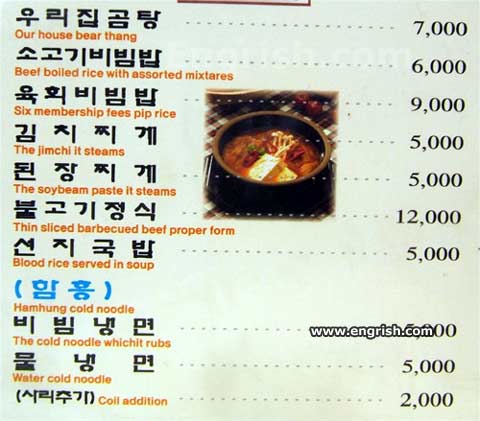
The hardest thing about the test was trying to interpret the English wording of each question. It had been translated quite confusingly from Korean, and at times it was hard to tell what the sentence was trying to convey - not unlike trying to decipher the "food" options on your average Korean menu.


Usually, though, it was easy enough to guess the correct answer by identifying a few key phrases in the options:
  • "slow down"
  • "drive carefully"
  • "watch out"
  • "be alert"
And avoiding options with the phrases:
  • "don't pay attention"
  • "speed up"
  • "keep driving at the same speed"
  • "don't think about the child in the road"

Most of the questions consisted of a picture with 5 or 6 multiple choice options. I was instructed to choose the 2 best answers based, usually, on driving safely and what to watch out for in the accompanying scenario.


For example, given the following picture...

...you may be asked:

In this scenario, which are the safest ways to proceed? (Choose 2)
  1. Speed up to pass the pedestrian before she crosses the road.
  2. Be alert for parked cars backing out into the road.
  3. Honk your horn to make the pedestrian walk faster.
  4. Reduce your speed to give the pedestrian time to cross.
  5. Stop your car in the middle of the road and look for any other pedestrians or parked cars.

Another question was an animation of a car driving down a road, switching lanes, and turning left at a traffic light. Other cars would move around in the simulations and pedestrians would cross in front of you. The question asked me to identify the two most dangerous situations in the animation.

Though most were common sense, on a couple of questions I had to guess completely, since they covered things like fines or administrative stuff. I don't know how I scored on them - the test never gave me a breakdown of my results.

[If you still want to prepare for the test, check out this excellent Korean road guide prepared by the Osan US Air Force base.]

The hardest part of the whole day was actually FINDING the Driver's License Agency office. What should have been a simple 30-minute trip turned into 2 hours. The map that the agency provided on their website was mind-numbingly terrible. At one point I stopped at a government office to ask for directions. A helpful employee looked at the map quizzically for a few minutes, crossed it off, then turned the paper over and hand-drew his own map on the back that turned out to be impressively accurate.

If you're trying to find your own local DLA branch office, I suggest more reliable sources (Google maps, Daum maps, any bum on the street) for directions to get to your particular testing center.

the DLA's version
Google maps: got it right.


Safe driving!

Tuesday, December 21, 2010

The North Korea Situation

Even when liars tell the truth, they are never believed. The liar will lie once, twice, and then perish when he tells the truth. - The Boy Who Cried Wolf

**Disclaimer: I reserve the right to make or not make wild accusations and gross assumptions without any scientific basis or expert knowledge.

A lot of people back home ask me what is up with North Korea. I know it has been dominating the news lately, what with the bombing of Yeonpyeong Island, Lee Myung Park's threats of retaliation, Kim Jong Il's threats of nuclear war, and the US involvement in South Korea's military training exercises yesterday along the disputed maritime border. But I'm not worried.

For the most part, South Koreans tend to ignore Kim Jong Il completely. They don't pay attention anymore to the angry, bespectacled little Korean man who keeps crying wolf. When something serious happens - a boat sinks, or a bomb explodes - some will hold candlelight vigils and call for blood. Yet his threats of war, or a nuclear holocaust go largely unheeded by the public. Even the news of an actual, isolated attack will blow over within a month or two, and he will disappear from media coverage for a time.

Soon after I arrived in Korea, I asked my co-teacher whether she worried about the situation with North Korea. "Not really." She seemed surprised at the question. If the North attacked, Mrs. Yoon said, she wouldn't be able to go anywhere to escape. What's the point of worrying about something you can't control?

The fact is that Kim Jong Il is a loose cannon. No one is completely sure what he is capable of. In addition to the recent bombing, which killed two soldiers and two civilians, in March 2010 he was blamed for torpedoing a South Korean Navy ship, killing 46 soldiers. (China, Russia, and North Korea disputed the results of the investigation.) Yeonpyeong is the third attack blamed on North Korea in the 16 years that Kim Jong Il has been at the reins, and the second this year.

But crazy and violent as Kim Jong Il may be, he's not stupid. He knows that, while the South Korean public may ignore his persistent wolf-cries of war, the military and global political machines will not. They can't afford to. His reputation as a wild card, as someone who is capable of anything, is the best thing going for him right now, and probably forever. Like a child with a hair-trigger reaction and a penchant for tantrums, Kim Jong Il knows that his "parents" don't want to do something to provoke an outburst. They'll do anything to appease him, even if that means ignoring the occasional broken lamp and trash fire, and giving him a regular allowance.

But he also knows that there's a line. If he crossed that line, and instigated a war with South Korea, he must know that China and Russia would likely abandon their support for him, and the South Korean-allied forces would crush him and his regime quickly. He wouldn't just be sent to his room, with his Xbox and coloring books. He would be sent to boot camp.

To be fair, though, it's not all Kim Jong Il's posturing that is to blame for escalating tensions. South Korea patrols and conducts regular military exercises in disputed waters in spite of North Korea's claim over the territory. Perhaps they are more likened to kid siblings, who pull each others' hair and call each other names, trying to push the other across the line. The one who starts the fight, after all, gets sent to his room. The other, even if he ends up with a black eye, gets an ice cream cone.


Kim Jong Il and the Boy Who Cried Wolf are like two sides to the same coin; the one claimed that a wolf was attacking his sheep, while the other claimed that he was a wolf. Whether or not Kim's claim is valid remains to be seen. In the end, though, the lesson is the same. The liar will lie once, twice, and then perish when he tells the truth. A wolf is no match for a human with a spear.


On a lighter note, here's Kim Jong Il Looking At Things:
http://kimjongillookingatthings.tumblr.com/

English Teachers Desperately Needed in Ulleung-do

The two EPIK teachers on Ulleung Island (120km east of the mainland) will be leaving soon, and EPIK is looking for one elementary school and one middle school teacher to take their spots beginning in March 2011.

The perks, above and beyond the regular EPIK contract benefits, include
  • a 500,000 won monthly "rural" bonus 
  • 10 extra days of vacation
  • relocation allowance 
  • resident ferry rates - 5,000 won one-way
  • north korea would never, ever attack you


For more info on the position, the island, or the people you would be replacing, check out their blog: http://notanothertourist.blogspot.com/2010/12/wanted-teachers-in-ulleungdo.html

Friday, December 17, 2010

Gochu Soju

I went out for dinner last night with the members of the Pohang Climbing Center. This is apparently a drink concoction they enjoy - sliced hot green peppers in soju. Considering how terrible soju is, anything would probably be an improvement. Gochu soju wasn't actually that bad.

Getting a Korean Driver's License

homegirl is dangerous. she's a korean driver.
Three things happen within two minutes after you get into a car in Korea:

1. You think "Well, I suppose red lights must mean something different here."
2. You paw furiously at the seat cushion in search of a seatbelt.
3. You swear to God that you will never drive in Korean traffic if he gets you out of here alive.

Whoever coined the moniker "The Land of the Morning Calm" clearly wasn't talking about traffic in Korea. It takes travelers a while to understand the organized chaos that is driving in this not-so-long-ago-underdeveloped country. Eventually, though, after their third hour on an overheated bus they take back their oath to God and decide it's about time to get a Korean driver's license.

In this post I'll walk you through all of the 3 steps necessary to get yours. [Note: Though these instructions are geared more towards Americans, most of them will apply to other nationalities as well. For your own specific licensing requirements, call your local testing site. See the note at the end of this page.]


1. Get your foreign driver's license notarized

getting through the embassy
There are few steps involved in getting your Korean license. For citizens of some countries, however, there is an extra step - a step that is especially aggravating if you chose not to live in Korea's populationally irresponsible capital city. For Americans it involves traveling to Seoul (an $80 and 6-hour round-trip from Pohang), visiting the geriatrically-slow US embassy (appointments on weekday mornings only!), and having your US driver's license notarized (a $50 service).

You could also visit the US embassy outpost in Busan during one of the public notary's visits, which occur, from what I can tell, every third quarter moon in August. [Editor's note: American Citizen Services provides consular services in Busan once a month.]

Once you DO have that special piece of paper with that special embossed seal on it, though, the rest of the process is relatively simple (though still not quite as much of a piece-of-cake as some other sites make it out to be).*


2. Visit your local driver's license office

Find your local driver's license office [운전면허시험관리공단] here.

When you visit your local office, you will need the following:
  • Affidavit affirming the validity of your driver's license (other countries' requirements may differ slightly) [대사관 확인서]. See Step 1.
  • Foreign driver's license
  • Alien Registration Card (ARC) [외국인 등록증]
  • Passport [여권]
  • 3 recent (w/in 6 mos.) passport photos
  • 17,000 won (6,000 for the computerized test; 5,000 for physical exam; 6,000 for printing the actual license).


3. Pass a written test

Once you submit all of the necessary documents and undergo the 5 minute "physical exam" (basically an eye test, performed at the driver's license office), you will need to take a 20 question computerized test, which is administered in English.

For more specifics on the test, read Passing Your Korean Driver's License Test.

If you pass, they will ask you to surrender your foreign driver's license while you are in Korea. I'm not really sure why this is a requirement, since it's easy enough to get it back. The next time you're about to leave the country, go back to the driver's license office, show your passport and an airline ticket and they'll return it.


Even if you're just mulling over the idea of buying a car while you're in Korea, start planning to get your foreign driver's license notarized now. It's cheaper and easier if you don't have to make an extra trip to Seoul at the last minute.

And don't worry about timing. Though you may not buy a car right away, your Korean driver's license will be good for 9 years from the date of issue (compared to 1 year for an International Driving Permit!), regardless of the expiration date on your foreign license.

After that, you're legal to roam Korean streets at will. Just hope that God still has your back.


*Note: The Seoul government's English website states the following: Foreigners with a license issued from the following countries are not required to provide an embassy certificate. (U.S., U.K., Canada, France, Germany, Japan, Spain, Belgium, Poland and Italy). I assume this is referring to that special piece of embossed paper. As any foreigner knows who has lived in Korea more than 2.5 days, every single Korean will give you different information, even if they work for the same department of the same government organization. Even if they sit across from each other at the same desk. Even the same person on two different days. So this may all be changing as I write. Call your own local driver's license office. Again, find and contact your local driver's license office [운전면허시험관리공단]
here.

Monday, December 13, 2010

High1 Ski Video

I went to High1 Ski Resort over the weekend with some friends. I made a short video with some of the highlights from Saturday.

Wednesday, December 01, 2010

The Eight-Legged Playboy

바람둥이[Param dung-i] - literally "wind person" - is a popular expression in Korea that means "playboy", likening a man's mind to the capricious nature of wind. It's probably one of the first non-critical phrases that many foreigners remember, because, hey! it's always fun to share a laugh with a Korean when you call someone out on their infidelity.


Last week I learned a couple of new expressions that are also useful for talking about an uncommitted Korean's love life.


양다리 [Yang dari], meaning "both legs", refers to someone (a man or a woman) who is getting a little sum'n sum'n on the side, i.e. someone is sitting on both of their knees.

Santa wants to fill BOTH of their wishes!


God gave him 8 legs for a reason!

문어다리 [Mun-eo dari], a derivation of 양다리, means "octopus legs". As you can probably deduce, a 문어다리 doesn't limit him or herself to just one extra lover. Just because you have two hands doesn't mean you should only juggle two balls, am I right?!

Incidentally, if you're actually talking about octopus tentacles, the word is 문어발 [Mun-eo bal], or "octopus feet".


Related Posts Plugin for WordPress, Blogger...