Last Saturday I went rock climbing in Amnam Park (Busan) with some friends. Here's a video.
Friday, October 29, 2010


Wednesday, October 27, 2010
Rock Climbing in Busan - Amnam Park

In the afternoon we hiked and rappelled and scrambled to another rock wall called "The Shark", I believe, which jutted up from a large slab that stuck out into the turquoise water. It contained two smaller routes ("The beach's girl" and "Jaws") with overhangs that proved quite difficult (for me, anyway) but which were a lot of fun trying to figure out.
On the way back to Pohang we stopped near Busan University for some Korean-style Mexican food at Taco's Family, one of the few places I've found in Korea that actually serves decent enchiladas.
Check here for a video of the park and climbing.


Thursday, October 21, 2010
A Korean Fortune - Saju [사주]
I am a flower. I have lots of water in me. I should seek fire and trees and mountains. South and East are good directions. 2014 will mark the beginning of a good time for me. I shouldn't have more than two children (though if I want more, adopting is OK). I know this, because my birthday tells me so.


Saju [사주], or "human's life", is an ancient form of Korean fortune-telling which uses your birth date and time to reveal aspects of your personality and character, including predilections, positive attributes and talents, and needs. It is based on five elements that are said to make up all things:
Many Koreans believe strongly in the power of the saju, and consult theirs regularly in times of change, particularly before a big move, job change, or prior to a wedding, to see if they or their children are compatible with the spouse-to-be. The fortune teller, or reader, will often become a sort of counselor to her clients, advising them on a particular action based on the revelations in their saju.

On the 6th floor of Home Plus (CGV) next to the shiwae bus terminal in Pohang, two fortune tellers spend their evenings behind lace curtains in cozy plywood huts, reading birth dates and tarot cards for a steady stream of customers of every age.


Saju [사주], or "human's life", is an ancient form of Korean fortune-telling which uses your birth date and time to reveal aspects of your personality and character, including predilections, positive attributes and talents, and needs. It is based on five elements that are said to make up all things:
- water
- fire
- earth
- trees
- metal
Many Koreans believe strongly in the power of the saju, and consult theirs regularly in times of change, particularly before a big move, job change, or prior to a wedding, to see if they or their children are compatible with the spouse-to-be. The fortune teller, or reader, will often become a sort of counselor to her clients, advising them on a particular action based on the revelations in their saju.

On the 6th floor of Home Plus (CGV) next to the shiwae bus terminal in Pohang, two fortune tellers spend their evenings behind lace curtains in cozy plywood huts, reading birth dates and tarot cards for a steady stream of customers of every age.
Saju consultation: 9,000 won.
Tarot reading: 4,000 won.
I went to visit Min Jung, my friend Tony's girlfriend, who has been studying saju for four years under the tutelage of a 75 year-old buddhist monk living in the mountains around Gyeongju. Min Jung is an incredibly peaceful, yet warm person who I immediately felt comfortable around. We had been rock climbing together on a couple of occasions before, so I already knew her from those outings as well.
 She invited me into her small "office" and pulled two giant tomes off of the small bookshelf beside her chair. She asked my birthdate and time, spent a few minutes consulting the books, then drew two rows of four Chinese characters on a blank sheet of paper with a calligraphy brush. She spent another few minutes whispering to herself while she circled characters and drew lines between them, writing other characters beneath them with numbers and dates.
 When Min Jung had finished, she began to describe my "human's life". Saju is not "fortune-telling" in the sense that it reveals your future (although Min Jung did tell me that from 2014 would be a good time for me, and that I would be healthy into old age), but rather a picture of your character and how you relate to the world around you. Your character affects your future, though, and your saju can tell you what factors to consider when it comes time for a decision - where you should go, what kind of job you should hold, or what kind of person would be good for you to marry. I asked her questions about food I should eat (stay away from pork, eat lots of leafy greens), sports I should play (be careful with water sports), people I should befriend (look for fire, trees, mountains in others), colors that are bad for me (black and white).
I left feeling quite good, but unsure how I felt about saju and Korean fortune telling. Most of what Min Jung told me about myself I believe, but not because my saju told me I am that way. I believe it because I have already witnessed it in my own life - it confirmed much of what I already knew about myself, or what I felt but had never put words to before. I don't consider myself a very superstitious person, and I definitely don't believe in fate. But I was surprised at the accuracy of my saju, and everyone I know who has heard theirs has felt the same way. For now, I guess my jury's out - not that it matters, in the end. Beliefs are only shadows, after all, of what really is.
Tarot reading: 4,000 won.
I went to visit Min Jung, my friend Tony's girlfriend, who has been studying saju for four years under the tutelage of a 75 year-old buddhist monk living in the mountains around Gyeongju. Min Jung is an incredibly peaceful, yet warm person who I immediately felt comfortable around. We had been rock climbing together on a couple of occasions before, so I already knew her from those outings as well.

 When Min Jung had finished, she began to describe my "human's life". Saju is not "fortune-telling" in the sense that it reveals your future (although Min Jung did tell me that from 2014 would be a good time for me, and that I would be healthy into old age), but rather a picture of your character and how you relate to the world around you. Your character affects your future, though, and your saju can tell you what factors to consider when it comes time for a decision - where you should go, what kind of job you should hold, or what kind of person would be good for you to marry. I asked her questions about food I should eat (stay away from pork, eat lots of leafy greens), sports I should play (be careful with water sports), people I should befriend (look for fire, trees, mountains in others), colors that are bad for me (black and white).
I left feeling quite good, but unsure how I felt about saju and Korean fortune telling. Most of what Min Jung told me about myself I believe, but not because my saju told me I am that way. I believe it because I have already witnessed it in my own life - it confirmed much of what I already knew about myself, or what I felt but had never put words to before. I don't consider myself a very superstitious person, and I definitely don't believe in fate. But I was surprised at the accuracy of my saju, and everyone I know who has heard theirs has felt the same way. For now, I guess my jury's out - not that it matters, in the end. Beliefs are only shadows, after all, of what really is.
Thursday, October 14, 2010
POSCO in the news

They have just resumed operation of Korea's largest blast furnace - the fourth largest in the world - after a 3-month hiatus for repairs. According to The Korea Times,
[POSCO] also said that its daily production capacity is over 14,500 tons, equivalent to manufacturing 14,500 vehicles, and the production is at the top level of the industry.14,500 vehicles' worth of steel production - PER DAY?! Boy, do I take the industrialization of the world for granted.
Furthermore, the plant expects an annual production capacity of 41 million tons (which would bump them up to the world's #2 producer). To put POSCO's importance to Korea into perspective, the entire country of Korea produced 48.6 million tons of steel in 2009. Korea is the world's sixth-largest steel producer.
[Interestingly, steel production has been falling significantly over the last three years for all of the world's major producers except China and India. I couldn't find any info about this production change on the World Steel Association's website, which unsurprisingly paints a rosy picture of steel production.]
POSCO is also reported to be launching a program in partnership with the city of Busan to build a waste-to-energy power plant capable of producing 25 megawatts, or enough electricity to meet the demands of 40,000 households.
This marks the country’s first attempt of creating power from RDF, which refers to a fuel produced by shredding and dehydrating municipal solid waste including such materials as plastics.
Tuesday, October 12, 2010
Rock Climbing in Pohang
A few weeks ago I went camping and rock climbing with my friend Tony and his girlfriend in Juk-jang, a small town about 45 minutes outside of Pohang. We camped out next to a small creek and spent the morning and early afternoon climbing. I made this video about it.
The dog in the video is Shu, and belongs to Tony's girlfriend Min Jung. Shu is quite typical of the size of most Korean dogs. Korean women in particular love little dogs, and while I have always been partial to bigger canines, the little guys have started growing on me. I made another video just for Shu.
The dog in the video is Shu, and belongs to Tony's girlfriend Min Jung. Shu is quite typical of the size of most Korean dogs. Korean women in particular love little dogs, and while I have always been partial to bigger canines, the little guys have started growing on me. I made another video just for Shu.
A little off the top
I have been spending a lot of time lately in self-reflection and meditation, trying to address my weaknesses and shortcomings. Trying to be the man I want to be. One of the biggest obstacles I face on a daily basis is my ego; the part of me that attaches itself to material or physical possessions; the part of me that is selfish and proud and greedy.
On Friday I shaved my head.
Yesterday I arrived at school to students and teachers agape and gasping, as Koreans are never shy to do. They're the kind of noises and stares that are impossible to interpret, that contain no judgment, that mean only that something interesting is happening.
One of my students was not so ambivalent. "WHY?!!" He practically screamed at me. "I don't understand why you cut off all of your hair!!" He seemed to be on the verge of tears. I tried to explain how convenient the hairstyle can be, how I can roll out of bed without worrying about a bad hair day. He couldn't understand. He loved his hair. He appeared to be genuinely distraught.
Mr. Lee, one of my co-teachers, saw me in the hallway today. "In Korea, when someone gets a drastic haircut like that, we say that their character has changed." I smiled, thinking of my own attempt to influence my character in recent weeks, but then I thought again. Changed in a positive or negative way? "Usually negative," he replied, chuckling.
On Friday I shaved my head.
Yesterday I arrived at school to students and teachers agape and gasping, as Koreans are never shy to do. They're the kind of noises and stares that are impossible to interpret, that contain no judgment, that mean only that something interesting is happening.
One of my students was not so ambivalent. "WHY?!!" He practically screamed at me. "I don't understand why you cut off all of your hair!!" He seemed to be on the verge of tears. I tried to explain how convenient the hairstyle can be, how I can roll out of bed without worrying about a bad hair day. He couldn't understand. He loved his hair. He appeared to be genuinely distraught.
Mr. Lee, one of my co-teachers, saw me in the hallway today. "In Korea, when someone gets a drastic haircut like that, we say that their character has changed." I smiled, thinking of my own attempt to influence my character in recent weeks, but then I thought again. Changed in a positive or negative way? "Usually negative," he replied, chuckling.
Wednesday, October 06, 2010
Kimchi gold
As I wrote on Monday, kimchi is in short supply around these parts. NPR has also picked up on the story, which they blame on "heavy rains" - presumably a result of the typhoons that have been hitting the country lately.
Monday, October 04, 2010
The Journey
by Mary Oliver
One day you finally knew
what you had to do, and began,
though the voices around you
kept shouting
their bad advice—
though the whole house
began to tremble
and you felt the old tug
at your ankles.
"Mend my life!"
each voice cried.
But you didn't stop.
You knew what you had to do,
though the wind pried
with its stiff fingers
at the very foundations,
though their melancholy
was terrible.
It was already late
enough, and a wild night,
and the road full of fallen
branches and stones.
But little by little,
as you left their voices behind,
the stars began to burn
through the sheets of clouds,
and there was a new voice
which you slowly
recognized as your own,
that kept you company
as you strode deeper and deeper
into the world,
determined to do
the only thing you could do—
determined to save
the only life you could save.
One day you finally knew
what you had to do, and began,
though the voices around you
kept shouting
their bad advice—
though the whole house
began to tremble
and you felt the old tug
at your ankles.
"Mend my life!"
each voice cried.
But you didn't stop.
You knew what you had to do,
though the wind pried
with its stiff fingers
at the very foundations,
though their melancholy
was terrible.
It was already late
enough, and a wild night,
and the road full of fallen
branches and stones.
But little by little,
as you left their voices behind,
the stars began to burn
through the sheets of clouds,
and there was a new voice
which you slowly
recognized as your own,
that kept you company
as you strode deeper and deeper
into the world,
determined to do
the only thing you could do—
determined to save
the only life you could save.
Where's all the kimchi??
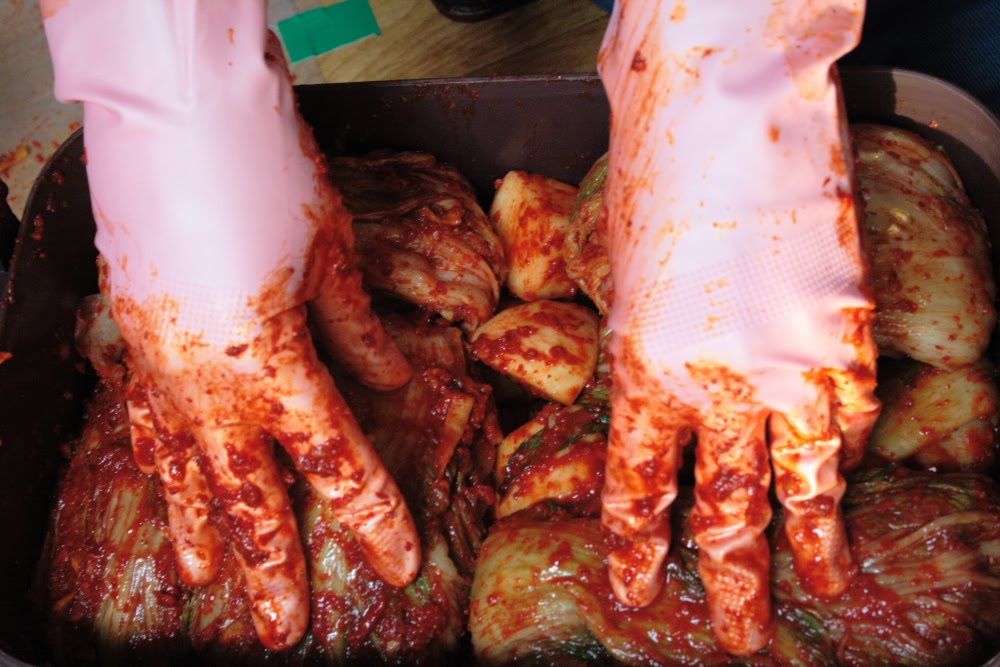 The other day I breezed through my cafeteria's buffet line, filling my tray with the usual rice, soup, and usual assorted side dishes. When I reached the end of the table, I was confused. Had I missed the kimchi? I went back for a second look. It wasn't there. The other teachers must have eaten it all, I thought. I checked the student line. Still I found nothing. A wave of disappointment crept through my body. I've been in Korea too long, I decided.
Kimchi is, needless to say, a staple of the Korean diet. They don't eat meals without it. It's taken for granted that when you visit a Korean restaurant, you will be given a never-ending side dish of kimchi. It was unnerving to see a Korean meal without the fermented dish. When I sat down I asked another teacher about it. "Kimchi has gotten too expensive these days," she said. "The school can't afford it." More expensive than pork? I asked. It was one of the side dishes that day. She told me people are joking that when you go to a restaurant, you order kimchi and they give you samgyeopsal (roasted pork) for free.
I've heard two theories about the recent skyrocketing in price.
1. Typhoon season destroyed a lot of the cabbage and lettuce crops.
2. President Lee's "Four Rivers Project" is razing the countryside and causing too much degradation of farmland and nature.
Whatever the reason, I miss my kimchi.
Subscribe to:
Posts
(
Atom
)
