Though it may be on its way to 50cc status...
Asian countries have been lauded in recent decades for their steadily rapid economic growth. For their prowess they earned the moniker "economic tigers," particularly the four economic powerhouses of Hong Kong, Singapore, South Korea, and Taiwan, with other southeast Asian countries recently dubbed "tiger cub economies". But tigers in Asia are severely endangered, with worldwide population estimates hovering around 3,500. Three of the nine original tiger subspecies have already become extinct.
Perhaps we should choose a better mascot for these still-thriving economies than an animal which, like it or not, is on a seemingly irreversible decline.
Perhaps we should consider an image still vibrant and visible throughout the continent, a representative of the asian worker's struggle, his pride in his work, her defiance of larger, looming economies that threatened to drive her off the road.
Perhaps it's time we thought outside the box.
I humbly propose: The Economic Scooter.

Any pedestrian traveler attempting to navigate an Asian city for the first time is quickly frustrated and annoyed by the seemingly endless throng of motorbikes and scooters that clog motorways across the continent. Southeast Asia, where the motorbike doubles as a minivan for the entire family, is particularly notorious.
Even in the developed Asian countries - the supposed "tigers" - the scooter hasn't lost its edge. Though consumers are buying cars in record numbers, the scooter market is still thriving. Businessman or delivery boy, no one is above a little scooter ride.
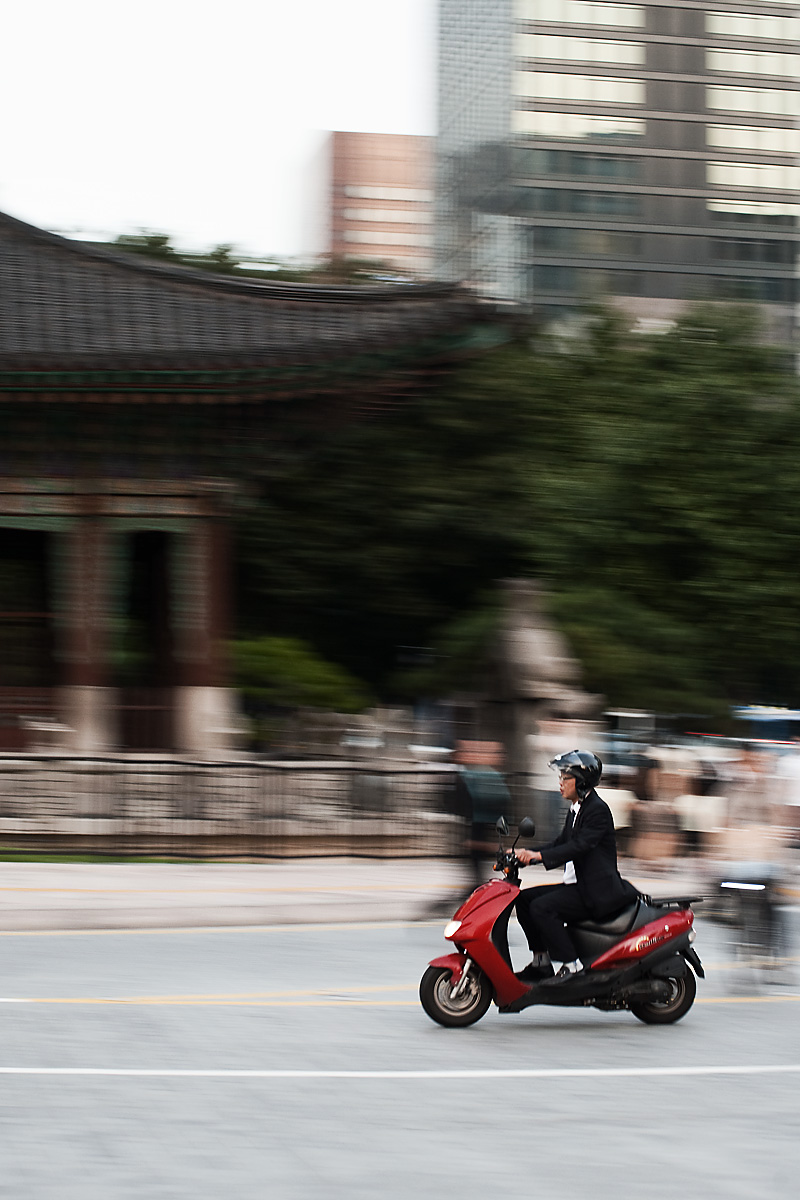

As the sort-of-proud owner of a scooter myself, I can attest to the following facts about scooters:
1. They are cheap. You can buy a brand-new scooter in Korea for 1,000 USD. I fill my gas tank once a week for 5 USD.
2. They are faster than cars.* Since scooters are often held to few, if any, traffic laws, they can go wherever, whenever they please. Go the wrong way down a one-way street? Cars will pull over. Run a red light? The cops will wave you past. Drive full-speed along a crowded sidewalk during market day? Pedestrians will move to the street.
*Within city limits.
3. They look more dangerous than they really are. I know how #2 sounds, but don't worry Mom! There's order amidst the chaos. After about a week of riding in traffic, you reach a moment of scooter zen, and your role becomes clear like water pouring into a stone-filled glass.
As a resident in and frequent traveler of Asia, I can also attest to the following facts about asian economies:
1. They are cheap. And by "they are" I mean "labor is."
2. They are faster than cars. Ok, that one doesn't make much sense.

4. They are built on a foundation of collective values. You may discount this one as irrelevant, namby-pamby, or idealistic, but let me give you some advice: don't. The Korean word "jeong" [정] - variations of which exist in China and Japan - is difficult to translate, but loosely means "togetherness, love, sympathy, feeling," and just about any other feel-good word that makes you want to give someone a hug. Though much of Koreans' behavior and interaction is dictated by a seemingly draconian Confucian culture, Koreans also feel bound to each other through jeong - not as a burden, but as a blessing. This influences all manner of conduct, including business transactions, conversations, and how to behave in traffic. In my experience, road rage is a rarity throughout Asia. When I zip past a Korean sitting still at a red light, it seems - though I can't be sure - the driver simply thinks "he must have somewhere very important to be."


