i found a scorpion in my room last week. i had never actually seen a live scorpion so i stopped more out of fascination than fright when i first spotted it lying on the concrete floor of the room next to my shoe, unmoving. it remained motionless while i got my camera out to take pictures of it, and only once i tried trapping it with an envelope did it even flinch. it began to scurry aimlessly between the threatening envelope and the pile of dirty clothes on my floor - after it realized that i had it cornered its legs stopped moving and it curled its tail up to hover menacingly over its head. the paper provided a safe buffer between me and its attempted strikes as i finally managed to scoop it up. i took it to show mama, who promptly snatched the
envelope from my hands and set it on fire. "there are so many this time of year" she says nonchalantly.
two weekends ago i went to the shamba with the family (mama, baba, and vicky) to help them weed the 3 acre garden. most of the kenyans were out in their own shambas that saturday, and as soon as they spotted me with a hoe slung over my shoulder they would laugh and cry out in disbelief to my baba, asking 'does that mzungu really know how to weed?' the noontime sun baked us in the fields for three hours as we worked, and by the time we packed up to return home my sunburned skin was already beginning to ache. all of the work is done barefoot, and after two weeks the tops of my feet are still pink, even after blistering and peeling. it was a small price to pay for a rewarding cultural exchange (at least until melanoma sets in).
the following weekend all of the volunteers got together to celebrate thanksgiving - football in the morning and dinner in the afternoon. we rented the kitchen of a catholic center in order to cook, and cook we did. we feasted on turkey (slaughtered that morning), mashed potatoes, gravy, spaghetti, mac & cheese, dumplings, stuffing, green bean casserole, and at least ten different desserts. it more than made up for my dinner of ugali and cabbage on the actual thanksgiving day.
by the end of this week i will no longer be a trainee. i will be a peace corps volunteer.
Tuesday, November 29, 2005


blurred vision
GILGIL
when i first learned of my assigned site, my initial reaction was excitement mixed with the
slight hesitation that accompanies any unknown. i was assigned to Gilgil, a midway point between Naivasha and Nakuru, two of the bigger towns in Kenya, to work for the National Youth Service, a government-funded post-secondary trade school. there are about a dozen branches of the school scattered around the country, each offering a different technical specialty. the gilgil location was not only a learning center for catering and advanced building, but it was also the training center for all of the NYS recruits. they undergo six months of military training (sans weaponry,they carry small spade shovels instead), after which they have a two-year 'mandatory volunteer' service period. upon completion of service, they attend any trade school that they qualify for. NYS has a good reputation among companies in kenya for producing very dependable, disciplined employees, so i'm told. i travelled to the site with the principal of the catering school for a three day intensive visit in order to learn the day to day school operations as well as the expectations that the organization had of me. between meetings with several school principals, teachers, the commandant and deputy commandant, i spent most of my 'intensive' visit reading, touring the campus solo, or watching tv. the entire compound was wired with electricity and had running water, the existence of which inspired only lethargy in the staff, all of who had tvs, stereos, dvd players, etc.
i left my site visit divided - while the site itself was great, and equipped with more comforts than most peace corps locations, the work itself was lacking. the catering school was in desperate need of a computer teacher, which i was more than qualified to do - their six "Great Wall" computers, donated from the chinese embassy, were barely equipped to run windows 98 and office 2000. when i visited one computer class i found the students learning how to copy and paste in word using the file menu. the advanced building school needed math and science teachers. due to a hiring freeze on civil servants, imposed by the world bank for the past ten years, retiring NYS teachers couldn't be replaced from outside the organization. the remaining teachers were required to fill in the gaps left by the departed faculty member. this would seem to suggest that the workforce would be stretched thin, trying to make up for those that they lost. however, the supposed lack of teachers only impressed upon me the laziness and apathy in the teachers that remained. the computer teacher only taught one two-hour class per day, and that was his only job. i was assigned to the site to help NYS restructure their education system, hopefully providing a sustainable solution to their chronic problem. it seemed to me that they didn't necessarily want, or even really need, this help.
i've had to constantly assess and reassess my motivation for joining the peace corps, and i've come to the conclusion that two of the major factors would have remained unfulfilled by my primary project at this site. those being 1) a need to challenge myself and 2) a desire to work directly with small businesses. the second need is connected, if indirectly, to the first, in that one of the reasons that i wanted to work with small businesses was to understand their point of view. i want to experience the challenges of working in a business in a developing country - to struggle to get funding, to fight to sell my products, to be forced to deal with middle men and their low prices. the best way to find a solution to a problem is to experience it directly, to force your mind to come up with creative strategies.
as hard as it was for me to admit, i was also unhappy with the amount of luxuries that i was afforded by NYS. even the poorest neighborhoods in the US have running water and electricity; i didn't have to come to kenya to gain that experience. i wouldn't have had any problems with living in the NYS environment, which ironically, i had a problem with. i still wasn't able to come to a conclusive decision. i kept telling myself that i needed to adapt to the situation; i could probably have developed a secondary project working with small businesses, and the housing comforts would only limit me as much as i let them. my apcd (associate peace corps director) was pressing me for a decision, which i was unable to give. about a week after returning from the site, we received a visit from the country director. he pulled me aside to let me know they had decided to move my site to Thika.
THIKA
i would be replacing another trainee who, after being assigned to the site initially, decided to
et (early terminate) due to a conflict of interest with the peace corps. i will also be replacing a pcv currently serving, who has been developing projects at the site for the last two years. my primary assignment is to work with a group called Youth Action for Rural Development (which is, i later found out, somewhat of a misnomer - they don't do any development work with youth). i was able to visit the site for about an hour and a half, during which i visited the organization's headquarters, as well as my future house.
luke, the previous volunteer at the site, tells me that i'll have a lot of freedom with YARD, since i will be working directly with the president of the organization, who is very receptive to new ideas. they don't, as far as i could tell, have a well-defined purpose (if their poorly created title didn't already suggest the same), which leaves open the opportunity for me to instigate projects in which i have interest. luke developed a marketing project with local avocado and macadamia nut farmers, for which the group hired a permanent employee to oversee in his absence.
thika has a very moderate climate, is very green, and is home to the world's second largest
pineapple plant in the world (del monte). the area is also rich in coffee plantations, whose product is mainly exported. since i spent less than two hours in the area, more in-depth descriptions of my work site will have to wait until after i arrive.
Friday, November 04, 2005
picture update
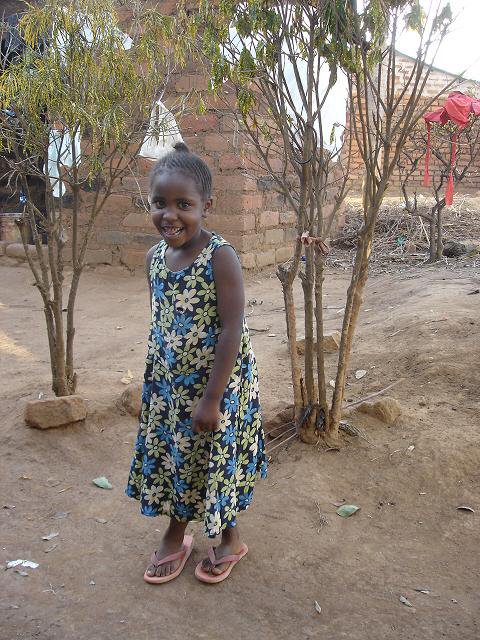 my five-year-old sister Vicky - she speaks very limited swahili and no english (except for the occasional "how ah yooo?" which she only says when she thinks i can't hear her). we communicate through smiles and tickles.
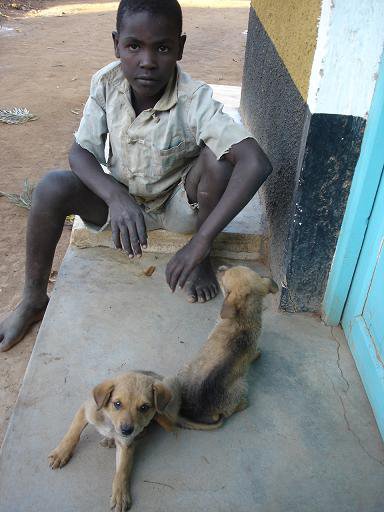 the puppies (and a neighborhood kid). my baba says i'm supposed to name them, but inspiration hasn't hit me yet. many families here own dogs but rarely do they acknowledge any responsibility for them, requiring them to scrounge for their own food. i slip them some bread or goat meat whenever i can. rabies is also a big problem here and we have to lock the pups up at night so they don't get attacked by larger dogs.
 the first slaughtering experience - we're plucking the feathers in this picture. everything i do outside (and often inside) attracts attention from the children. it can be annoying at times but they are so endearing that i don't stay upset.
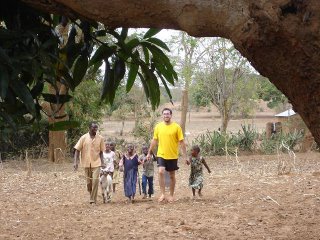 the escort after the goat escape.
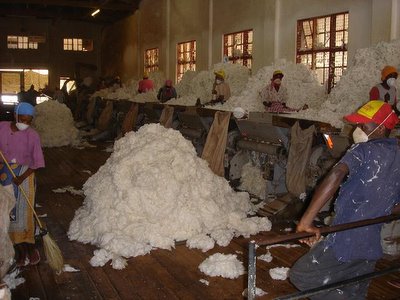
the cotton gin in kitui. all manually operated, with equipment left over from the 1930's. the workers make about $3 per day (9 hour shifts, 6 days per week).
Subscribe to:
Posts
(
Atom
)
